Monday, November 21, 2005

SFOP's Avenues of Hope Organizing for San Francisco Youth and Families - great post by Kim Knox

The San Francisco Organizing Project - SFOP's Sunday afternoon ['accountability session'] rally at Mission High School with 3000 community folks staring down politicians like me, Nancy Pelosi, Mark Leno, Aaron Peskin, Gavin Newsom and Norman Yee [Tom Ammiano, Sophie Maxwell and Ross Mirkarimi and Mark Sanchez and Sarah Lipson were also in the audience] was a breath of fresh air in SF schools and City politics.
SFOP's base and organizers deserve a lot of credit for building their voice and power by successfully bringing together one of the most diverse - multi-ethnic, multilingual, neighborhood and parish-based - political events of the year which linked issues of housing and economic justice with community safety and educational justice.
Their leaders talked about a broader vision of social justice - their AVENUES OF HOPE CAMPAIGN - that will help people unite to defeat the conservatism in Sacramento and the White House and advance SFOP's strategies of community organizing and policy change. It was very inspiring too to see so many young folks [older folks too] from June Jordan High School of Equity and Aim High Academy, 2 amazingly successful small schools in SF, and Principal Dr. Raymond Isola from Sanchez Elementary School in the Misison District as well.

Here's educational justice activist Kim Knox's article on the 11/20/05 SFOP rally from the Left in SF website: [one of the SFOP leaders she accidentally omits is Natalie Gee who challenged Assemblyman Mark Leno on universal health care and job training for working families and youth. Natalie is also active the Board of SFOP and a leader of the Chinese Progressive Association who will be going to the 4th World Social Forum in Hong Kong in a few weeks to join with other grassroots organizers in the US and throughout the world fighting against globalization]
-----
The San Francisco Organizing Project, a coalition of churches and schools, had an organizing conference on “Avenues of Hope: Offering a Future to the Youth and Families of San Francisco.”
The program’s organizers estimated 3,000 people at the conference. The presenters were House Minority Leader Nancy Pelosi, Mayor Gavin Newsom, Assemblymember Mark Leno, BOS President Aaron Peskin, BOE President Eric Mar and BOE Vice President Norman Yee.
Co-Chair Eleanor Williams of Providence Baptist Church explained that the proposal was created by 3,000 surveys received by SFOP from their members. They found that the biggest concerns that members had were education and jobs for youth. SFOP then did research to create nine proposals.
Co-Chair and Deacon Nate Bacon of St. Peter’s stated some of the information that they found-only 50% of African-American and Latinon students that enter in the 9th grade graduate from SFUSD in the 12th grade. Even though San Francisco has the lowest percentage (versus its population) of children of any urban area in California, it has the largest number of jailed youth. Bacon said, “We need to create avenues of hope where families can survive and thrive in the City of Saint Francisco.” Later Bacon also quoted a local minister who stated, “Nothing stops a bullet better than a job.”
At that point, several youth gave testimonies on the impact of education and lack of jobs on their lives. Marcus Garrett explained that he started hanging out with dealers and in the streets at 14-till he was sent to Sacramento at 16 by his mother. Another young speaker spoke about how when he got out of Juvenile Hall at 16, his parole officer wouldn’t give him approval to go back to a traditional high school. At 18, his parole officer refused to give him approval to enter the Job Corps program. But he announced that he has three sons and his wife has just been accepted to USF. He also reports that he is working with construction-and helping his friends get jobs in constructin.
Joe Trigueros and Brittany Donaldson then asked Mayor Gavin Newsom four questions-

1) Would the Mayor support programs that would allow all youth in the
juvenile justice system to have access to job training and education programs,
2) Would the Mayor agree to sponsor an employment summit with key
businesses to create summer jobs for youth in 2006,
3) Would the Mayor agree to implement CityBuild (a construction jobs
program that the Mayor is planning to implement in January 2006) and replicate
it for jobs in digital media, biotech and clean technology,
4) Would the Mayor agree to provide an annual public report card that
documents progress of local hiring?

The Mayor stated that he applaud SFOP of bringing this issues out to the community. He stated that he had already hired a new person to head Juvenile Justice, a point person for the new program for CityBuild along with Jesse Blout to work on these type of programs. He also promised to give SFOP a one year to five year program to show the progress of various programs. Newsom also stated that he had been to the Gates Foundation in San Francisco to get a honest assessment of why they reluctantly withdrew a $10 million grant from SFUSD. He didn’t give a list of what the Gates Foundation thought that SFUSD could do better.
Frank Arana asked Assemblymember Mark Leno two questions-

1) Would he promise to again sponsor legislation to provide universal
health care program to all youth up to age of 25 in California and
2) Would he promise to sponsor legislation on job training.

Leno agreed very quickly to both-and pointed out that even though the Governor vetoed Leno’s last legislation for universal health care for all children, the Governor recently sent a message that he was now (after the election) willing to support it. Leno also stated that he would continue to push for legislation that would allow San Francisco’s Board of Supervisors to pass a local vehicle tax that would bring $70 million into the coffers.
Marcus Garrett then asked President Peskin if he was willing to support legislation that would reduce youth violence and would he support the Small Schools Initiative? Peskin was the only one who repeated SFOP’s theme by stating “The Board of Superivsors is willing to follow your lead in creating Avenues of Hope.” He pointed out that Mirkarimi and Maxwell had passed legislation to create a Select Committee to Study Guns and Violence in San Francisco. He also pointed out Ammiano’s legislation to get more jobs for youth in San Francisco.
Ayanna Banks first directed her questions to BOE President Eric Mar-

1) Would he support community involvement in the Superintendent selection
process, including townhall meetings and school-based meetings,
2) Would he support taking “small schools by design” off the closure list,
including Aim High, June Jordan and Sanchez?,
3) Create a policy that supports the development of “small schools by
design” and gives them autonomy to be successful?

The crowd was at its loudest and on its feet when Eric simply said, “Yes, Yes, Yes!”
Eric said that he wanted a process where community input was truly heard and not just a tokenism. He agreed to work to get the three small schools off of the closure list. He also stated that he would work with other School Board members to do all that they could to support the Small School Initiative.
Ayanna Banks then directed the same questions to Vice President Norman Yee. Norman stated that he has always been supportive of community input in the superintendent selection. He noted that a citizen advisory board was being created in order to faciliate community invovlement in the selection.
As for the small schools, Norman stated that he is always supportive of “successful schools that are doing well with academics.” He noted that both of the high schools listed-Aim High and June Jordan-were doing well academically and he would be willing to support getting them off the closure list. He didn’t say anything about Sanchez.
At that point, Mayor Newsom was asked to return to the podium. Before Regnaldo Woods from Bethel AME Church asked Newsom if he felt the urgency that SFOP feels about getting programs on education and youth training implemented. Newsom said that he did-and he said,”When SFOP comes back in a year or two from now, we want to make sure that you all will know what progress will be making over the next five years.”
At that point, the program was concluded.
Full Posting from Left in SF

Saturday, November 19, 2005

To Ensure Fair & Equitable California Schools - Step Up Demands for Adequate Funding

With the Governor’s defeat in the Nov 05 Special Election and his popularity in decline and the Rob Reiner California Preschool for All Ballot Initiative headed for the June 2006 ballot, advocates for adequacy of funding for CA schools should be building their base and strategizing for bigger reforms at the state level in the years to come.

The Oakland-based Applied Research Center convened a racial justice summit last Wednesday at the State Building in downtown Oakland. ARC’s Tammy Johnson and Alfredo De Avila deserve an incredible amount of credit in convening an incredible group of sharp policy folks from many areas mixed in with community organizers and policy makers.

In the very frank discussion during the summit’s education working group, most of the 50 or so in attendance pointed to the inequality of funding of schools in low income communities of color [or some problem related to this] as the major issue that they wanted to address in their organizing or advocacy work.

Sacramento State University Professor and activist Duane Campbell points this out too in his Choosing Democracy Blog where he cites the Public Policy Institute of California’s October 29, 2003 report Reality Check: Expectations For California Students Outstrip Resources .

The differences between California and the nation are striking on both dimensions. For example, California has 25 percent fewer teachers per pupil and spends approximately 9 percent less per student than schools in the rest of the United States.

Yet, to meet the state’s performance goals under the API system, approximately 70 percent of students at every school would have to exceed the national median on the Stanford 9 achievement test. “These are exceptionally high standards by any measure,” says PPIC research fellow Heather Rose, who co-authored the study, High Expectations, Modest Means: The Challenge Facing California’s Public Schools. “California expects students to do much better than students in other states, but with fewer means.”

California’s relatively modest school resources have less to do with low state spending generally than with a lower percentage of spending on K-12 education, higher cost of living, and larger population of school age children, according to the study. In 1999-2000, 22 percent of total government spending in California went to public schools compared to 25 percent in the rest of the nation. At the same time, there were 8 percent more pupils per capita in California than in the rest of the country.

[The authors strongly suggested the need for an overhaul of California’s horribly inequitable and structurally racist system of school finance - Eric ]

The report also raises important questions about the effectiveness of California’s system of school finance, where the amount of money provided to schools is based on previous funding levels rather than on independent needs assessments. “The way we finance schools operates on an automatic pilot mentality — doing what was done before — instead of addressing what schools really need or taking into account what specific resources really cost,” says Rose.

Professor Campbell concludes that there has been no improvement in school funding since the 2003 PPIC report.

----------------------------

The WILLIAMS CASE
Many educational justice activists credit the ACLU/Public Advocates Williams vs. California case also as a step forward in addressing funding inequities, but also racism and socio-economic inequality in the state’s schools.
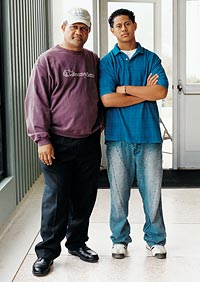
The case was filed on May 17, 2000 [the 46th Anniversary of the landmark Brown V. Board of Education case] behalf of 46 students in 18 schools throughout the state and including 12 year old Samoan immigrant Eli Williams from San Francisco’s Burbank Middle School and later Balboa High School [both SF schools named in the suit].
The grievances ranged from lack of material needs like text books and computers to the inadequacy of teaching staff, unfair testing requirements and decaying facilities that wouldn't pass even minimal prison health inspections.

To emphasize the structural racism in the school finance system in California, the advocates emphasized that students of color in the 18 schools cited by the plaintiffs make up 96 percent of the student body, compared to the state average of 59 percent minority enrollment.

In August 2004, the state reached a $1 billion settlement in the case. The state agreed to immediately spend $188 million to buy books for and make repairs at the lowest-performing schools. The settlement also created a system for students and teachers to lodge complaints about substandard conditions, and imposed a 30-day deadline for resolving them.

But many say the reality of the Williams case settlement is far from its promise.

Sacramento Bee columnist Peter Schrag describs the Williams settlement in critical terms: "It moves things forward, but by inches, not by yards."
Schrag has been covering the Williams lawsuit since it was filed, and has also written a book, "Final Test: The Battle for Adequacy in America's Schools," on these lawsuits nationally. Read Schrag's essay.

CA SCHOOL BOARDS ASSOCIATION BUILDS AN ALLIANCE FOR FUNDING REFORM

Even mainstream groups like the California School Boards Association are now stepping into the mix in alliance with Children Now, the California League of Women Voters, the California Teachers Association and members of the state’s Education Coalition to coordinate a public dialogue about the concept of adequate funding.

I have been in the CSBA's delegate assembly governance body since 2001. At our early December meeting in San Diego we will be kicking off our statewide campaign.

Seeing the urgent need to move away from a system that simply provides schools a portion of the year’s available revenues rather than determining what funding is required to attain the expected student outcomes, education and child advocates, business leaders, good-government groups and others have joined a campaign to advocate for change.

According to CSBA: “The need for such a campaign became evident last year when settlement of the American Civil Liberties Union lawsuit against the state – Williams v. State of California – failed to produce any meaningful reform that would pull state funding for public education out of the downward spiral that began in the late 1970s. “Public school advocates have filed suit over education funding levels in a majority of states, but so far even those that have won legal victories have not actually increased the amount of money schools have at their disposal to improve educational offerings.”

* California ranks 44th in the nation in per-pupil funding despite
being the sixth largest economy in the world.
* California has among the highest expectations in the nation for its students and public schools, and its more than 6 million schoolchildren come from the most diverse backgrounds and circumstances.


“An investment in students and K-12 public education is an investment in children, the economy, society and democracy. Unfortunately, California’s investment over the past 20 years has been woefully inadequate,” said CSBA Executive Director Scott P. Plotkin. “We’re optimistic that we will be able to move past the divisive politics that have bogged this conversation down in the past and have a rational conversation about our public education goals, activities and resources.”

Click here for more info on CSBA's efforts

Friday, November 18, 2005

Big Challenges Ahead for SF Schools

Left in SF is the best resource for cutting edge political analysis of progressive policy, labor and education, housing and economic justice struggles going on in our City.

For a great posting on the challenges ahead for SF Unified School District - check out local schools activist and Prop H [Preschool Sports Arts Music Librarians and Learning Support] Community Advisory Committee Member Kim Knox's analysis -

Post-Strike Notes [by kim knox]
Now that the Local 790 strike on SFUSD has been averted, there are still some big outstanding items that the BOE has to tackle:

1. Keep talking to the teachers-they are still working on their contract and they have voted to consider a strike on their own.
2. Keep talking to Local 21 and other unions that have members at SFUSD-they don’t have a contract as well.
3. Budget money for raises and professional development. Think of the funds as an investment.
4. School closure-Round 1 of School Enrollment is over on Jan. 23. You need to either determine (with public input) the five to six schools that will be cut or move the date for Round 1 of School Enrollment.
5. Superintendent Search. Ackerman has shown up for the last two meetings and a hour in the meeting, she has Gwen Chan sit in her seat-while Arlene sits next to the student delegates. After 20 minutes or so, suddenly Arlene disappears.
You have a boat w ithout a captain. Get community input on what vision they have for THEIR school district-and what they want in THEIR superintendent.
6. Over million extra dollars was put into the Central Office in last year’s budget. Find out where Harrington thought that there could be fat-and then pursue taking it out-and giving it back to the classroom.

There are many issues facing SFUSD-even without the strike. We all need to work hard to address those issues.
Click here for the full posting.

Kim Knox is the editor and author of several environmental education books and was elected to the Green County Council in 2004. She also founded the SF Envrionmental Summit for Youth and the Environment Bowl for High School Students.

Thursday, November 17, 2005

Parents, Teachers and Students are the Heroes in Averting the SF Schools Strike of 2005

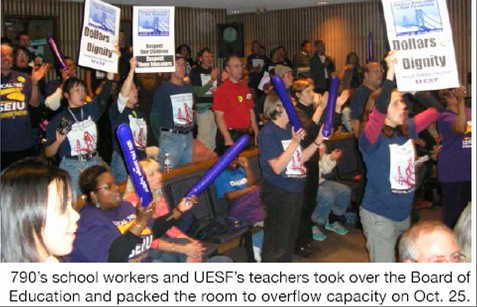
Despite the mainstream coverage of the Mayor's involvement and SEIU 790 and Teachers Union involvement in settling the labor dispute with the SF Unified School District, I think the real heroes are the hundreds and thousands of parents, teachers and students that flooded the board with emails and phone calls, and spoke out at school board meeting after meeting about the need for a fair contract for the 1200 SEIU 790 members who work as custodians, secretaries and cafeteria workers in our district.
Parent groups like Coleman Advocates, Parent Advocates for Youth, Parents for Public Schools, the SFUSD Parent Advisory Council and others played a significant role, as did Youth Making a Change and hundreds of students from schools like SOTA, Balboa, Mission and Lowell that wrote letters to the Board, superintendent and other district officials.
Teachers and Paras from United Educators of SF and other labor groups were constantly active at board meetings and behind the scenes in supporting the SEIU 790 workers. The labor solidarity of the teachers and other unions supporting SEIU 790 was unprecedented in our school district.
Thanks also to PPS, Green Party leader Kim Knox, Parent Advisory Council leader Rick Reynolds, sfschools listserve and K.C. Jones' www.sfschools.org blog for providing timely up to date info for parents and community members as well.

Another unmentioned hero also was my colleague Commissioner Sarah Lipson. On Tuesday night, in the midst of a full moon and during the heat of the discussion of an ill-conceived proposal from the Superintendent to shift 2 January and March professional development days to Thursday and Friday, thus locking out Paras and classified staff from their jobs, many in the audience [students, parents, teachers, and community members] lined up one after the other to denouce the proposal as 'sneaky' and disrespectful to staff. Lipson made a 10:30 pm motion to kill the proposal and then later to delay it until our negotiating team could have a last chance at reaching an agreement with SEIU 790 leadership. Luckily the motion passed with Commissioner Mark Sanchez, Norman Yee and my support.

If the motion had failed, I believe the negotiations would have broken down and we would be dealing with a strike right now. The delay allowed me to become involved in the labor negotiations that resumed after midnight at City Hall. And, with the help of SF Controller Ed Harrington, Mayor Newsom's Chief of Staff Steve Kawa and others, we were able to hammer out an agreement by 4am. We collectively had prevented the strike from proceeding.

I woke up this morning in an incredible mood not just because of the weird SF warm sunny weather, but because our schools would be open and running and that we had all worked collectively to ensure a fair contract for the 1200 SEIU members and avoided a potentially devastating and costly strike in our schools.

Wednesday, November 16, 2005

Strike Avoided in San Francisco Schools!

Good news!
At 3:30am the SF Board of Education and SEIU 790 leadership reached a tentative agreement on our contract dispute.
This means there will be no strike!
Thanks to all Board members who met past midnight in an especially difficult night of meetings; and to Jill Wynns and Norman Yee who worked with me and our Director of Labor Relations Tom Ruiz and Chief of Policy and Planning Myong Leigh to hammer out the tentative agreement with the SEIU 790 leadship. I also wanted to say that Controller Ed Harrington, Mayor's Chief of Staff Steve Kawa, SF Human Resources Director, and Education Liaison Hydra Mendoza were instrumental in bringing SEIU 790 and the Board together.
Thanks also to SEIU 790 for working with the SF Unified School District also to bring about an end to the labor conflict. It is my understanding that SEIU members now must ratify the contract proposal presented by their leadership. Then the Board of Education must vote on the contract as well probably in the December 13, 2005 Board meeting.I hope this helps San Francisco students, parents, teachers and staff breathe a little easier now...

Monday, November 14, 2005

New Rethinking Schools - features special on Fighting Against Military Recruiters and Militarism in the Schools

My favorite Education publication is Rethinking Schools. The new issue of the magazine is out. Check out the special feature on fighting against military recruiting in the schools.

The publication began in 1986 when a group of Milwaukee-area teachers decided to not only struggle to improve education in their own classrooms and schools, but to help shape reform throughout the public school system in the United States.
In 19 years Rethinking Schools has grown into a nationally prominent publisher of educational materials, with subscribers in all 50 states, all 10 Canadian provinces, and many other countries.

One of the anti-military recruiting policies promoted in the current issue is driven by Portland Teachers -

Draft Resoution to End Military Recruitment Abuse
Fall 2005
As is true throughout much of the United States, in Portland, Ore., military recruiters lie to and mislead high school students. They show up uninvited on campus. They call students at home. They ask personal questions about students' future plans and then assure them that the best way these can be realized is by first joining the military. Want to go to college? Join the military. Want to be a musician? Join the military. Want to kickbox? Join the military.

Not surprisingly, recruiters frequent schools serving working class and low-income communities. [See "The Recruitment Minefield," in the Spring 2005 issue of Rethinking Schools.] The following resolution was drafted by a group of teachers and activists who decided that without a districtwide policy, recruitment abuses were sure to continue or even increase. They hope to build community support for the resolution and to have it introduced at a future school board meeting. For more information, contact Bill Bigelow, bbpdx@aol.com.

Whereas: No Child Left Behind regulations (Section 9528) require that public secondary schools "shall provide military recruiters the same access to secondary school students as is provided generally to post secondary educational institutions or to prospective employers of those students;" and
Whereas: Portland secondary teachers, counselors, parents, and students report that military recruiters have pursued students aggressively, including: arriving at high schools without invitation, approaching students with no supervision by school authorities, contacting students by phone and email even when requested not to do so by parents and students themselves, visiting students' homes, buying students gifts, lying to and misleading students about military life and military regulations (including making promises that recruits will not be sent to Iraq), manipulating or casting aspersions upon students' post-high school hopes, approaching students in their classes, participating in curricular and extracurricular activities at school (even bringing weapons on campus); and
Whereas: Military access is disturbingly uneven from one Portland high school to another and tends to be more intense in schools serving predominantly low- or middle-income neighborhoods (e.g., Roosevelt, Marshall, Jefferson, Madison, and Franklin); and
Whereas: It is the responsibility of Portland Public Schools to promote the welfare of students while at school and at school events, and to provide students with complete and accurate information about the choices they will confront upon graduation from high school;

Therefore Be it resolved that pursuant to the NCLB Act, Portland Public School officials will provide military recruiters no greater access to students than that provided to post secondary educational institutions or prospective employers, and will provide student information to U.S. military authorities only after obtaining permission to do so in writing by an individual student, or by a parent or guardian of the student; and
Be it further resolved that any vendors with access to student information through legitimate business dealings with a school and/or a school's students may not give, lend, or sell this information to the military or risk being banned from doing business with Portland Public Schools; and
Be it further resolved that in accordance with Section 9528 of No Child Left Behind, military recruiters shall be granted no special access to students; specifically, recruiters: 1. must secure prior permission before coming onto a high school campus; 2. may engage in recruitment activities no more than once per year; 3. may not participate in any extra-curricular activities, including but not limited to field day events, graduation ceremonies, school assemblies, or sporting events; 4. may not bring weapons, Humvees, or other military equipment onto a high school campus for any purpose whatsoever; 5. may meet with students only by appointment and only in a designated counseling or career center; and 6. may not participate in the design or teaching of any course curriculum; and
Be it further resolved that Portland Public Schools students, staff, and parents shall be informed at least two weeks prior to military recruiters coming on campus—publicized in the same manner as for other institutional recruiters; and
Be it further resolved that if a military recruiter is found to have lied to a student, he or she shall be permanently banned from Portland Public Schools; and
Be it finally resolved that recruiters shall not be allowed on the campus of any Portland elementary or middle school.
Fall 2005

For the table of contents of the current issue - Fall 2005 Rethinking Schools
----------------------

Contact the American Friends Service Committee for more info on anti-military policies and organizing - AFSC.

Another great resource is the Guide: the No Child Left Behind Act’s Military Recruitment Provision & Opt-Out Practice By: Josh Sonnenfeld, Counter Recruitment Organizer & former RCNV Intern: ...,....

See also the CCCO [Central Committee for Conscientious Objectors] Military out of the schools project - MOSP

For info the SF Unified School District anti-war, student privacy, etc. policies - click here.

FIRE Schoolyard bullies like Fox TV's Bill O'Reilly!

Giving Al Qaeda the green light to attack San Francisco
"And if al Qaeda comes in here and blows you up, we're not going to do anything about it. We're going to say, look, every other place in America is off limits to you except San Francisco. You want to blow up the Coit Tower? Go ahead."
Fox TV's Bill O'Reilly during his radio show on 11/8/05

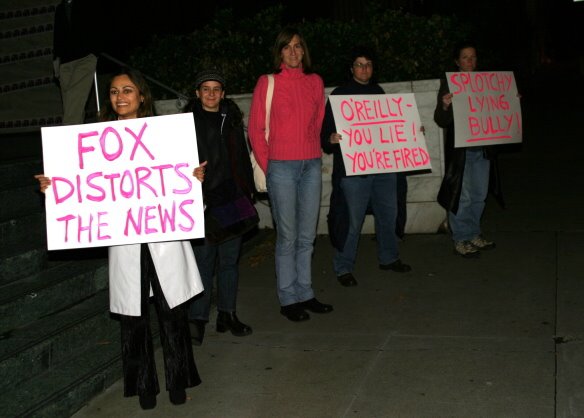
Most San Franciscan's are used to right wing and conservative commentators like Bill O'Reilly and we expect to be criticized and sometimes 'picked on' by radio and TV hosts. But I didn't expect the level of violence and vindictiveness from O'Reilly's election day remarks against all San Franciscans - Giving Al Queda the Green Light to Attack SF . The only thing that distinguishes O'Reilly from your typical schoolyard bully is that he has a national mass audience through Fox TV and other networks. Despite O'Reilly's subsequent efforts to downplay his remarks, I agree with progressive Supervisor Chris Daly [see below] that concerned folks should contact Fox News and demand that O'Reilly's show be cancelled.

SF Schools parent and blogger extraordinaire KC Jones hit the nail on the head with his comments:
Now I know why I voted for Prop I - O'Reilly is such an idiot:
"'You know, if I'm the president of the United States, I walk right into Union Square, I set up my little presidential podium and I say, 'Listen, citizens of San Francisco, if you vote against military recruiting, you're not going to get another nickel in federal funds," ' O'Reilly said Tuesday on his radio show as San Franciscans were approving the two measures.How dare San Francisco exercise their voting rights! How dare they get out of line! I can almost hear him breaking into another apoplectic round of "Shut up! Shut up! Shut up!"
Now I know, Prop I was worth it.
For More Visit - SF Schools
-------------------
Progressive SF Supervisor Chris Daly fired back calling for Fox TV to fire O'Reilly -

The Daly Blog - November 11, 2005
Fire Bill O'Reilly
I love San Francisco. When I heard what Bill O'Reilly had to say about our City on his Tuesday radio broadcast , I couldn't sit still...
And if al Qaeda comes in here and blows you up, we're not going to do anything about it. We're going to say, look, every other place in America is off limits to you except San Francisco. You want to blow up the Coit Tower? Go ahead.
I continue to be outraged.
Given how the conservatives have used the tragic events of September 11th and the heroism of New York's fire fighters to forward their political agenda over the past 4 years, it's hard to miss the irony of O'Reilly's target selection.Of course San Franciscans know that Coit Tower, the fire hose nozzle on Telegraph Hill, was built as a monument to San Francisco's fire fighters. I called my friend, San Francisco Fire Fighters Local 798 President John Hanley, this morning to find out what he thought. Hanley was livid. He joined me outside of Station #3 on Post Street, America's busiest firehouse, to call on Fox News and Westwood One to fire Bill O'Reilly.
It's harder still to miss that Bill O'Reilly is full of hate. It's fine to disagree with San Francisco's majority opinion for gun control, against the war and military recruiting, or for gay marriage. But to green-light another terrorist attack on American soil crosses way over the line. We are a diverse city with people from all walks of life. Families with children live here, Mr. O'Reilly. Your comments are chilling, un-American and make you little better than the terrorists.
Fox News and Westwood One have a great responsibility as broadcasters to the American public. Both should take immediate action to terminate their contracts with Mr. O'Reilly.
----------------
Fire Bill: vol. 2
Got a call from Todd Chretian early last night. The Prop I author had just appeared on "The Situation with Tucker Carlson." He'd been contacted by an "O'Reilly Factor" producer offering me a one-on-one debate with O'Reilly.
A fair debate with O'Reilly? Anytime. Anywhere.
Of course, there's never been a fair debate on O'Reilly's show. So where does that leave us? Well, KPIX, San Francisco's CBS affiliate has offered to host. I think Coit Tower would be a great venue.
The call to fire Bill O'Reilly has gotten some seconds. There's a couple of threads up on Daily Kos including one encouraging folks to boycott O'Reilly's sponsors. With O'Reilly digging in, this could get even more interesting.
for more Daly Blogs click here!
-------------

On a personal note, in January 2003 after I authored a major anti-war resolution for the SF School District on the eve of the Iraq War [which passed unanimously at our school board] O'Reilly's TV staff were frantically trying to interview me and my co-author School Board Commissioner Mark Sanchez. They pursued us like pit bulls. But fortunately, we both resisted, knowing what a sham of a 'news program' the O'Reilly Factor really is. Too bad Oakland School Board member and former anti-war leader and civil rights lawyer Dan Siegel went on the show, and too bad former SF politicians like Angela Alioto get suckered into appearing on O'Reilly's show since their appearances only serve to legitimize O'Reilly and the right wing propaganda he promotes. And, O'Reilly's show makes the interviewees also look like idiots and suckers as well to their audience. Great fun for the talk show hosts to further 'bully' anyone or any City that they disagree with. Not too different than schoolyard bullies...
-----------------

Sunday, November 13, 2005

Asthma, Schools and Environmental Justice

Marie Hoemke, a former SF School Nurse and activist with the SF Asthma Task Force, has been one of the driving forces of implementing better Asthma policies in the San Francisco Schools - addressing a serious issue of environmental racism in our City. But she hasn't done this alone. She's worked alongside amazing parent and enviornmental justice activists like Maria Luz Torre, Lorrie Jones, Natasha Madaris and Parent Voices, Beth Saiki and Anjali Nath of the American Lung Association, and Kathy Perry of Kaiser and the Chair of the City's Task Force. Hoemke has been at it for over a decade. In the 1990's she worked with teachers, parents and students from George Washington Carver Elementary like school counselor Veronica Lightfoot to begin the district's first school asthma education program in 1996. See the SF Asthma Task Force's Strategic Plan.

For a concise history of the struggle for envirnonmental justice in the SF Schools in the Bayview Hunters Point communities - check out this article from the Action Alliance for Childen's July-August 2000 issue of the Children's Advocate.
Check out also SF Chronicle environmental reporter Jane Kay's excellent coverage of the struggle to change City and School District policies in the aftermath of the deaths of 3 children.

Marie, with Parent Voices, the American Lung Association, Bayview Hunters Point and other parents in the South East neighborhoods of SF and others are keeping the pressure on the School District to deal with asthma and other environmental justice issues in our district.

For a useful tool for school districts - check out - Tools for Schools
Help improve the air in your school through the Tools for Schools action kit.
The Tools for Schools kit shows schools how to carry out a practical plan of action to prevent and resolve indoor air problems—and create a healthier environment for children and staff.
The number of children with asthma increased by 60 percent during the 1980s, and poor indoor air quality can trigger asthmatic episodes. Over half of the schools surveyed found at least one environmental problem which affects indoor air quality, according to a recent government report.
Good indoor air quality contributes to a favorable learning environment for students, productivity for teachers and staff, and a a sense of comfort, health, and well-being for all school occupants. These combine to assist a school in its core mission—educating children.
For more information about Tools for Schools, just call 1-800-LUNG-USA to be connected automatically to your local American Lung Association office.


See also the American Association of Adminstrator's new
Powerful Practices: A Checklist for School Districts Addressing the Needs of Students with Asthma

This checklist, developed by AASA and partner school districts, is intended for school administrators to use to help you identify areas of asthma management your district is already doing well, as well as areas in which you may want to focus more energy.

Asthma Wellness: Keeping Children With Asthma in School and LearningProject Facts
Asthma is the most common chronic childhood disease, affecting more than five million school-aged children. It is the reason 10 million school days are missed each year and thereby can have significant negative impacts on academic performance. It is critical for school leaders to be proactive and implement policies and practices that will keep children with asthma in school and learning. This is why AASA—the oldest and largest membership organization for school superintendents—has undertaken an effort to reduce the burden of asthma among children and youth. This ambitious five-year effort is funded by the Division of Adolescent and School Health (DASH) of the Centers for Disease Control and Prevention (CDC).

For SF School Board Resolutions on Asthma - click here.

Thursday, November 10, 2005

San Francisco Schools Desegregation Order Ends - Racial and Socio-Economic Inequality Continues

Heather Knight's SF Chronicle article gives some sense of what kind of desegregation and student assignment plan San Francisco will be moving towards. But she totally leaves out how 'separate and unequal' the schools have become especially following the impact of the Brian Ho vs. SFUSD early 90's lawsuit which challenged admissions at SF's elite Lowell High School and threatened the continuation of the SF desegregation consent decree.
The best source for info on the racial and socio-economic inequality in SF schools is Consent Decree Monitor Stuart Biegel [UCLA Law Professor] and his website - SFUSD CONSENT DECREE SITE. His Report #22 – Filed August 1, 2005 is a good outline of the ongoing inequality in the SF schools.

SF - New challenges await school assignment plan
Heather Knight, Chronicle Staff Writer - Thursday, November 10, 2005
One day after a federal judge announced the end of the court order overseeing the desegregation system in San Francisco's public schools, it was clear the debate over the way children are assigned to schools is far from over -- and could wind up back in court.
U.S. District Judge William Alsup turned down a lawyers' request Tuesday to extend the 22-year-old "consent degree'' for 18 months past its planned sunset date of Dec. 31, meaning the school district will be out from under court supervision in seven weeks.
In his decision, Alsup wrote that the current system, which uses socioeconomic factors but not race in assigning students to schools, "imposes a burden on families" and "has not and will not produce the benefit of diversity or racial integration."
Members of the San Francisco Board of Education said Wednesday that since using socioeconomic factors had not worked to desegregate all public schools, they planned to devise a system using students' race as a factor in time for assignments for the 2007-08 school year.
"You can't create racial equality if you're not race-conscious," said Board President Eric Mar. "Having race in the student assignment system is a necessity." ...
Full Article

The Chronicle's Bob Egelko's piece from the day before focussed more on the Judge's decision, but similarly didn't give much info on how the rapid resegregation of SF and other Urban School District is creating a more unequal system where race and class are barriers to an equal education.

SAN FRANCISCO Judge puts end to court's role in desegregation of city schools He restores control to district after 22 years of supervision
Bob Egelko, Chronicle Staff Writer - Wednesday, November 9, 2005
A federal judge ordered a halt Tuesday to 22 years of court supervision over San Francisco schools' desegregation policies, saying the involvement of the legal system may only be increasing segregation.
U.S. District Judge William Alsup rejected requests by the San Francisco Unified School District, the NAACP and a group of Chinese American parents to extend by 18 months a court order, known as a consent decree, that governs school assignments.
The order, first signed in 1983 to settle a suit that accused the district of policies that segregated African American and white children, is due to expire at the end of this year. Alsup's ruling leaves school assignments in the hands of the elected school board and Superintendent Arlene Ackerman, who plans to retire in June.
"What is best for the children of San Francisco should be left to the professionals in the district, subject to the voices of all in the community," the judge wrote.
He said the schools are now laboring under "court-ordered resegregation" under a revised system, negotiated by opposing community groups and the district in 2001, that prohibited the use of race in school assignments and substituted socioeconomic status. The proposal to extend the consent decree would have locked the current system in place for at least another year, Alsup said. ...
School board President Eric Mar said Alsup was right to criticize the current assignment system. He said the board and the superintendent must devise a plan that balances the needs of the poorest children with those of families on the West Side -- middle class, working class, immigrants and Chinese Americans -- who want their children to attend schools close to home.
"We need to come up with a plan that is consistent with the progressive values of San Francisco but also with the changing demographics of the city," Mar said.


Desegregation time line

Events in the San Francisco school desegregation case:
-- 1969: The first lawsuit is filed accusing the San Francisco Unified School District of a policy of segregation. It was dismissed in 1978 after a court ruling in favor of the district.
-- 1978: The NAACP and a group of African American parents sue the district and the state, accusing them of maintaining a segregated school system in San Francisco.
-- 1983: U.S. District Judge William Orrick approves a consent decree prohibiting enrollment at any school of more than 45 percent of a single racial or ethnic group, requiring each school's staff to reflect districtwide student racial and ethnic composition, and taking additional steps to desegregate 19 historically segregated schools.
-- 1993: The decree is modified after court-appointed researchers find that desegregation goals have largely been achieved but that the academic performance gap persists for black and Latino students.
-- 1994: A group of Chinese American parents sues to overturn the decree, saying that it was an unconstitutional act of racial discrimination and also that it is no longer necessary.
-- 1999: Orrick rules that the Chinese American plaintiffs are likely to succeed in their claim that race-based student assignments are no longer constitutional because school enrollment does not reflect any discriminatory practices that existed before 1983.
-- 2001: A revised consent decree, negotiated by both groups of plaintiffs and the district, eliminates use of race in student assignments and substitutes a "diversity index" based on socioeconomic status, language use, family background and other factors. The decree is to expire Dec. 31, 2005.
-- Tuesday: U.S. District Judge William Alsup, who took over the case after Orrick's retirement in 2002, denies a request by all parties to extend the decree for 18 months.
E-mail Bob Egelko at begelko@sfchronicle.com.
Full Article

Wednesday, November 09, 2005

Coverage of the CA Special Election - journalist David Bacon

One of my heroes is people's Journalist David Bacon - he also produces a weekly radio program Wednesday mornings from 7:30-8am on KPFA 94.1 FM [SF Bay Area] on labor struggles.
Here are a few photos and info on the outcome of the Nov. 8, 2005 CA Special Election from Bacon -

OAKLAND, CA - 7 NOVEMBER 05 - Union members, community activists and political leaders joined forces to defeat Propositions 74, 75, 76 and 77. The measures, put on California's special election ballot by Governor Arnold Schwarzenegger, would have extended probation for teachers, restricted union political fundraising, given the governor more power over the budget, and taken redistricting out of the hands of elected officials. They all went down to defeat.

The day before the election, activists trained volunteers to go door-to-door to talk with voters and heard from former Congressman and Oakland mayoral candidate Ron Dellums. Union members walked precincts and made phone calls at local labor phone banks, with the help of Hollywood director Rob Reiner. And students and teachers at Oakland High School held a rally in the street during lunchtime to condemn the four labor-opposed propositions, as well as Proposition 73, which would have required a minor woman to notify her parents before having an abortion. That measure was also rejected by the state's voters.
Click here for more of David Bacon's work.

CA - Arnold takes a big ass-whooping in the Nov. 8, 2005 CA special election - Props 73-78 all defeated.

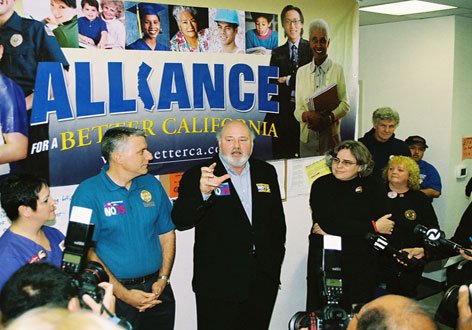
When I made it to the SOMA [south of market district] victory party for the SF Alliance for a Better California sometime around 11pm the hundreds in attendance expressed a tremendous accomplishment in battling against tremendous odds, especially for Prop 74 [Punish New Teachers Act] and Prop 75 [Paycheck Deception Act to silence teachers, nurses, firefighters and workers], and Prop 73 [the anti-choice parental notification act].

Veteran labor, anti-war and queer community elder Howard Wallace smiled intensely when he learned that the no on Prop 75 vote had surpassed the yes vote shortly after 10pm.
SF Alliance Director Robert Haaland and local staff and volunteers did a tremendous job with SF Labor Council head Tim Paulson in turning out 1300 volunteers today in one of the largest Get-out-the-vote efforts in SF history.

United Health Care Workers organizer Leon Chow, also the Chair of the Chinese Progressive Association told me that hundreds of immigrant activists worked precincts up and down the hills of SF's Chinatown, along with students and youth to turn out the immigrant vote. The Asian Law Caucus and APA's for an Informed California conducted a community exit poll that will hopefully shed light on the voting patterns of Chinese and immigrant voters in the Special Election.

State Ballot Measures as of Midnight!
( 578 of 578 ) San Francisco precincts reporting as of Nov 9, 2005 at 12:19 am
For the current results - http://vote2005.ss.ca.gov/Returns/prop/38.htm
What a major climax to this incredibly important CA election. Let's continue the momentum to send Arnold back to Hollywood and to turn the tide against the conservative and big business assault on our schools and communities!

Tuesday, November 08, 2005

CA Election Day hopes - turnout and turning the tide against the big business/conservative assault

According to recent press reports, San Francisco voters are now turning out in large numbers for this Nov. 8th Special Election. At my polling place this morning under looming clouds at 9am in the Richmond District of SF it looked like a lower turnout. But then the sun came out and I attended a huge spirited community rally at the Plumbers Union Hall on Market Street where hundreds of GOTV [get out the vote] volunteers and community leaders hit streets to defeat the Governor's initiatives.
Nicole Derse, local SF coalition director of the Alliance for a Better California, told me that 800 volunteers worked neighborhoods up and down SF over the weekend. The Alliance represents 2 & 1/2 million Californians. She also said that dedicated student volunteers of the League of Pissed Off Voters worked SF State University campus dorms and classrooms as well. Local labor and housing activist Robert Haaland, the director of the SF Alliance, said also that the outpouring of community support for the campaign has been tremendous. Many in the audience like Supervisor Tom Ammiano predicted that the Governor's initiatives will be defeated by the power of grassroots efforts like the Alliance and Labor Council actions up and down the state.

Despite the unprecedented millions of dollars pumped into the special election by the Governor and his corporate and wealthy allies, it seems the 'people power' of immigrant, people of color, labor, women and repoductive rights, consumer rights and environmentalists will prevail in this election.
More info: Latino's united
Immigrants and youth united
My prediction is that at the end of this Election Day, the Governor will be badly injured - politically - in this first battle for his to struggle to retain the CA Governor's seat in Nov. 2006. Hopefully, the grassroots forces continue to come together and stay united to back a progressive alternative candidate that can defeat the Governor in the Gubernatorial race for next year and, in the long term, also turn the tide against the big business/conservative assault on our democracy and communities.

RE Turnout in SF - see Steve Rubenstein's SF Chronicle article
(11-08) 11:22 PST SAN FRANCISCO -- Even the free cookies being handed out by some poll workers didn't sweeten the mood of San Francisco voters, who largely said today that they think the special election was unnecessary and that they planned to vote down Gov. Arnold Schwarzenegger's ballot measures.
...The special election, which is part of Schwarzenegger's government reform effort, already has generated spending of more than $300 million and is among the most expensive campaigns in California history.
Across the state, about 6.8 million people were expected to vote in the election, which includes propositions on matters including parental notification for minors seeking abortions, redistricting and teacher tenure.
...Voter Jim Ellis agreed. "The propositions were compelling in a negative way," he said. "It was a waste of my money and the taxpayers'."
Said voter Christopher Riess: "This was a power grab, and a very expensive one."
E-mail Steve Rubenstein at srubenstein@sfchronicle.com.

SF Schools Consent Decree will expire Dec. 31, 2005

United States District Judge William Alsup has just ruled today that the SF Unified School District's Consent Decree will expire December 31, 2005. He rejected the NAACP's request for an 18 month extention of the decree.
In the 11/8/05 ruling the Judge stated:
"[t]he consent decree has proven to be ineffective, if not counterproductive, in achieving diversity in SF public schools...
As the decree has come to be used, the Court must pretend to supervise decisions better left in the hands of education professionals subject to the rough and tumble of local politics and government."

Now it is up to our Board of Education and district to ensure fairness and equity in our student assignment system and also in how we distribute our resources as well. We have been meeting with community advocates and the researchers from the Harvard Civil Rights Project and other groups to come up with a new system that can allow our district to counter the rapid resegregation going on in our district and urban districts around the country.
For more history on the Consent Decree from this blog see
Consent Decree Monitor's report on resegregation in SF Schools
Racial Justice and the SF Schools
History of the dramatic White and Middle Class Flight in SF Schools

Monday, November 07, 2005

States Should Invest in Universal Preschool!


Preschool for All is needed more than ever in CA - despite the 2 recent studies on the effects of preschool and childcare. The mainstream press reported on 2 new studies showing both positive and negative effects of spending long hours in organized child care and preschool - The National Institute of Child Health and Human Development's study of early child care and youth development and the Stanford/UC Berkeley National Center for Education Statistics' Early Childhood Longitidinal Study.
But others are pointing to the cost-benefits and social justice and equity reasons for states' investing in preschool for all - check out for example the November 07, 2005 edition of the Christian Science Monitor
States should invest in preschool
By Andrew White

NEW YORK – Millions of middle-class and wealthy American parents assume preschool to be an important part of their 3- and 4-year-old children's lives, but that's far from the reality of this nation's working poor. At a time when the diversity of languages, educational backgrounds, and economic status among families is rapidly widening in almost every state in the nation, a massive expansion of affordable preschool is ever more essential yet still far from being realized in too many states.
One of every 4 children under age 6 in the United States today is a child of immigrants, an extraordinary increase from just a decade ago. More than half of these children are from poor families, according to a recent report from the Urban Institute. These are exactly the families and children who can benefit most from strong early-education programs.
Preschools and prekindergartens that develop the skills, imaginations, and social and emotional capacities of 3- and 4-year-olds can transform children's lives, especially when the schools include social services and education for parents, such as classes on child development, literacy, or English as a second language. The cognitive and emotional benefits, mapped out in a landmark collection of studies published by the National Research Council and the Academy of Medicine five years ago, have been even more fully documented in the years since. With rapid cognitive growth occurring in a child's first five years, it is the prime time to lay the foundations for healthy and productive lives.
While these findings are valid for all children, the results are especially powerful for children from families that don't speak English at home, who are more likely to have a low income, or whose parents haven't had much formal education.
Children from poor families who take part in strong early-education programs are much less likely to need special education services or to be held back as they get older. They are far more likely than their peers to graduate from high school, stay out of trouble with the criminal justice system, and ultimately have better economic futures. In a study of the universal prekindergarten program in Tulsa, Okla., Hispanic children showed especially impressive gains on language and other skills that led to stronger reading in primary school.
...
Californians may have the chance to vote for a truly universal prekindergarten plan through a ballot proposal next June.
... Immigrants have become a fundamental part of communities and the economy in suburbs and cities across the US. It's time to get past the increasingly anachronistic policy debate about whether or not working-class immigrants have a place in this country and instead learn to adapt. A big first step would be the institutionalization of full-day preschool programs that help to strengthen families and improve communities over the long haul - for everyone.
• Andrew White is director of the Center for New York City Affairs at Milano: The New School for Management and Urban Policy.
For the full aricle
-------------------------------
In California a broad and growing coalition of educators, parents and community groups called Preschool California want every child in California to have the opportunity to go to quality preschool. We are working on a CA statewide ballot iniative for the June 2006 ballot that would make Universial high quality preschool a reality for many more Californians.Preschool should be more than just a special program for the poor, or a private advantage accessible only to the well-to-do. It should be a voluntary opportunity for every child in California.

For more info on the initiative and the growing movement to achieve publicly funded, quality preschool opportunity for all California children whose parents want to enroll them contact Preschool California

Sunday, November 06, 2005

How to Assess the Educational Health of San Francisco Schools

From Dr. Kathy Emery's great website - Education and Democracy

How to Assess the Educational Health of a School District?
by Kathy Emery
The last two superintendents of the San Francisco Unified School District have based their reputations on raising standardized test scores. Both claimed to have done so, but the FACTS belie the claims.
High-stakes testing advocates such as Mayor Gavin Newsom and Superintendent Arlene Ackerman claim that they are "not ideological, but results driven." But test scores as "results" are based on ASSUMPTIONS about what signifies intelligence and which knowledge is important. Basing assessment on test scores alone, or even primarily is highly ideological.
  • "It is wrong to evaluate schools based on students' standardized achievement test scores. Educators and non-educators alike need to understand why." James Popham, The Truth About Testing: an Educator's Guide to Action

1. Standardized tests are created so that the results closely correlate with socio-economic status. This is done ON PURPOSE. This ensures their "reliability," i.e., students get the same score every time they take the test. For an example of how tests are strongly correlated to SES view a map comparing selected census track's median income with the API of the neighborhood's elementary school in San Francisco in 2003. More data: look at a map of median income and compare it to API scores of all elementary schools in San Francisco, all middle schools and all high schools.
You can look at the test score data from one elementary school in SF during the last 5 years. And then look at Popham's analysis of a standardized test to determine how many items are correlated to SES and how many to "inherited aptitude." Not much is left over for other kinds of interventions. [more by Popham and Berlak]

2. There are many and various "threats" to the "validity" of a test score. Here are just a few:

  1. Test scores are supposed to be reported as a range, not a single number. Test makers do not claim that their tests are accurate enough to be reported precisely. There are too many variables that interfere with a test taker when they are taking the test (too hot in the room, not feeling well, distracted by a sudden but brief commotion outside, low blood sugar, not enough sleep the night before................ ). The conditions under which every child in every school in every district of the state are not standardized. The validity of the test scores depends on such standardization of conditions.
  2. Most comparisons of a school from one year to the next are based on the combined test scores of the students (such as the Academic Performance Index in California). These scores are NOT "matched scores," that is the student population tested from one year to the next is not the same.
  3. The degree to which the student population taking the test differs in its demographics from the student population used to norm the test is the degree to which the test is invalid. For example, if the norming sample has only 2 percent English language learners but the school has 25 percent English language learners, the test is not very valid at all.

See Harold Berlak's Handbook for more information about why using test scores to evaluate student achievement is not a good idea.

What is the Alternative to Using Test Scores to Measure Achievement?

One can start thinking about how to develop alternatives by looking at Debbie Meier's Six Alternative Assumptions to the high-stakes testing agenda. Meier expands upon these assumptions in her book, In Schools We Trust.

The real question today, a question provoked by the Business Roundtable's successful implementation of high-stakes testing, is how can parents, teachers and other local community members work together so they begin to trust each other enough to have honest, deep and ongoing conversations about educational goals, assessment, pedagogy, curriculum, standards, governance, and so forth?

If the members of a school's community cannot develop alternative vision to high-stakes testing, then our public school system will continue on its current path of punishing "low-performing" schools and allowing "high-performing" schools to produce task-completers rather than problem-solvers. This distinction is addressed in Don Arnstine's Democracy and Arts of Schooling in which he distinguishes between education and socialization. He argues that it is crucial for any possibility of democracy that we do both.

SEE alternative reform models in SF and the Bay Area.
For more go to Education and Democracy.

Friday, November 04, 2005

The Boondocks hits your TV Sunday Night; Universal Preschool needed in CA despite the latest Preschool Studies


The Boondocks hits your TV's Sunday night - 11pm Cartoon Network!
According to Newsweek, on Aaron McGruder's new Cartoon Network series 'The Boondocks,' no one is safe—not even Rosa Parks.
The Detroit Free Press says comic artist extraordinaire McGruder simply "tells it like it is."
For more on the Comicstrip .
See also the excellent Post 911 Alternet interview with the amazingly sharp and creative Aaron McGruder
http://www.alternet.org/story/11859/

Universal Quality Preschool for All is needed more than ever in CA - despite 2 recent studies on the effects of preschool and childcare.
The mainstream press reported on 2 new studies showing both positive and negative effects of spending long hours in organized child care and preschool - The National Institute of Child Health and Human Development's study of early child care and youth development and the Stanford/UC Berkeley National Center for Education Statistics' Early Childhood Longitidinal Study.
But as reported in the SF Chronicle, advocates for expanding preschool in California shot back with their messages too.
"We want all children to be better prepared and be successful for life," said Catherine Atkin, president of Preschool California. "All children benefit from a quality preschool experience."
The Chronicle also reported that efforts to expand preschool are growing across the country, including in Georgia, Oklahoma, New Jersey and New York. California is one of three states -- including Massachusetts and Illinois -- where significant plans are being made to offer all 4-year-olds voluntary preschool.
In California, the proposed universal preschool ballot initiative expected for the June 2006 state ballot would levy a 1.7 percent tax on couples who make at least $800,000 annually or single people who make $400,000.

A broad and growing coalition of educators, parents and community groups called Preschool California want every child in California to have the opportunity to go to quality preschool. We are working on a CA statewide ballot iniative for the June 2006 ballot that would make Universial high quality preschool a reality for many more Californians.
Preschool should be more than just a special program for the poor, or a private advantage accessible only to the well-to-do. It should be a voluntary opportunity for every child in California.
For more info on the initiative and the growing movement to achieve publicly funded, quality preschool opportunity for all California children whose parents want to enroll them contact Preschool California

Friday, October 28, 2005

Sister Rosa Parks - thank you.

Oct. 25, 2005 - Thank you sister Rosa for bringing struggle to our movements and inspiring us to fight on!
Thank you for not just taking on racism and segregation just that one day in Montgomery, Alabama, Dec. 1. 1955. But also for strategizing with E.D. Nixon, organizers and community groups, before and after that day, and for most of your life.
Thank you for nurturing young folks and giving them the skills and experience needed to become the warriors of tomorrow.
Thank you for visiting an Francisco in 1997 and honoring one of our schools [where my wife taught for many years] with your name – Rosa Parks Elementary School in the Fillmore District. The mural on the wall of the school stands out as one of the finest in our City.

--------------------------------
Great resources for teaching about Sister Rosa:
Putting the Movement Back into Civil Rights Teaching
http://www.civilrightsteaching.org/

SF/Bay Area Freedom School [an amazing grassroots summer project by a number of parents, teachers and youth]

Stanford’s MLK papers project -

Lastly, don’t miss - Education for Liberation: Putting the Movement Back into Civil Rights Teaching. Saturday, November 12, 2005Laney College, Oakland, CA. A day-long conference for teachers, youth activists, parents, social justice activists, school administrators/school board members. All who pre-register will receive a free copy of Putting the Movement Back Into Civil Rights Teaching. Small workshops on the Civil Rights Movement, education reform issues, and contemporary social justice struggles, led by Bay Area activists. The conference is free. Lunch is provided ($5 donation requested.) Register on-line.

Thursday, October 27, 2005

CA High School Exit Exam - Blaming the Victims

BLAMING THE VICTIMS? STUDENTS WILL BE PUNISHED BY THE HIGH SCHOOL EXIT EXAM
EDITOR'S NOTE: John Rogers is Associate Director of the Institute for Democracy, Education and Access (IDEA), a research center at UCLA that examines key policy issues affecting equity and access within California's educational system.
BY CAROLYN GOOSSEN, PACIFIC NEWS SERVICE

Q: Why are African-American and Latino kids failing the High School Exit Exam in larger numbers than other groups?
A: African-American and Latino students are far more likely than any other group in the state to attend schools that lack qualified teachers, space and instructional materials. Take, for example, the eight high schools in South Los Angeles. More than 99 percent of the students in those high schools are African-American or Latino. More than one-third of the teachers at these schools lack a full teaching credential. Two-thirds of the math teachers are not credentialed to teach math. Because most of these schools are dramatically overcrowded, they use a year-round calendar that provides students with 17 days fewer instruction each year than other high schools in the state. And, students attending these high schools came from South Los Angeles middle schools with similar shortages of qualified teachers and overcrowding.
Q: Statistics say that 85 percent of English learners in this state are Latino students. Does this also have an impact on the results?
A: Yes, many of the Latino students who have not yet passed the exit exam are recent immigrants still learning English. Their inability to pass the exam is often a function of their taking a test in a language that they don't yet fully understand. Latinos who are fluent in English have far higher pass rates.
Q: Many see the exit exam as a way to ensure that a high school diploma means something, and that students who graduate have at least basic English and math skills. Shouldn't we have something like the exam to make sure all students have these basic skills?
A: If we want to ensure that all students can demonstrate basic skills, we need to provide all students with access to quality instruction. More fundamentally, I would argue that basic skills are not enough. What parent would be satisfied with basic academic competence as a goal? Our high school diploma should mean young people are prepared for successful futures, which requires greater investment in our schools.
...
Q: On Sept. 30, the Human Resources Research Organization -- an independent evaluator of the Exit Exam -- released the exit exam passage rates. What did the results show? And what does it mean for different groups of immigrant students?
A: This recent report confirms what we have been saying for several months: that around 100,000 students in the Class of 2006 are at risk of not graduating this spring because they have yet to pass the exit exam. The vast majority of these students are: 1) special education students; 2) immigrant students still learning English; and 3) African-American and Latino students attending schools with substandard conditions.
Denying these students diplomas will undermine the ability of many young people to move on to successful futures and will generate cynicism among young people who have not been given a fair chance to succeed. It is not too late to avoid these outcomes. California still has time to follow the report's recommendations and to create options for students who have not yet passed the exit exam.
Q: What kinds of options did the report recommend?
A: It suggested on that districts could grant students diplomas if the students successfully completed a summer program. Options such as this offer a way for the state to avoid the calamity of having perhaps 100,000 students denied a diploma.

From Pacific News Service
http://news.pacificnews.org/news/

Wednesday, October 19, 2005

Bay area youth groups support alternatives to the CA High School Exit Exam, but the Governator vetoes them on Oct. 7, 2005

I bumped into my friend Tiny of Poor News Network/KPFA [94.1FM] at the 10/16/05 Poor People's March and Community Congress which was organized by an alliance of mass-based grassroots organizations and the Living Wage Coalition in SF. The SF people's 'community congress' was inspiring and powerful. Click here for more on the event from beyondchron.com.

The previous week Tiny covered the important work of Oakland Bay Area's grassroots youth groups -

  • the new la Fuerza Unida [not the San Antonio grassroots group which took on Levis Corporation in the Pre-NAFTA period of struggle against Globalization and plant closures] and
  • Youth Together [an amazing multiracial organization fighting for youth self-determination with the help of seasoned organizers like Raquel Jimenez and others].
Both organizations along with Californians for Justice, LA's Coalition for Educational Jusitice, SF's Teachers for Social Justice and many others have been urging support for CA state educational justice legislation -

  • AB1531, which would have allowed school districts to develop alternatives to the mandatory high school exit exam that California students have to pass before they graduate and receive their diploma, and
  • SB385, which focuses on allowing English learner students to take the high school exit exam in the student's first language.
Both bills were vetoed by the "increasingly right wing leaning Govenator" on Friday Oct 7th.
In response to the veto, Assembly Member Karen Bass, (D. Los Angeles) who authored 1531 said, "I am disappointed that the Governor can't see the residual effect of mass failure of students whose schools do not have adequate resources."

Click here for Tiny's full article on the organizing and the event

For more people's news and perspectives check out Poor News Network
http://www.poormagazine.org/index.cfm

Or by RADIO - worldwide -
For Your Poor News Network, Pacifica Radio! Listen to KPFA San Francisco/Bay Area!
Every last Monday of the month at 7:30 AM listen to PNN's radio broadcast (KPFA 94.1fm) on your San Francisco dial or www.KPFA.org on line. [ http://www.kpfa.org/ ]

For more on educational justice and other racial equity legislation in California - check out the Oakland-based Applied Research Center's legislation page

Tuesday, October 18, 2005

Latino Communities Oppose Props 74, 75 and 76

From Duane Campbell's Choosing Democracy Blog -
Latino Leaders oppose CA Propositions 74, 75 & 76
Latino Leaders Unite Against Governor’s Agenda, Urge Community to Vote No on Propositions 74, 75, 76 and 77
Monterey Park, CA – Assembly Speaker Fabian Núñez and L.A. City Council President Alex Padilla gathered with other California Latino elected officials and community leaders for a press conference today in order to show that they are united in opposition to the Governor’s agenda, which takes California in the wrong direction and hurts Latino families, and instead are working to support good schools, affordable health care, safe communities and a better quality of life.
“The Governor’s so-called reform agenda – which was dreamt up by Pete Wilson and his staffers who now work for Arnold – hurts our public schools, threatens quality health care and cuts funding to local law enforcement,” Speaker Núñez said.
“The Governor’s people have said outright that they are counting on us to not turn out to vote. But we’re here to show the Governor that the Latino voters cannot be taken for granted, cannot be brushed aside, and cannot be silenced.”
“We are opposed to these phony reforms because they hurt our public schools, threaten quality health care and cut funding to local government and law enforcement,” said L.A. City Council President Alex Padilla.
“These initiatives are designed to shift power to the Governor and make things worse for the average Californian.”
“This weekend, we will be walking precincts in East L.A. in the name of my late husband, Miguel Contreras,” said Maria Elena Durazo, UNITE/HERE Local 11 President. “I ask the Latino community and all hardworking Californians to get out there and show the Governor that we won’t be silenced, and we won’t be ignored.”
... Participants in the press conference, held at the East Los Angeles Community College, consisted of elected officials as well as Los Angeles community leaders, including Congresswoman Hilda Solis, State Senator Richard Alarcon (D-Sun Valley), Assemblymember Ron Calderon (D-Montebello), L.A. City Councilman Ed Reyes, SEIU Local 660 President Annelle Grajeda, SEIU Local 1877 President Mike Garcia, Salvadoran Legal and Education Fund executive director Carlos Vaquerano, Silvia Beltran of Homies Unidos, and President of Latino Movement USA Juan José Gutierrez.The Alliance for a Better California is a coalition of nearly 2.5 million firefighters, nurses, teachers, police officers, and other working Californians and community members who oppose Propositions 74-78.
More
More on the Alliance for a Better California campaign against Props 74-78.