November 13.
The California Dept. of Education and Jack O'Connell are hosting a major conference on the Achievement Gap at the Sacramento Convention Center on Nov.13 and 14. There is a wide diversity of speakers. Attendees, like myself, have a great deal of choice.
Perhaps I am just picking poorly. But, after the first day I observe that there are a great number of presenters claiming to be experts, each with a fix, and very few teachers making presentations.
Here is a part of the problem. You can not reform schools without bringing teachers along in the reform. Most speakers agreed that there is little evidence of improved scores in California.
So, 14 years of standards based reform. And, 14 years of test based reform. Little or no improvement in scores. Russlynn Ali of Ed trust west provided again the data.
If you want to influence teachers you will have to listen to teachers. You will have to know their views well.
So far, I have seen endless panels of experts and very few teachers. That is a part of the problem.
I recognize that this may be only a selection bias. Perhaps I just picked the wrong presentations. I tried to get into one panel described as teacher centered but it was full.
It was a good choice to have a debate between Chester Finn and Richard Rothstein.
Duane Campbell
Nov.16.
The Achievement Gap Summit has spurred some media commentary on the problems of the schools. The letters to the Sacramento Bee were mostly people responding with their solutions without listening to the problems. This was a pattern at the summit also.
I have a solution, now where is the problem.
I attended the event and went to a number of presentations.
In a Morning Report on Capitol Public Radio this morning I heard Jack O’Connel say that perhaps the first step forward might be racial sensitivity training for all California teachers. This is another example of applying the solution without knowing what is the problem.
Perhaps for the hundreds of superintendents and associate superintendents and principals, racial sensitivity training would help. They need to learn to pay attention to the real problems.
However, for teachers, this is poor direction. California teachers since at least the early 1990’s have taken one or more courses in multicultural education and one or more courses in assisting English Language learners. Of course the quality of the courses varied. I have taught these and other courses.
A basic truth is future teachers want to do well, they want to teach kids and be successful. And then the data on NAEP, state tests, etc. show an achievement gap.
As pointed out by Russylnn Ali at the conference, most California kids do poorly. We rank at the bottom of the states in reading and near the bottom in math. This data was widely shared at the conference and accepted by almost all. It is up on the web sites of the conference.
Teachers, particularly new teachers, need a support in creating a positive productive classroom environment. This requires resources, time, support networks, and sufficient counselors in the schools. And, they need coaches who are successful teachers and experts in helping kids such as English Language learners. New teachers have non of these. Instead they enter a failing system, try to do well, get frustrated, fail more, and become less effective and more defensive. Richard Rothstein spoke to the resources failure. Lack of resources is a political failure.
Sensitivity training for teachers will not resolve any of these issues.
Next post: some limits to the white privilege argument.
Duane Campbell : Sacramento
Showing posts with label achievement gap. Show all posts
Showing posts with label achievement gap. Show all posts
Friday, November 16, 2007


Wednesday, January 17, 2007
inside the box
 The most interesting debate for me at last night’s San Francisco school board meeting (ie until I had to leave at 9:15 PM) was over the supposedly mutually exclusive choice between spending prop H money on “violence prevention programs” ( $50K block grants to be spent as the school site chose) or academic support for teachers. Superintendent Gwen Chan argued that since the SFUSD district was now a “program improvement district” the priority needed to be “academic support” (as if violence prevention isn’t a precondition for learning). The Community Advisory committee argued for violence prevention and 4 Wellness Centers (instead of the 3 that Chan’s plan called for) as a priority, arguing that the students themselves defined that as a priority.
So, two things become clear to me in this debate. One, there isn’t enough money (in a BIG WAY). Two, the local community won’t get to set the priorities – state legislatures do.
These are the fundamental issues that were the pink elephants in the room last night. The debate should have been explicitly about how to do we mobilize the SF community to demand more money from the state and city (instead of arguing over the few crumbs we get from the table see ny times article, also below). The debate also should have focused on why does the community have so little say in what the educational theory and priorities are and how do we get a more democratic decision making process implemented? These issues remain unspoken. Instead, we have accepted the paradigm of inadequate funding and decision by test score alone in public debate.
The small school policy debate (that followed the prop H proposal discussion) has been equally narrowed to one in which the only reason an educational reform should be made into policy is to make sure that the school system continues to socialize and sort in a legitimate fashion. It was clear to me last night that small school proponents have accepted the premise that those who don’t “succeed” in school should be blamed for their failure as individuals. Equity, according to the small school proponents last night, will exist if school success cannot be correlated to race, gender, class or neighborhood or parental income. That is, if failure can be pinned on the individual or family, then the successful can wash their hands of any responsibility for the growing polarization of wealth and its resulting social, cultural and political impoverishment (not to mention impending ecological disaster – and why isn’t Gore’s An Inconvenient Truth required viewing in the district?). Apparently it is okay if a student is damaged or alienated by the school experience as long as such damage isn’t correlated with race, class or neighborhood. Equal opportunity damage. Yeah, sign me up.
The debates and presentations last night occurred within the paradigm that defines success as going to college. Let’s ignore all the reasons why the system, as is, will never let everyone go to college (which is why the RHETORICAL goal of getting the college bound to be proportional to disaggregated demographics exists). What if everyone went to college? Would that necessarily result in everyone having a decent home, health care, functional families, disposable income and world peace (would it alter the nation’s spending priorities – see article, also below)? What are people actually learning in school? How long does that learning last? How many adults, for example, learned algebra and still know it? Is anyone learning in school how the power structure in this country actually works (as opposed to the myth of how it works)? No one is explicitly examining, debating or questioning whether qualifying to go to college is really evidence of how well one has accepted one’s role to support the status quo.
Asking everyone to think outside the box (eg give up the myth that we live or could live in a meritocratic society) is like being against slavery in 1750. It is an exercise in frustration, unless one is thinking in the long term. But unlike 1750, I worry that in 2007 there is no long term, that we are locked into a box on a truck heading towards the edge of a cliff. Two articles in the NY TIMES (yesterday and today, snippets below) make me feel that we are indeed in deep trouble unless we make some fundamental changes – one of which is transforming schools from places in which we socialize to one in which we actually start educating people. And for that to happen, much greater sums of money must be spent on schools, not war, as a necessary but not sufficient variable. It is not a matter, as Jurgis Rudkus (The Jungle) thought it was, of merely “working harder.”
What $1.2 Trillion Can Buy
by david leonhardt, January 17, 2007
…… $1.2 trillion would pay for an unprecedented public health campaign — a doubling of cancer research funding, treatment for every American whose diabetes or heart disease is now going unmanaged and a global immunization campaign to save millions of children’s lives.
Combined, the cost of running those programs for a decade wouldn’t use up even half our money pot. So we could then turn to poverty and education, starting with universal preschool for every 3- and 4-year-old child across the country. The city of New Orleans could also receive a huge increase in reconstruction funds.
The final big chunk of the money could go to national security. The recommendations of the 9/11 Commission that have not been put in place — better baggage and cargo screening, stronger measures against nuclear proliferation — could be enacted. Financing for the war in Afghanistan could be increased to beat back the Taliban’s recent gains, and a peacekeeping force could put a stop to the genocide in Darfur.
All that would be one way to spend $1.2 trillion. Here would be another: The war in Iraq.
When Being Green Raises the Heat
By KEN CALDEIRA January 16, 2007
CARBON DIOXIDE is heating up the Earth. Ice caps are melting, ocean levels are rising, hurricanes are intensifying, tropical diseases are spreading and the threat of droughts, floods and famines looms large. Can planting a tree help stop all this from happening?. . . . While preserving and restoring forests is unquestionably good for the natural environment, new scientific studies are concluding that preservation and restoration of forests outside the tropics will do little or nothing to help slow climate change. And some projects intended to slow the heating of the planet may be accelerating it instead. . . . Consider Pacific Gas and Electric’s surcharge plan. While the carbon soaked up by California’s forests reduces atmospheric carbon dioxide concentrations everywhere, cooling Crete, Cancún and Calcutta, the sunlight they absorb warms the state and the surrounding region.. . . The broadest goal is neither to slow the growth of carbon dioxide in the atmosphere nor to slow climate change, but rather to preserve the irreplaceable natural balance that sustains life as we know it on this planet. . . . regardless of its impact on climate — we need more trees, not fewer. But the notion that we can save the planet just by planting trees is a dangerous illusion. To preserve our environment, we must drastically reduce carbon dioxide emissions, and this will require a major transformation of our energy system.
Monday, January 08, 2007
Asian American parent & youth organizations support School Desegregation and Equity in Supreme Court's Seattle/Louisville Cases; Boston's CAPAY
 As I and other San Francisco School board members work towards improving our future equity and desegregation plans for our 57,000 public school students, a number of community groups are starting to build support nationwide for our work here and in other urban centers.
Last month Asian American organizations from San Francisco to New York filed a 'friends of the court' [amici curiae] brief to weigh in on the US Supreme Court's arguments in the Seattle and Louisville school desegregation cases.
 Besides SF's Chinese for Affirmative Action and NY's AALDEF [Asian American Legal Defense and Education Fund], other 'amici' include - Asian Americans United, Asian Pacific Islander Legal Outreach, Asian Pacific Islander Youth Promoting Advocacy and Leadership, Boston Asian Youth Essential Service, Cambodian Association of Greater Philadelphia, Coalition for Asian American Children and Families,
Coalition for Asian Pacific American Youth, Detroit Asian Youth Project, Filipinos for Affirmative Action, Japanese Community Youth Council, One Lowell, Providence Youth Student Movement South Asian Youth Action!, and United Chinese Association of Brooklyn.
Lead attorney for the Asian American organizations, is former SF Asian Law Caucus attorney Khin Mai Aung, now with AALDEF. From AALDEF's December press release:
 Civil rights groups Asian American Legal Defense and Education Fund (AALDEF) and CAA Chinese for Affirmative Action/Center for Asian American Advocacy asserted a compelling interest for the nation’s public schools to actively ensure equal access to quality education and a diverse learning environment. In both cases, locally elected school boards in Seattle, Washington, and Louisville, Kentucky had voluntarily adopted measures to reverse racial segregation in their public schools, and considered race in their cities’ kindergarten to 12th-grade school assignments. Similarly, in San Francisco, where more than 50% of public school students are Asian American, School Board Commissioners would also like to propose a race-conscious student assignment plan that would include considerations of race in a narrowly tailored manner.
 CAA, which joined AALDEF in filing an amicus brief with the High Court, represents Chinese American parents and children who favor such an approach.
AALDEF Staff Attorney Khin Mai Aung said, “Asian American students in particular rely on the invaluable benefits of racially integrated public schools, which more accurately reflect their communities and greater U.S. society. If the Court were to bar school districts from desegregating their schools, the quality of education for Asian American children would be significantly harmed. AALDEF supports efforts by districts nationwide to consider race and other factors in order to fulfill the promise of educational equity embodied by the Court’s decision in Brown v. Board of Education, more than 50 years ago.”
CAA Policy Advocate Christina Wong said, “In many of San Francisco’s schools, racial isolation has increased in the absence of race considerations in student assignment plans. Our current school assignment process has failed to provide our children with a racially integrated environment. CAA supports the voluntary use of race and ethnicity as a factor in the school assignment process to ensure that thousands of our city’s students receive a well-rounded education.”
Cindy Choy, a parent leader with the Visitacion Valley Parents Association, said: “As a parent and resident of one of San Francisco’s most diverse neighborhoods, I’ve witnessed firsthand how important it is for children to learn in a racially diverse environment. It would be easy to have my only daughter go to a school with a majority of Chinese students like herself but that would not allow her to learn and benefit from other groups of people. ...
AALDEF/CAA amicus brief: www.aaldef.org/docs/amicus-K-12_deseg-2006.pdf.

Boston's Youth Organizing with CAPAY
Last year I visited various Boston social justice organizations, including the Asian American Resource Workshop, Chinese Progressive Association, U Mass Boston's Ethnic Studies programs, and a progressive Asian American youth organizing group recommended by UMass's Peter Kiang called CAPAY -Coalition for Asian Pacific American Youth. CAPAY is one of the organizations that support the AALDEF/CAA brief in favor of civil rights and desegregation.
I attended one of CAPAY's workshops and a summer picnic with activist supporters Sophia Kim and Gee Quach and was impressed with the dynamic organization and the young folks that make it strong. One of my former TA's Anjela Wong, now finishing her EdD at the University of Wisconsin, Madison, was a former CAPAY leader.
Danger: School Privatization - the Right-Wing Fordham Foundation's role
 It's a 'chilly' but sunny 60 degrees here in the San Francisco/Oakland Bay Area, but I wish I were in Miami this week with Mike Klonsky, Pedro Noguera, Debbie Meier and many others for the 6th Annual Small Schools Workshop gathering. Klonsky's latest blog points out the conflicts of interests with the conservative Thomas Fordham Foundation's role as both an authorizer and operator of charter schools. Foundation head Checker Finn is a former Reagan administration assistant secretary for education.
 ... I still can't help wondering how the Fordham Foundation, with close ties to the Bush Dept. of Education, can be both a charter school authorizer and operator of a chain of charter schools. I guess I've already answered my own question.
As privately-managed charter schools increasingly become the answer to the question "where does school reform go now that school reform is dead?" the conservative think tank led by Checker Finn has obviously been doing some thinking. Why sit around and complain, as Finn often does, about the failure of charter school accountability under NCLB? Why not get into the business ourselves?
So, as Edweek's Eric Robelen , who makes private management seem almost heroic, puts it, Fordham has "taken the plunge" and will operate nine charter schools in southwest Ohio, which has become charter school's version of Mecca.
According to Robelen's account, the nine schools serve some 2,700 students, mostly from low-income and minority families. They run the gamut from two charters operated by the for-profit Edison Schools Inc. to a school started by a Baptist minister.
More on Pedro Noguera -more on his newest book with Jean Yonemura Wing
Friday, January 05, 2007
SF School Parents Add Voices for New SFUSD Planning for 2007
 Photo - Parent and social justice activist Francisco Hererra at the Parent Leadership Action Network gathering in Oakland.
Parent leader Lisa Schiff has a great new commentary in Beyond Chron's School Beat: Parent Voices are Part of the New SFUSD Plan. Schiff outlines how progressive school board members worked with parent groups like hers [PPS] and others like Coleman Advocates, Chinese for Affirmative Action, ACORN, SFOP and others to demand stronger, more meaningful parent voice in our district.
San Francisco public school parents are typical San Franciscans. We want to be involved, consulted and listened to when it comes to issues affecting our communities and one of those issues is most certainly our public schools. Last year, in a unified voice, the community told the Board of Education (BOE) and the district administration that the difficult path through declining enrollment and insufficient budgets could only be successfully traversed if two major projects were undertaken.The first was to develop a new long-term comprehensive education plan for the district. The second was to meaningfully include the voices of parents and guardians regarding issues such as educational programs, the achievement gap, school closures, the needs of different communities and neighborhoods and more.With capacity building support from Coleman, the SF Education Fund and others we are also working towards a stronger mechanism for parental and community involvement in our upcoming Superintendent Search Process as well.
Please join us for SFUSD's final set of parent/community conversations organized with help from our Parent Advisory Council, Hugh Vasquez and the SF Ed Fund, PPS and others.
- Saturday January 6 from 10-11:30am (in Spanish) PPS-SF Office -- 9 Silliman St, Ste 6 (@ San Bruno)
- Thursday January 11 from 7-8:30 pm (in English) San Francisco Education Fund -- 47 Kearny St (between Post and Market)
- Wednesday January 17 from 10-11:30 am (Chinese and English) PPS-SF Office -- 9 Silliman St, Ste 6 (@ San Bruno)
- Tuesday January 30 from 10-11:30 am (in English) PPS-SF Office -- 9 Silliman St, Ste 6 (@ San Bruno) .
More info - Parents for Public Schools; San Francisco Education Fund
SF Parent Voices leader Maria Luz Torre and 2 of my former colleagues from the Northern California Coalition for Immigrant Rights now are on the advisory board of the PLAN [Parent Leadership Action Network] - Jenny Ocon of the Parent Services Project and Christina Wong of Chinese for Affirmative Action.
Our San Francisco Unified School District Parent Advisory Council Members are:
Debra Anderson has children at AP Giannini Middle School and Burton High School, and a son in college. She is a native of San Francisco and lives in Oceanview. She has been active with parent groups and the SSC at her children’s schools, and as a volunteer with the Young Scholars program.
Charles Armstrong has children at Cesar Chavez Elementary School and the Willie Brown Academy. He lives in the Western Addition. He has been active at his children’s schools and is a member of the SSC at Willie Brown Academy.
Ana Castillo has two children at Monroe Elementary School, where she has been active with the parents’ group, and lives in the Excelsior. She is a native of San Francisco but new to the SFUSD, as her older child attended private school. She is bilingual in English and Spanish.
Cindy Choy has a child at El Dorado Elementary School and lives in Visitacion Valley. She is a member of the SSC at El Dorado, serves on the DELAC, is a leader of the Visitacion Valley Parents Association, and works with Parents for Public Schools. Her primary language is Cantonese.
Stephanie Choy is the PAC’s Vice Chair. She has a child at RL Stevenson Elementary, one at Lincoln High, and another in college. She lives in the Forest Hills neighborhood. She has been involved in her children’s schools for years, as a parent leader and member of SSCs.
She speaks some Cantonese and Mandarin.
Nick Driver has two children at Alvarado Elementary and lives in the Dolores Park neighborhood. He has been involved in the school’s parent group and SSC, as well as the SFUSD Bond Oversight committee. He also speaks Mandarin.
Derrick Eva has a child at Charles Drew and lives in Hunters Point. He has been involved in the school’s parent group and on the SSC, and is active in the Bayview/Hunters Point communities as well as working on school and district initiatives.
Kelly Huang has a child at RL Stevenson Elementary School. She lives in Visitacion Valley and is involved with the Vis Valley Parents Association. Her primary language is Cantonese.
Milena Levitin has a child entering Kindergarten at the new Dianne Feinstein Elementary School. She lives in the outer Sunset, and is active with the Russian immigrant community. She is bilingual in English and Russian.
Jenny Mai has children at Lincoln and Lowell high schools. She lives in Visitacion Valley and is involved with the Vis Valley Parents Association. Her primary language is Cantonese.
Emily Murase is the PAC’s Secretary. She has a child in the Japanese Bilingual Bicultural Program (JBBP) at Rosa Parks Elementary School. She is a product of San Francisco public schools and has been active with the JBBP for many years. She is bilingual in English and Japanese.
Cecilia Roman has a daughter at Leadership High School and two in college. She lives in the Excelsior and is bilingual English/Spanish. She has been a leader at her children’s schools for years, and has been on SSC and ELAC committees at several schools.
Donna Smith has a grandson at Aptos Middle School, and lives in the Excelsior. She has been involved in developing leadership among public school families for many years. She has been on the district’s Title I advisory committee and is a Parent Liaison at Balboa High School.
Kate Steinheimer is the PAC’s Chairperson. She has a child at Grattan Elementary, and lives in the Haight. She has been involved with Grattan’s parent group as well as the SSC, and has worked with the SFUSD’s committee on food and nutrition.
Luis Vasquez-Gomez has a son in middle school at San Francisco Community, where he is been involved as a volunteer. He lives in the Mission District and is bilingual English/Spanish.
Joanna Warrens is the PAC’s Parliamentarian. She has a son at Sunset Elementary, where she is an active volunteer. She lives in West Portal, and has served on the San Francisco Civil Grand Jury.
(There are currently two open seats for Alternates on the PAC.)
Charles Armstrong has children at Cesar Chavez Elementary School and the Willie Brown Academy. He lives in the Western Addition. He has been active at his children’s schools and is a member of the SSC at Willie Brown Academy.
Ana Castillo has two children at Monroe Elementary School, where she has been active with the parents’ group, and lives in the Excelsior. She is a native of San Francisco but new to the SFUSD, as her older child attended private school. She is bilingual in English and Spanish.
Cindy Choy has a child at El Dorado Elementary School and lives in Visitacion Valley. She is a member of the SSC at El Dorado, serves on the DELAC, is a leader of the Visitacion Valley Parents Association, and works with Parents for Public Schools. Her primary language is Cantonese.
Stephanie Choy is the PAC’s Vice Chair. She has a child at RL Stevenson Elementary, one at Lincoln High, and another in college. She lives in the Forest Hills neighborhood. She has been involved in her children’s schools for years, as a parent leader and member of SSCs.
She speaks some Cantonese and Mandarin.
Nick Driver has two children at Alvarado Elementary and lives in the Dolores Park neighborhood. He has been involved in the school’s parent group and SSC, as well as the SFUSD Bond Oversight committee. He also speaks Mandarin.
Derrick Eva has a child at Charles Drew and lives in Hunters Point. He has been involved in the school’s parent group and on the SSC, and is active in the Bayview/Hunters Point communities as well as working on school and district initiatives.
Kelly Huang has a child at RL Stevenson Elementary School. She lives in Visitacion Valley and is involved with the Vis Valley Parents Association. Her primary language is Cantonese.
Milena Levitin has a child entering Kindergarten at the new Dianne Feinstein Elementary School. She lives in the outer Sunset, and is active with the Russian immigrant community. She is bilingual in English and Russian.
Jenny Mai has children at Lincoln and Lowell high schools. She lives in Visitacion Valley and is involved with the Vis Valley Parents Association. Her primary language is Cantonese.
Emily Murase is the PAC’s Secretary. She has a child in the Japanese Bilingual Bicultural Program (JBBP) at Rosa Parks Elementary School. She is a product of San Francisco public schools and has been active with the JBBP for many years. She is bilingual in English and Japanese.
Cecilia Roman has a daughter at Leadership High School and two in college. She lives in the Excelsior and is bilingual English/Spanish. She has been a leader at her children’s schools for years, and has been on SSC and ELAC committees at several schools.
Donna Smith has a grandson at Aptos Middle School, and lives in the Excelsior. She has been involved in developing leadership among public school families for many years. She has been on the district’s Title I advisory committee and is a Parent Liaison at Balboa High School.
Kate Steinheimer is the PAC’s Chairperson. She has a child at Grattan Elementary, and lives in the Haight. She has been involved with Grattan’s parent group as well as the SSC, and has worked with the SFUSD’s committee on food and nutrition.
Luis Vasquez-Gomez has a son in middle school at San Francisco Community, where he is been involved as a volunteer. He lives in the Mission District and is bilingual English/Spanish.
Joanna Warrens is the PAC’s Parliamentarian. She has a son at Sunset Elementary, where she is an active volunteer. She lives in West Portal, and has served on the San Francisco Civil Grand Jury.
(There are currently two open seats for Alternates on the PAC.)
Wednesday, August 16, 2006
California Star Test Results and NAEP ?
Reports on test scores
Good news. The State Schools supt. Reports that school test scores have improved.
Also. See below.
State SCHOOLS CHIEF JACK O'CONNELL RELEASES 2006 STAR PROGRAM RESULTS SHOWING SIGNIFICANT GAINS ACROSS THE BOARD
Glendale/San Francisco — State Superintendent of Public Instruction Jack O'Connell today released results of the 2006 Standardized Testing and Reporting (STAR) Program that show California students remain on a steady trajectory of improved student achievement.
Forty-two percent of students statewide scored at the proficient or advanced level in English-language arts, an increase of 2 percentage points over last year, and 40 percent of students scored at the proficient or advanced level in mathematics, an increase of 2 percentage points over last year.
Since 2003 when all state tests were completely aligned to state standards for the first time, the number of California students who scored proficient and above in English-language arts has grown by 7 percentage points, and the number of students who scored proficient or above in mathematics grew by 5 percentage points.
"I am extremely pleased that these results show that California’s public school students continue to make steady gains in nearly every subject and grade level," O’Connell said. "Since our state adopted rigorous standards for what every student should learn in every grade, and began systematically integrating those standards into classroom materials and instruction, student achievement has continued to improve.
"While movement from year to year is certainly worth noting and analyzing, the real test of sustainable academic achievement is steady gains over multiple years. At this point in California’s transition to a standards-based assessment system, it is worth stopping and taking note of our struggles and success. It is now clear that after almost 10 years of standards based reform, including four years of complete alignment between our standards and our tests, education in California is clearly making meaningful, sustained improvement. There is no doubt we still have a lot of work to do, and no one should be satisfied with our current position, but reforming an entire education system is slow, difficult work. Yet thanks to the hard work of our students, teachers, and administrators, more students than ever before are being prepared with skills and knowledge essential to their future success in our competitive global economy. This improvement deserves recognition and celebration."
Noteworthy gains were made this year in many areas, including mathematics, where 23 percent of students statewide scored at the proficient and advanced level in Algebra 1, an increase of 4 percentage points over last year. In addition, 25,714 more students took Algebra I in 2006 than in 2005. Second through fourth graders also made steady gains in math with scores ranging from 54 to 59 percent at proficient and above. The greatest gains in English-language arts came in grade two, where 47 percent of students scored at the proficient and advanced levels, and in grade three, where 36 percent scored at that level – marking a 5 percentage points increase over last year for each grade.
Each ethnic and socioeconomic subgroup of students has also shown steady improvement over the four years since the tests became standards-aligned. However, the achievement gap persists between African American students, Latino students, or socio-economically disadvantaged students and their white or Asian peers.
"I remain deeply concerned that the achievement gap continues to be unacceptably wide," O’Connell said. "The academic achievement of our Latino, African American, and socio-economically disadvantaged students lags far behind the rest of their peers. We are working to address this problem by providing struggling schools extra resources and additional interventions, and with better training for teachers. But clearly, we must work harder, faster, and with more focus to narrow this gap and to permanently close it. This will be my top priority as I start my second term as Superintendent."
The above is certainly good news. However, we must ask, if state scores are improving, why are not the scores improving signigicantly on the national test, the NAEP?
The National Assessment of Educational Progress. (NAEP)
Report. On-line. http://nces.ed.gov/nationsreportcard/states/profile.asp
“In 2005, the average scale score for fourth-grade students in
California was 207. This was not significantly different from1 their
average score in 2003 (206), and was higher than their average
score in 1992 (202).
California's average score (207) in 2005 was lower than that of the
Nation's public schools (217).
Of the 52 states and other jurisdictions2 that participated in the
2005 fourth-grade assessment, students' average scale scores in
California were higher than those in 1 jurisdiction, not significantly
different from those in 6 jurisdictions, and lower than those in 44
jurisdictions.
The percentage of students in California who performed at or
above the NAEP Proficient level was 21 percent in 2005. This
percentage was not significantly different from that in 2003 (21
percent), and was not significantly different from that in 1992 (19
percent).
The percentage of students in California who performed at or
above the NAEP Basic level was 50 percent in 2005. This
percentage was not significantly different from that in 2003 (50
percent), and was not significantly different from that in 1992 (48
percent).
From the available data we can conclude:
On the state STAR tests, closely tied to the state standards and the state textbooks, students are making modest progress.
However, if the question is, Do students read better? Or do they know math better?
If students read better, they should achieve at a higher rate on any respectable reading test- not only the test that precisely matches the words selected on the test. Here NAEP scores are important.
There has been no significant change in California reading and math scores on the NAEP.
Duane Campbell
Good news. The State Schools supt. Reports that school test scores have improved.
Also. See below.
State SCHOOLS CHIEF JACK O'CONNELL RELEASES 2006 STAR PROGRAM RESULTS SHOWING SIGNIFICANT GAINS ACROSS THE BOARD
Glendale/San Francisco — State Superintendent of Public Instruction Jack O'Connell today released results of the 2006 Standardized Testing and Reporting (STAR) Program that show California students remain on a steady trajectory of improved student achievement.
Forty-two percent of students statewide scored at the proficient or advanced level in English-language arts, an increase of 2 percentage points over last year, and 40 percent of students scored at the proficient or advanced level in mathematics, an increase of 2 percentage points over last year.
Since 2003 when all state tests were completely aligned to state standards for the first time, the number of California students who scored proficient and above in English-language arts has grown by 7 percentage points, and the number of students who scored proficient or above in mathematics grew by 5 percentage points.
"I am extremely pleased that these results show that California’s public school students continue to make steady gains in nearly every subject and grade level," O’Connell said. "Since our state adopted rigorous standards for what every student should learn in every grade, and began systematically integrating those standards into classroom materials and instruction, student achievement has continued to improve.
"While movement from year to year is certainly worth noting and analyzing, the real test of sustainable academic achievement is steady gains over multiple years. At this point in California’s transition to a standards-based assessment system, it is worth stopping and taking note of our struggles and success. It is now clear that after almost 10 years of standards based reform, including four years of complete alignment between our standards and our tests, education in California is clearly making meaningful, sustained improvement. There is no doubt we still have a lot of work to do, and no one should be satisfied with our current position, but reforming an entire education system is slow, difficult work. Yet thanks to the hard work of our students, teachers, and administrators, more students than ever before are being prepared with skills and knowledge essential to their future success in our competitive global economy. This improvement deserves recognition and celebration."
Noteworthy gains were made this year in many areas, including mathematics, where 23 percent of students statewide scored at the proficient and advanced level in Algebra 1, an increase of 4 percentage points over last year. In addition, 25,714 more students took Algebra I in 2006 than in 2005. Second through fourth graders also made steady gains in math with scores ranging from 54 to 59 percent at proficient and above. The greatest gains in English-language arts came in grade two, where 47 percent of students scored at the proficient and advanced levels, and in grade three, where 36 percent scored at that level – marking a 5 percentage points increase over last year for each grade.
Each ethnic and socioeconomic subgroup of students has also shown steady improvement over the four years since the tests became standards-aligned. However, the achievement gap persists between African American students, Latino students, or socio-economically disadvantaged students and their white or Asian peers.
"I remain deeply concerned that the achievement gap continues to be unacceptably wide," O’Connell said. "The academic achievement of our Latino, African American, and socio-economically disadvantaged students lags far behind the rest of their peers. We are working to address this problem by providing struggling schools extra resources and additional interventions, and with better training for teachers. But clearly, we must work harder, faster, and with more focus to narrow this gap and to permanently close it. This will be my top priority as I start my second term as Superintendent."
The above is certainly good news. However, we must ask, if state scores are improving, why are not the scores improving signigicantly on the national test, the NAEP?
The National Assessment of Educational Progress. (NAEP)
Report. On-line. http://nces.ed.gov/nationsreportcard/states/profile.asp
“In 2005, the average scale score for fourth-grade students in
California was 207. This was not significantly different from1 their
average score in 2003 (206), and was higher than their average
score in 1992 (202).
California's average score (207) in 2005 was lower than that of the
Nation's public schools (217).
Of the 52 states and other jurisdictions2 that participated in the
2005 fourth-grade assessment, students' average scale scores in
California were higher than those in 1 jurisdiction, not significantly
different from those in 6 jurisdictions, and lower than those in 44
jurisdictions.
The percentage of students in California who performed at or
above the NAEP Proficient level was 21 percent in 2005. This
percentage was not significantly different from that in 2003 (21
percent), and was not significantly different from that in 1992 (19
percent).
The percentage of students in California who performed at or
above the NAEP Basic level was 50 percent in 2005. This
percentage was not significantly different from that in 2003 (50
percent), and was not significantly different from that in 1992 (48
percent).
From the available data we can conclude:
On the state STAR tests, closely tied to the state standards and the state textbooks, students are making modest progress.
However, if the question is, Do students read better? Or do they know math better?
If students read better, they should achieve at a higher rate on any respectable reading test- not only the test that precisely matches the words selected on the test. Here NAEP scores are important.
There has been no significant change in California reading and math scores on the NAEP.
Duane Campbell
Tuesday, July 25, 2006
SF Freedom School sizzles with intergenerational dialogue
One of this summer's best experiences so far has been my time with students, parents, teachers and veteran civil rights social justice movement leaders and organizers brought together by Kathy Emery, Sherri Sawyer, Sandra Mitchell and others from the SF Freedom School.
For the first session on JULY 8 - Intersection of Education and Civil Rights: Highlander and Organizing about 20 of us had a great time talking, watching films, eating - building the beloved community for the long haul... participants have come not just from SF and Oakland and Berkeley schools, but also from Watsonville, Concord, San Pablo, Richmond, and other areas as well.
Morning: Documentary Film: excerpts from You Got to Move (87 min, 1985, film by Lucy Massie Phenix & Veronica Selver. Myles Horton and the Highlander Research and Education Center and their influence on different protest movements.)
Guest Speaker: Civil Rights and Women's Movement veteran Chude Allen (Freedom Summer, Mississippi)Afternoon: Docudrama: Walkout (110 min, 2006, directed by Edward James Olmos. A young chicana student organizes a school boycott in protest of the discrimination of Mexican-Americans in Los Angeles, 1968.)
On July 15 [i missed this session], the topic was: Setting the Stage: Segregation and the Emergence of Civil Rights Organizations
Morning: Documentary Film: Take me to Chicago (first 60 min of “The Promised Land” 1995; film by Anthony Geffen. Jim Crow laws and sharecropping make the political and economic life unbearable for blacks in the South.)Guest Speakers: Civil Rights Movement veterans Jean Wiley (SNCC 1960-67 Maryland, Alabama) and Jimmy Rogers (SNCC, 1991-67, Alabama)Afternoon: Docudrama: Freedom Song (110 min, 2000; directed by Phil Alden Robinson. Growing up in Mississippi in the 50s and beginning organizing with SNCC, the Student Nonviolent Organizing Committee.)
In last Saturday's sizzling heat we spent quality time with former SNCC staffer and Organize Training Center director Mike Miller, and longtime Chicano/Latino community leader Betita Martinez, also a former SNCC staffer from back in the day.
Topics: Local Leadership: SNCC’s concept of participatory leadership
Morning: Activity: Leadership Training with Mike Miller, ORGANIZE! Training Center
Guest Speaker: Mike Miller, ORGANIZE! Training Center (SNCC, Mississippi; Saul Alinsky, Kansas City, MO)Afternoon: Documentary Film: Freedom on My Mind (110 min, 1994; produced and directed by Connie Field and Marilyn Mulford. The story of the Mississippi Freedom Movement in the early 1960s, from voter registration efforts to Freedom Summer and the formation of the Mississippi Freedom Democratic Party.)
Please join us for the next Saturday 10-4pm Upcoming sessions - FREE! and REALLY GREAT PEOPLE [students, teachers, parents, social justice folks] -
JULY 29, Power Structures: Institutionalized inequality and socially-structured repression of dissent
Morning: Documentary Film: Excerpts from different documentaries (60 min)Guest Speaker: Commissioner Mark Sanchez (SFUSD School Board)Afternoon: Activity: San Francisco Power Structures: How to analyze and understand them (Kathy Emery)
AUGUST 5, Nonviolence and Direct Action: Its power and its limitations
Morning: Documentary Film: A Force More Powerful (30min, 2000; produced and directed by Steve York. Disciplined and strictly nonviolent, black college students in Nashville, Tennessee, successfully desegregated the downtown lunch counters in five months, becoming a model for the entire civil rights movement.)Morning and Afternoon Guest Speaker: Civil Rights Movement veteran Bruce Hartford (CORE, SCLC 1963-67, Alabama, Mississippi). Bruce will give his workshop on the "Key Concepts of Nonviolent Direct Action."
AUGUST 12, Arts and Protest: How does art foster protest?
Morning Performance: Interactive theater performance about the women and teen activists in the Montgomery Bus Boycott by Awele (ah WAY lay) Makeba (award winning and internationally known actor, emerging playwright, storyteller, recording artist and educator)Afternoon: Documentary Film (excerpts):excerpts from We Shall Overcome (58 min, 1990; produced and directed by Jim Brown. By tracing the sources of the song, this film uncovers the diverse strands of social history which flowed together to form the Civil Rights Movement.)Guest Speakers: Civil Rights Movement veteran and song leader Wazir Peacock (SNCC, Mississippi & Alabama)
http://www.educationanddemocracy.org/ED_SFFS.html
For the first session on JULY 8 - Intersection of Education and Civil Rights: Highlander and Organizing about 20 of us had a great time talking, watching films, eating - building the beloved community for the long haul... participants have come not just from SF and Oakland and Berkeley schools, but also from Watsonville, Concord, San Pablo, Richmond, and other areas as well.
Morning: Documentary Film: excerpts from You Got to Move (87 min, 1985, film by Lucy Massie Phenix & Veronica Selver. Myles Horton and the Highlander Research and Education Center and their influence on different protest movements.)
Guest Speaker: Civil Rights and Women's Movement veteran Chude Allen (Freedom Summer, Mississippi)Afternoon: Docudrama: Walkout (110 min, 2006, directed by Edward James Olmos. A young chicana student organizes a school boycott in protest of the discrimination of Mexican-Americans in Los Angeles, 1968.)
On July 15 [i missed this session], the topic was: Setting the Stage: Segregation and the Emergence of Civil Rights Organizations
Morning: Documentary Film: Take me to Chicago (first 60 min of “The Promised Land” 1995; film by Anthony Geffen. Jim Crow laws and sharecropping make the political and economic life unbearable for blacks in the South.)Guest Speakers: Civil Rights Movement veterans Jean Wiley (SNCC 1960-67 Maryland, Alabama) and Jimmy Rogers (SNCC, 1991-67, Alabama)Afternoon: Docudrama: Freedom Song (110 min, 2000; directed by Phil Alden Robinson. Growing up in Mississippi in the 50s and beginning organizing with SNCC, the Student Nonviolent Organizing Committee.)
In last Saturday's sizzling heat we spent quality time with former SNCC staffer and Organize Training Center director Mike Miller, and longtime Chicano/Latino community leader Betita Martinez, also a former SNCC staffer from back in the day.
Topics: Local Leadership: SNCC’s concept of participatory leadership
Morning: Activity: Leadership Training with Mike Miller, ORGANIZE! Training Center
Guest Speaker: Mike Miller, ORGANIZE! Training Center (SNCC, Mississippi; Saul Alinsky, Kansas City, MO)Afternoon: Documentary Film: Freedom on My Mind (110 min, 1994; produced and directed by Connie Field and Marilyn Mulford. The story of the Mississippi Freedom Movement in the early 1960s, from voter registration efforts to Freedom Summer and the formation of the Mississippi Freedom Democratic Party.)
Please join us for the next Saturday 10-4pm Upcoming sessions - FREE! and REALLY GREAT PEOPLE [students, teachers, parents, social justice folks] -
JULY 29, Power Structures: Institutionalized inequality and socially-structured repression of dissent
Morning: Documentary Film: Excerpts from different documentaries (60 min)Guest Speaker: Commissioner Mark Sanchez (SFUSD School Board)Afternoon: Activity: San Francisco Power Structures: How to analyze and understand them (Kathy Emery)
AUGUST 5, Nonviolence and Direct Action: Its power and its limitations
Morning: Documentary Film: A Force More Powerful (30min, 2000; produced and directed by Steve York. Disciplined and strictly nonviolent, black college students in Nashville, Tennessee, successfully desegregated the downtown lunch counters in five months, becoming a model for the entire civil rights movement.)Morning and Afternoon Guest Speaker: Civil Rights Movement veteran Bruce Hartford (CORE, SCLC 1963-67, Alabama, Mississippi). Bruce will give his workshop on the "Key Concepts of Nonviolent Direct Action."
AUGUST 12, Arts and Protest: How does art foster protest?
Morning Performance: Interactive theater performance about the women and teen activists in the Montgomery Bus Boycott by Awele (ah WAY lay) Makeba (award winning and internationally known actor, emerging playwright, storyteller, recording artist and educator)Afternoon: Documentary Film (excerpts):excerpts from We Shall Overcome (58 min, 1990; produced and directed by Jim Brown. By tracing the sources of the song, this film uncovers the diverse strands of social history which flowed together to form the Civil Rights Movement.)Guest Speakers: Civil Rights Movement veteran and song leader Wazir Peacock (SNCC, Mississippi & Alabama)
http://www.educationanddemocracy.org/ED_SFFS.html
Friday, July 07, 2006
Schools in China and San Francisco - Dropouts/Pushouts
The schools we visited in Jinan, the Capitol of Shandong Province in China on Monday seemed better-resourced than many of our schools in the San Francisco/Oakland Bay Area. Today I met with San Francisco middle school students who will be entering many of our high schools next year like Lowell, Galileo and Lincoln. A few are going on to private and parochial schools as well. The students are participating in a great program called SummerBridge.
The 2 Jinan schools we visited, Jinan Primary School and Jinan #2 High School, were both probably that city's showcase schools, like Lowell or School of the Arts High Schools are here in SF. We didn't see the regular schools, especially those that the 'common people' attend in Jinan.
Besides some of the China analysts like Walden Bello, Gordon Chang, William Hinton and others I have been reading, I have found the work of Dale Wen very enlightening as well. Dale's great analysis China Copes with Globalization for the International Forum on Globalization was a must read for me. The section on China's workforce, health care system, and on growing poverty and inequality were very helpful, as was the section on China's diverse 'New Left'. Wen has a great website as well - Dale's China Page
On the inequalities in China's education system Wen writes:
And, while some try to constantly downplay this crisis, the numbers for Native American, African Americans and Chicanos/Latinos are even more alarming. See SF Schools Blog for more.
Given China's huge population [even in Jinan, one of China's lesser known urban centers with about 5 million people, the school system was larger than Los Angeles Unified] the figure given by Wen of 3 million students dropping out in that huge nation is probably a much lower rate than that of California or especially in our urban districts like San Francisco, Oakland and Los Angeles.
At some point I hope to visit schools in China in the rural areas, and those in the City that are not the Party's showcase schools.
For more on my china trip with photos etc. go to my China blog Jooksing in the Motherland
The 2 Jinan schools we visited, Jinan Primary School and Jinan #2 High School, were both probably that city's showcase schools, like Lowell or School of the Arts High Schools are here in SF. We didn't see the regular schools, especially those that the 'common people' attend in Jinan.
Besides some of the China analysts like Walden Bello, Gordon Chang, William Hinton and others I have been reading, I have found the work of Dale Wen very enlightening as well. Dale's great analysis China Copes with Globalization for the International Forum on Globalization was a must read for me. The section on China's workforce, health care system, and on growing poverty and inequality were very helpful, as was the section on China's diverse 'New Left'. Wen has a great website as well - Dale's China Page
On the inequalities in China's education system Wen writes:
Despite China’s stunning economic progress, annually there are still more than 3 million kids drop out of elementary and junior high school. The majority of these drop-out kids are girls, which means that their future children are more likely to miss the opportunity of education as well.China's dropouts or "pushouts" as some of us call them are as invisible there as they are here in San Francisco schools. Education Week in their Diplomas Count report and the NY Times have noted that more than a third of high school dropouts across the nation leave school without ever going beyond the ninth grade.
And, while some try to constantly downplay this crisis, the numbers for Native American, African Americans and Chicanos/Latinos are even more alarming. See SF Schools Blog for more.
Given China's huge population [even in Jinan, one of China's lesser known urban centers with about 5 million people, the school system was larger than Los Angeles Unified] the figure given by Wen of 3 million students dropping out in that huge nation is probably a much lower rate than that of California or especially in our urban districts like San Francisco, Oakland and Los Angeles.
At some point I hope to visit schools in China in the rural areas, and those in the City that are not the Party's showcase schools.
For more on my china trip with photos etc. go to my China blog Jooksing in the Motherland
Monday, June 12, 2006
SF High School Graduations Marred by CA Exit Exam
This week marks the happiest week for teachers like my wife Sandi and others [parents, teachers, adminstrators, but especially the students] in San Francisco Unified School District as schools hold GRADUATION CEREMONIES at all levels of the district.
As a school board member, I always try to attend a number of graduation ceremonies at Elementary, Middle and High Schools and continuation schools throughout our City. My kindergartener Jade also has a advancement ceremony for her class as well! :-)
On one sour note though - this year marks the first when the racist and class-biased California high school exit exam or CAHSEE will bar tens of thousands of students from receiving the diplomas they have earned, including hundreds of high school seniors in San Francisco. Hundreds more of our students have also just simply given up and dropped out as a result 0f the high stakes testing system and a lack of an equal opportunity to learn which impacts them and millions of other of low income, immigrant, special education and students of color up and down the state.
See the student stories from San Jose and Ventura County Schools -
From the Just Schools Education Roundup site from IDEA at UCLA - A daily compilation of education news coverage of statewide interest provided by UCLA/IDEA •Institute for Democracy, Education and Access.
As a school board member, I always try to attend a number of graduation ceremonies at Elementary, Middle and High Schools and continuation schools throughout our City. My kindergartener Jade also has a advancement ceremony for her class as well! :-)
On one sour note though - this year marks the first when the racist and class-biased California high school exit exam or CAHSEE will bar tens of thousands of students from receiving the diplomas they have earned, including hundreds of high school seniors in San Francisco. Hundreds more of our students have also just simply given up and dropped out as a result 0f the high stakes testing system and a lack of an equal opportunity to learn which impacts them and millions of other of low income, immigrant, special education and students of color up and down the state.
See the student stories from San Jose and Ventura County Schools -
From the Just Schools Education Roundup site from IDEA at UCLA - A daily compilation of education news coverage of statewide interest provided by UCLA/IDEA •Institute for Democracy, Education and Access.
Exit Exams Mar Graduations By Luis Zaragoza/San Jose Mercury News
James Lick High senior Cesar Sanchez was determined to attend graduation this week even though he wouldn't be allowed to walk across the stage. And so on Wednesday night, Sanchez sat quietly among friends and relatives of the kids wearing caps and gowns, occasionally catching glimpses of other seniors who, like him, did not qualify for a diploma because they failed the state's high school exit exam.Lack of diploma may close doors to careers By Jean Cowden Moore/Ventura County Star
What a difference a diploma makes. Without a high school diploma, young adults won't get past the first step in applying for many entry-level jobs. And they won't be able to enlist in the military until six months after they would have graduated. That's the plight facing about 41,750 high school seniors this year _ roughly 10 percent of the Class of 2006.
Tuesday, May 30, 2006
Building the Black/Brown Alliance LA-Style; 17 year old Senior Antonio Williams tells it like it is on the racist CA High School Exit Exam
 One of my mentors Chicano Studies Prof. Carlos Munoz and other Chicano, Latino and African American activists are getting together in Los Angeles this coming weekend at
The First Annual National Conference on Latino and African American Race Relations
Date: June 3, 2006 Time:Registration: 6:00 PM Begins: 7:00 PM
Location:Omar Ibn Al Khattab Foundation 1025 W.Exposition Blvd (Directly across from USC at Vermont & Exposition Blvd.)Los Angeles, CA 90007
Critical issues will be discussed and policy made that will no doubt change Los Angeles and be an example across the country. The conference will feature a morning Symposium that will feature national Latino and African American leaders who will dialogue on issues of immigration, labor, politics, health, economic empowerment and violence in our communities, schools and jails.
Rev. Al Sharpton and Christine Chavez, granddaughter of Cesar Chavez will headline the morning symposium that includes Mayor Roosevelt Dorn of Inglewood, Ca, Mayor Eric Perrodin of Compton Ca, Mayor Letica Vasquez of Lynwood Ca, State Sen Gloria Romero & Assemblymember Karen Bass, & Moderator Dr Earl Ofari Hutchinson.
Registration begins at 6:00 PM. Symposium begins at 7:00 PM
Registration fees for the conference are free.
However, donations can be made toProject Islamic HOPEP.O. Box 43-A-122Los Angeles Ca 90043 - For more info e-mail islamichope@aol.com or call (323) 769-5267
-------------------
Poor News Magazine intern Antonio Williams tells it like it is on the racist and class biased CA High School Exit Exam.
Of the 46,700 seniors who have failed the test, 20,600 are designated as limited English learners and 28,300 are very lo-income.Poormagazine.org
I am a 17 year High School Senior. I failed the Exit Exam. Due to the delay ruling of the first challenge I might have a chance to receive a diploma as I am in the class of 2006. But what about my younger brothers and sisters? ...
According to Multiple Measures Approaches to High School Graduation published by the School Redesign Network at Stanford University, alternatives are currently being used by several states such as Oregon, Vermont, Washington and Maine. The Stanford Study stated that rather than being detrimental to student learning, alternatives such as the Senior Year Demonstration encourages an ambitious range of thinking and performance skills in students who participate.
So why can't Jack O'Connell understand that? Or better yet why doesn't Jack O'Connell listen to us, the students struggling with resource-poor, arts-poor and skilled- teacher poor schools. Struggling under endless test preps and no real teaching...
As I, a young African/Latino PoorNewsNetwork reporter watched the young Latina student of Richmond High School capture a corporate media minute in April and spit truth, I felt hope. As I, a young African/Latino high School student watched a young person of color question a stereotype to thousands of corporate media viewers, I felt possibilities. As I, a young brother of color who failed the exit exam watched resistance to the racist and classist Exit Exam. I didn't feel like completely giving up. At least through the media lens, I felt like we were listened to. Maybe sometime in the future we will be heard.
Thursday, May 25, 2006
SF Bay Area parents and students vow to fight back against CA Supreme Court's reinstatement of CA Exit Exam
 Photo - Coalition for Eductional Justice - LA
The mainstream media reported this morning on the California Supreme Court's decision allowing the discrminatory CA High School Exit Exam or CAHSEE to go into effect for 2006 and the despair of tens of thousands of high school students like Salvador Rodriguez and Iris Padilla who may be denied their diplomas in a few weeks. The SF Chronicle also reported on the gloating of CA Schools Superintendent O'Connel who advised the mostly low income and immigrant students,
"Study hard, do your homework, listen to your teachers, and prepare to pass the high school exit exam. I have every expectation that the high school exit exam is here to stay."But to many San Francisco and Bay Area parent and community activists, this advice was both patronizing and a slap in the face to them because of the widespread acknowledgement of the unequal learning conditions for the students of color, English learners and others who have been disadvantaged by the high stakes testing and 'accountability' systems pushed by Democrats like O'Connell and Republicans like President Bush and CA Gov. Schwarzenegger.
"It's devastating news. Now, again, they're robbing the students of their diplomas," said Raúl Alcaraz, organizer of the Richmond High School branch of Youth Together, a social justice organization. "It was a very irresponsible decision to be made two weeks before their graduation."But East Bay Assemblymember Loni Hancock got it right in her piece for the progressive California Progress Report blog - California Exit Exam Fails Kids and the State
See also ACSD's SMARTBRIEF website - California high court reinstates exit examA single high stakes test such as the California High School Exit Exam should not be the sole reason to withhold a diploma from students who have otherwise met all the course and grade requirements for high school graduation...
The American Counseling Association recognizes the importance of tests as only one indicator of student achievement. ...On many occasions, I have outlined reservations about the use of single high stakes tests (in this case, the Exit Exam) and requested the Department of Education to take action so students who had failed the CAHSEE would have an opportunity to submit written work, portfolios, or achieve at a determined score on the state’s achievement tests or other nationally normed tests to demonstrate their competencies...
We must also acknowledge that in many of our urban schools, more than 50% of the students who enrolled in 9th grade have dropped out by their senior year. We cannot write off these students without also looking at ourselves, the policy makers and the policy enforcers. Judge Freeman has ruled that we are not meeting our obligation to offer every student a high quality education. Californians should demand that we improve the quality of education for all students.
The California High School Exit Exam is an important indicator of our ability to teach all students to achieve what we want them to know and be able to do by the time they graduate from High School. However, passage of one test should not be the only way we determine who does and who does not receive a diploma.
Siding with state education officials, the California Supreme Court on Wednesday lifted an injunction that had blocked use of the state high school exit exam as a graduation requirement for the Class of 2006. With a reversal by the state appeals court unlikely, the decision means an estimated 47,000 students who failed the test probably won't receive their diplomas. Los Angeles Times (free registration) (5/24), The Sacramento Bee (Calif.) (free registration) (5/24)
Wednesday, May 24, 2006
Bombshell - CA High School Exit Exam is back on the table for 2006 graduates, says Superintendent O'Connell
 I just received this through the CA School Boards Association - State Superintendent O'Connell has just announced that a CA Supreme Court ruling now allows the CAHSEE [CA High School Exit Exam] to go into effect as planned, despite the Alameda County Court's decision on May 12 that blocked the CAHSEE from implementation this year.
"I am extremely pleased that the Supreme Court has reinstated the California High School Exit Exam as a condition for graduation. As a result, school districts can continue their graduation exercises as planned before this litigation began."I will communicate with districts today to ensure they are aware that the exit exam is a graduation requirement. Students who have worked hard to pass this exam will be given a diploma that signifies their mastery of essential skills in reading and math. I hope that this decision will give students in the class of 2006, their parents, and their schools certainty. "We will not give up on the students who are still struggling to pass. They will continue to be given every option to master those skills theywill need in order to succeed beyond high school."The Alameda County Superior Court on May 16th had unfortunately dismissed the other CAHSEE lawsuit called Californians for Justice Education Fund v. the State Board of Education which was brought by the grassroots Californians for Justice and Public Advocates.
"In sending this case to the Court of Appeal, the Supreme Court has provided us an opportunity to argue the merits of this case."
But Public Advocates filed late yesterday filed an emergency appeal with the California Supreme Court. Yesterday’s filing asks the Supreme Court to consider and reverse Judge Freedman’s denial of relief on an expedited basis. Given the stay of the Valenzuela injunction, the Californians for Justice case now provides an alternative basis for a delay in the CAHSEE diploma denial penalty.
Click here for the CFJ case brief.
So the fight is still on to ensure an equal opportunity to learn for all students and an end to racist and class-biased standardized tests like the CAHSEE which discriminates against immigrant, ELL, African American, Latino, and Special Education students and causes more drop outs in our high schools.
Thursday, May 18, 2006
SF vs. LA - Mayoral School District Takeover politics
 This week's LA Weekly features a fascinating piece on Mayor Antonio Villaraigosa's efforts to take over the LA schools from control by their democratically elected Board of Education.
As Billionaire Eli Broad, Richard Riordan, and other conservative and big business forces pushed for years for Mayoral takeovers of democratically elected school boards in San Francisco, San Diego, Los Angeles and other urban districts, LA has been the recent focus since the Mayor stunned his parent, teacher and progressive allies with his takeover plans this year.
Villaraigosa made a mayoral takeover of the Los Angeles Unified School District — the nation’s second-largest school system — his No. 1 policy initiative. And the opponent in the campaign is no longer Hahn, but L.A. Unified and the powerful teachers’ unions — which strongly oppose mayoral control. City Controller and Villaraigosa aide-de-camp Laura Chick, so effective in her blowtorching of Hahn during the last campaign, has already spent months turning the flame on L.A. Unified administrators, priming them for Villaraigosa’s attack. The sharp criticism has already caused Superintendent Roy Romer to accuse Villaraigosa of “trashing the district” to further his political agenda.I like how the the Weekly delves into Mayor Antonio's background as a former union and teacher organizer with UTLA [United Teachers of LA] and the current conflict with UTLA and CTA [CA Teachers Asscociation]. But the political intrigue with mayoral campaigning, sound bites, and ongoing shenanigans in Sacramento to push legislation make for the most useful parts of the feature.
Villaraigosa came to the issue of municipal takeover almost by accident, embracing the concept late in the mayoral campaign as he and Hahn were competing to see who could be tougher on education. Yet as a former teachers’-union organizer, he seems almost uniquely qualified to lead such a campaign, the type who could pull a Nixon in China — a phrase he has used to describe himself. Bewildered teachers’ union leaders have offered no angry challenges to his plan, voicing instead a mixture of confusion and disappointment in the man they consider an ally.Lastly, LA wonks are now looking at San Francisco for some solutions to LAUSD's school funding crisis. Mayor Antonio and his staff are now looking at providing more local resources for Sports, Libraries, Arts and Music programs for their schools San Francisco style! Though our Mayor often tries to take credit for it, our SF $60 million/year local school support initiative was crafted by progressive Mission District Supervisor Tom Ammiano [and his former legislative aide Brad Benson and policy advocate Hunter Cutting] along with school board members like me Mark Sanchez and Jill Wynns, and championed by dozens of grassroots parent, teacher and education groups and passed overwhelmingly by San Francisco voters in November 2003.
District officials repeatedly argue that Los Angeles should model itself after San Francisco, by providing a greater level of city funds to pay for children’s programs, arts activities and school safety. In Los Angeles, the school board held a special hearing to receive testimony from San Francisco city officials, who recently beefed up funding for children, but no one from the media covered the event.We'll keep our eyes on Mayor Antonio and his efforts to ram through his takeover bill in Sacramento to wrestle control from the LA Board of Education. But luckily there appears to be little support for Mayoral takeovers in San Francisco, a City with a rich history of sometimes wild, but fairly democratic elections. The SF electorate has also tended to support broad electoral reforms like district elections, public financing and instant runoff and choice voting to improve democracy in our City.
Monday, May 15, 2006
Educational Justice - Connecting CA's Valenzuela ruling re Exit Exams with the Williams [2004] and Brown [1954] cases
 Nettie Hunt and her daughter, Nickie, sit on the steps of theU.S. Supreme Court in May 1954.Photo by Cass Gilbert/Bettman/Corbis
Wednesday, May 17th - Remembering the anniversary of the 1954 Brown v. Board of Education US Supreme Court decision, the historic 2004 CA Williams case and the Valuenzuela case, decided on Friday, which successfully halted the CAHSEE [CA HS Exit Exam], at least for this year.
The 2004 Williams case and last week's Valenzuela ruling expose the continuing lack of equal educational opportunities for African American, Chicano/Latino, English Learner and low income students throughout San Francisco, California and communities around the United States today.

San Francisco Unified School District Student plaintiff Eliezer Williams, 7th grader at Luther Burbank Middle School in San Francisco's Excelsior District, and his father Sweetie Williams, at an ACLU press conference in 2000. Eliezer's school was infested with vermin and roaches, two of the three bathrooms were locked all day, every day, and children were afraid to play in the gym because they are worried that the cracked ceiling tiles will fall on them during games.
On the 52nd Anniversary of the Brown v. Board of Education US Supreme Court decision Youth Together and Asian and Pacific Islander Youth Promoting Advocacy and Leadership (AYPAL) youth and allies will bring educational inequity issues to the forefront. The youth and their organizations are holding an accountability meeting with State Administrator Randolph Ward who currently 'oversees' the Oakland public schools. Hundreds of Williams’ Settlement complaint forms have been collected and will be submitted to the School District to demand concrete changes in the Public Schools in Oakland. (4:15-5-30pm, Lincoln Recreational Center, 250 10th St., Oakland. Free). More info.
In 2004 Liz Guillen of Public Advocates summarized the Williams case:
The most significant legislation aimed at closing the education opportunity gap was passed in the final days of the 2003-04 legislative session when the California Senate and Assembly passed four bills to fulfill the settlement in the Williams v. State lawsuit. The lawsuit was filed over four years ago, on the Anniversary of Brown v. Board of Education. The plaintiffs are Eliezer Williams and over a million other students trapped in the worst schools with no chance to meet the State’s standards because their schools do not provide basic tools such as textbooks and trained teachers, and their school buildings are overcrowded, dilapidated, filthy and unhealthy. The State spent nearly $20 million to defend and delay the lawsuit, but on August 13, [CA] Governor Schwarzenegger acknowledged that it is ultimately theFor more on the significance of the Brown case and social movements for educational justice -
State’s responsibility to ensure basic equality in learning conditions. On August 27, the Legislature passed SB 550, SB 6, AB 1550 and AB 3001, defining standards for textbooks, teachers and facilities, establishing an accountability system to make sure schools provide these basic necessities, and providing new money to back it up.
http://www.rethinkingschools.org/brown/
www.nea.org/brownvboard/
NEA resources
For more information about the Williams settlement or the legislation, contact Liz Guillen at (916) 442-3385, or John Affeldt and Jenny Pearlman at (416) 431-7430 at Public Advocates, Inc. See our website at http://www.publicadvocates.org/. For a copy of the legislation, go to http://www.leginfo.ca.gov/, click on Bill Information and enter the bill number.
Friday, May 12, 2006
CA Judge blocks high school exit exam for this year
 CA High School Exit Exam blocked!
SF CHRONICLE ARTICLE
Education reporter Anette Asimov just posted her story -
California's high school exit exam is officially dead for this year -- unless state educators can persuade an appeals court to overturn the final ruling issued today by an Alameda County Superior Court judge.Asimov didn't mention that the judge's order relies on the historic Williams case [2000-2004] which highlights the unequal conditions and lack of equal opportunities to learn for many low income immigrant and students of color throughtout California. More on the Williams Case
It's an 11th-hour upset victory for thousands of low-income students and English learners who sued the state on February 8, claiming that many students have not had the opportunity to learn the material on the exit exam because they went to substandard schools with unqualified teachers, insufficient textbooks, and squalid conditions.This is a tremendous victory for the courageous Bay Area students Liliana Valenzuela, Ahmed Osama Abd El Rahman, Noemi Cervantes, Mayra Ibanez, Mayela Barragan and her parents and Laura Echavarria and the many other plaintiffs, but also for the parent, teacher and student organizations like Californians for Justice, Teachers for Social Justice, and Coalition for Educational Justice that have been challenging the race and class biased CAHSEE and other high stakes tests in California. Arturo Gonzalez and Morrison and Forster did tremendous work on this case. For more on opposing the harm of high stakes testing in CA or other areas see -
http://www.calcare.org
http://www.calcare.org/links/
http://www.fairtest.org/
MORE ON CFJ/Public Advocates CAHSEE Lawsuit
MORE ON the Valenzuela Case
Tuesday, May 09, 2006
CA High School Exit Exam Struck Down? Judge Says CA Exit Exam is Unfair
 Education reporter Nanette Asimov reports this morning that the CA High School Exit Exam has tentatively been "Struck Down. " For more on the Valenzuela lawsuit and the Californians for Justice/Public Advocates suit - CFJ case Valenzuela case
Though the article doesn't acknowledge the tens of thousands of students who have dropped out or been 'pushed out' because of the high stakes testing in our state, Asimov points out that of the 47,000 students who have not passed the exam, well over 60% are Latino or "economically disadvantaged", while 44% who have not passed are English learners. view chartJUDGE SAYS CALIFORNIA EXIT EXAM IS UNFAIR
Final ruling today could halt plans to deny diplomas
Judge Robert Freedman of Alameda County Superior Court said he based his ruling on the concept of "equal protection" and is expected to make a final ruling at a 2 p.m. hearing today.Some parent, teacher, student activists like those in LA's Coalition for Educational Justice have stressed the Racism and Class Bias of the exam itself. But the CFJ/Public Advocates suit and the Valenzuela case both focus on the educational injustice faced by most African Americans, Chicano/Latinos, English learners, and low income students who still do not have an equal opportunity to learn in California's public schools from San Francisco to LA.
His ruling comes just weeks before graduation ceremonies begin at 1,129 California high schools and just days after state schools Superintendent Jack O'Connell announced that 46,768 seniors -- 10.7 percent of the class of 2006 -- had not yet passed the exit exam. Of those students, 61 percent are poor, and 44 percent are English learners.
But attorney Arturo Gonzalez of the San Francisco law firm Morrison & Foerster, who brought the lawsuit challenging the exam, said he was thrilled with the judge's tentative ruling.full SF Chronicle article; also see Joel Rubin in the Los Angeles Times; Laurel Rosenhall and Cameron Jahn in the Sacramento Bee; Luis Zaragoza and Connie Skipitares in the San Jose Mercury ;Cassandra Braun in the Contra Costa Times; JULIET WILLIAMS AP ...
"I felt strongly that the state should not deprive a student of a diploma unless the state can say that every student has been fairly and properly prepared for that test," Gonzalez said. "There is overwhelming evidence that students throughout the state have not been taught the material on the test. And many students have been taught by teachers not credentialed in math and English."
Gonzalez said he filed the suit after reading news reports last fall that about 100,000 seniors were poised to be denied a diploma.
The suit, Valenzuela vs. California, was named for its lead plaintiff, Liliana Valenzuela, who, like Iris Padilla, is a Richmond High senior. According to the suit, Liliana maintains a 3.84 grade-point average and is 12th in her senior class of 413 students. She has passed the math portion of the exam, but not the English portion. Her first language is Spanish. The suit said that students who have repeatedly failed the test -- especially English learners -- have not had a fair opportunity to learn the material because they are more likely to attend overcrowded schools and have teachers without proper credentials.
Thursday, May 04, 2006
SF Freedom School, June Jordan School for Equity, and AYPAL, Youth Together fight for Educational Justice 52 Years After Brown
 One of my favorite things about living here in the SF Bay Area is that there are always dozens of cultural and political events going on almost every week to pick and choose from. That's what attracted me to SF in 1984 in the middle of the conservativism of the Reagan years - I visited here from my hometown of Sacramento and have never left. As a parent too the diversity of organizations and events and actions here in the City allow me to bring my 6 year old to socialize with other social justice movement families and teachers. As a lifelong learner and teacher, it allows me to always expand my own worldview from the struggles and stories and experiences of so many that pass through SF and the Bay Area.
The San Francisco Freedom School is holding their first annual -
San Francisco Freedom School Concert/Fundraising Event
featuring Veterans of the Civil Rights Movement,
the Bay Area Labor Chorus and
Awele Makeba, storyteller/actor and teaching artist for social change
6:30 PM
Saturday, May 6, 2006
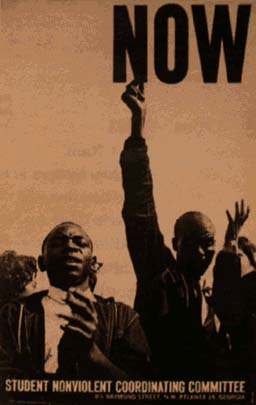
St. Francis Lutheran Church, Parish Hall
152 Church Street, San Francicso
across the street from Safeway (K, L, M, J, N, F, 94K, 94M, 94N)
6:30 PM Food and Drink; 7 PM to 8:30 PM Program
RSVP greatly appreciated but not essential
Call 415-703-0465 or email mke4think@hotmail.com
--- --
June Jordan School for Equity is also celebrating their accomplishments this evening at their campus in the Excelsior district of SF - check out the SF Weekly article on June Jordan and the small schools movement in SF by Ryan Blitstein's great article A Study in Size.
As SF Teachers have ratified their tentative contract [I and the rest of the Board of Education are likely to vote in favor of the settlement as well on May 9] and Oakland teachers struggle over their tentative agreement, SF Schools blog is highlighting - Thank a Teacher Today Campaign:
Parents For Public Schools has joined the San Francisco Education Fund, DonorsChoose, and others to promote the Thank a Teacher Today Campaign during the month of May 2006. The campaign encourages everyone in San Francisco to take a moment during the month and throughout the year to personally thank teachers and let them know that we recognize and appreciate their dedication and hard work on behalf of our City¡¦s young people.And as the anniversary of the historic Brown vs. Board of Education Supreme Court decision approaches - grassroots student, teacher and community groups are continuing their campaigns for educational justice - Please support Oakland's AYPAL, Youth Together and others -
Frustrated Oakland students, community members, concerned parents, teachers and the public demand equal resources for the Oakland Public Schools. Hundreds of Complaint forms have been collected and will be submitted to the School District to demand concrete changes in the Public Schools in Oakland. Our schools are in a State of Emergency with inadequate resources, dilapidated facilities, unqualified teachers that are the root causes of many issues in Oakland. Settlement provides up to $1 billion for the lowest-performing schools base Academic Performance Index (API) deciles 1-3, which 62 Oakland public Schools are eligible to get these funds.
When: Wednesday, May 17, 2006 (anniversary of Brown vs. Board of Education)
Where: Lincoln Rec. Center is 250 10th Street @Harrison in Oakland Chinatown
Time: 4:15-5-30pm
AYPAL's Campaign Demands:
• Fully Funded Schools
• Equitable Resources across School Sites
• Full compliance with the William's Case Settlement
For more Info on AYPAL/Youth Together and the Williams VS. California case [filed 2000, settled 2004]---
Next week - UC Berkeley friends from Ethnic Studies and CJWP and the
Enviromental Justice Movement are sponsoring this great dialogue that links many different struggles - Frontlines and Fence Lines... Linking Black Panthers, Zapatismo Environmental Justice and Sustainability
May 9, 2006
6:00-8:30 pm
Room 126 Barrows Hall
UC Berkeley (N of Bancroft bet. Telegraph and Bowditch)
What contributions can the Black Panthers, Zapatismo, racial justice and
indigenous movements have for movements towards environmental justice
and sustainability? Ashanti Alston, a former Black Panther Party member and member of the Black Liberation Army, shares his stories and lessons learned from years of working in the BPP and BLA and also from several recent trips to zapatista territory, for movement building.

Sunday, April 30, 2006
May 1st immigrant rights actions; Blogging from Arizona; resisting the exit exams
Photo from the film Walkout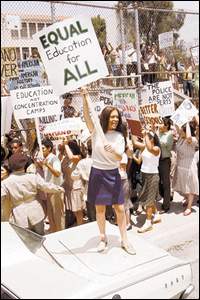
On the eve of the historic May 1st actions for immigrant and workers' rights here and all over the US I am blogging from Phoenix/Tempe Arizona area - the hotbed of Minutemen Project/Sen. Jon Kyl/Prop 200 & 203 [anti-immigrant/anti-bilingual education groups]. More on May 1st Actions in your area.
I am here with educators, school board members and activists from California, Arizona, Texas and New Mexico to support Latino student achievement and learning. Some of us have been inspired by the walkout/'blowout' activism of youth in many of our school districts, but the discussion on these matters has been mostly in the hallways, but not in the official Arizona, California or Texas state school board association led workshops and plenary sessions.
There has been no discussion too of the racist/anti-immigrant Prop 203 [2000 - multimillionaire Ron Unz's AZ version of his 1998 Prop 227 in CA] and Prop 200 [2004 - the son of CA's 1994 Prop 187] or of the general assault on bilingual education and immigrant communities in the education system. As usual there's no talk or consciousness of the historic 1920's Phoenix/Tempe educational justice case Romo v. Laird or the 1969 Chicanos Por La Causa-led boycott of schools and fight to change the school system. For background - see the MALDEF analysis of school desegregation - Black, White and Brown.
But local immigrant rights and social justice groups here are planning for more large demonstrations targeting their elected officials for May Day. Though some principals and school districts are cracking down on students' rights to protest and raise their voices, many young people have been encouraged by the local and nationwide upsurge in activism.
Like California, Idaho and Utah - Arizona is imposing their AIMS high school exit exam this year and high school students must pass the test in order to receive a diploma. 27 states now impose this form of high states testing. Local student and parent groups here say that the exam has 'pushed out' many low income, Latino, African American and special education students - and the schools systems, especially in the rural Native American and Latino areas and in the urban centers are still largely segregated and unequal to the schools in the suburbs and predominantly 'Anglo' neighborhoods.
The student and parent resistance to the CA High School Exit Exam continues - see previous posts; and the 2 lawsuits from Californians for Justice/Public Advocates and Morrison and Forster proceed as well. SF's the Beat Within published this insightful student perspective from Perry Jones on the issue -
'Going Dumb' -- Why Young People Exit School En Route to the Exit Exam
-->
On the eve of the historic May 1st actions for immigrant and workers' rights here and all over the US I am blogging from Phoenix/Tempe Arizona area - the hotbed of Minutemen Project/Sen. Jon Kyl/Prop 200 & 203 [anti-immigrant/anti-bilingual education groups]. More on May 1st Actions in your area.
I am here with educators, school board members and activists from California, Arizona, Texas and New Mexico to support Latino student achievement and learning. Some of us have been inspired by the walkout/'blowout' activism of youth in many of our school districts, but the discussion on these matters has been mostly in the hallways, but not in the official Arizona, California or Texas state school board association led workshops and plenary sessions.
There has been no discussion too of the racist/anti-immigrant Prop 203 [2000 - multimillionaire Ron Unz's AZ version of his 1998 Prop 227 in CA] and Prop 200 [2004 - the son of CA's 1994 Prop 187] or of the general assault on bilingual education and immigrant communities in the education system. As usual there's no talk or consciousness of the historic 1920's Phoenix/Tempe educational justice case Romo v. Laird or the 1969 Chicanos Por La Causa-led boycott of schools and fight to change the school system. For background - see the MALDEF analysis of school desegregation - Black, White and Brown.
But local immigrant rights and social justice groups here are planning for more large demonstrations targeting their elected officials for May Day. Though some principals and school districts are cracking down on students' rights to protest and raise their voices, many young people have been encouraged by the local and nationwide upsurge in activism.
Like California, Idaho and Utah - Arizona is imposing their AIMS high school exit exam this year and high school students must pass the test in order to receive a diploma. 27 states now impose this form of high states testing. Local student and parent groups here say that the exam has 'pushed out' many low income, Latino, African American and special education students - and the schools systems, especially in the rural Native American and Latino areas and in the urban centers are still largely segregated and unequal to the schools in the suburbs and predominantly 'Anglo' neighborhoods.
The student and parent resistance to the CA High School Exit Exam continues - see previous posts; and the 2 lawsuits from Californians for Justice/Public Advocates and Morrison and Forster proceed as well. SF's the Beat Within published this insightful student perspective from Perry Jones on the issue -
'Going Dumb' -- Why Young People Exit School En Route to the Exit Exam
-->
The week after the test, a memo was sent out to each class informing us that a
high percentage of students across California had scored low on the test, so the exit exam would be put on hold until further notice. But now the exit exam is back, standing between my cousin and his education. I still see the test, and his reaction to it, as evidence that the school system has failed my little cousin and his generation of students. With little hope of receiving a high school diploma or anything else to show for all the effort they put into their education, it's not surprising that some students give up and just "go dumb."
Friday, April 21, 2006
Real critiques of NCLB; CA State Board of Education screws English learners [again]
Graphics from Rethinking Schools
 Shari L's An Old Soul blog provides an excellent response to latest critiques of the NCLB:
***********
Despite strong advocacy from immigrant communities, bilingual education advocates and civil rights groups, the California State Board of Education has done it again - screwing English learners and immigrant students throughout the state. See Duane Campbell's Choosing Democracy Blog.
In its decision yesterday to adopt mainstream criteria for materials for Reading/Language Arts/English Language Development, the state board of education missed an historic opportunity to demonstrate true and visionary leadership by amending and adopting criteria for new reading textbooks to address low test scores and narrow the achievement gap for English learners.
Shari L's An Old Soul blog provides an excellent response to latest critiques of the NCLB:On NCLB: AP outraged in all the wrong placesSee also: An Old Soul or NCLB =Contractors profit and AP sets it up for Spellings to come in and save the day ; Angela Valenzuela's Eductional Equity Blog from Texas ; For general progressive critiques of NCLB see Rethinking Schools ; Harold Berlak's Manual on NCLB & High Stakes Testing; or Kathy Emery's Education and Democracy website.
AP sure knows how to tap into NCLB outrage alright but it's outrage in all the wrong places. I think this is a seriously covert article pushing an agenda, and, hint, it's not the progressive one, folks. If you don't question their premise, boy, it's easy to fall for their propaganda. And, look, even Alternet takes the bait, hook, line and sinker.
***********
Despite strong advocacy from immigrant communities, bilingual education advocates and civil rights groups, the California State Board of Education has done it again - screwing English learners and immigrant students throughout the state. See Duane Campbell's Choosing Democracy Blog.
In its decision yesterday to adopt mainstream criteria for materials for Reading/Language Arts/English Language Development, the state board of education missed an historic opportunity to demonstrate true and visionary leadership by amending and adopting criteria for new reading textbooks to address low test scores and narrow the achievement gap for English learners.
Critics of the current options for schools - including Assemblywomen Judy Chu, D-Monterey Park, and Jackie Goldberg, D-Los Angeles - wanted the board to also let schools use textbooks they said would help non-English speakers with vocabulary while learning basic subject matter.The new textbooks could have provided California’s 1.6 million English learners with much better materials to prepare them for the rigorous tests of Reading/Language Arts and English proficiency.
Shelly Spiegel-Coleman, project manager for multilingual curriculum at the LA County Office of Education, said her group and others who favored change were shut out of talks."The curriculum that's going to be sustained for the next eight years ... will have the same lessons, same text, same teachers guide, no matter who sits in front of the teacher," she said.
Thursday, April 20, 2006
Students, Parents and Californians for Justice challenge High School Exit Exam - 2nd lawsuit filed
 Students and parents throughout the state of California are continuing their resistance to the race and class biased California High School Exit Exam or 'CAHSEE' which is being implemented for this year's graduating seniors. The statewide racial justice group Californians for Justice and their lawyers - Public Advocates - in a lawsuit filed yesterday allege that the state Board of Education and Supt. of Public Instruction Jack O'Connell reviewed exam alternatives too late for lawmakers to consider or implement them. The LA Times reported today:
A grass-roots advocacy group sued the state in Alameda County Superior Court this week, seeking more time for the Legislature to review alternatives to the high school exit exam. If successful, thousands of public high school students in the class of 2006 who have failed the test would receive their diplomas.Also, parents and students in Richmond, CA and other West Contra Costa County Unified School District neighborhoods spoke out last week against the CAHSEE as well. Though their school board resolution that would have attempted to grant diplomas to high school students who met reasonable graduation requirements but had not passed the CAHSEE failed by a 4:1 vote, they are vowing to continue their efforts for equity for their communities. See Tiny's report in Poor News -
...It is the second exit exam-related lawsuit filed this year. Ten high school students and their parents sued in February to stop the exam, alleging the state did not adequately prepare all students for the test or find alternatives.
"California officials have had five years to develop workable alternatives, but they didn't even start looking until December," Public Advocates managing attorney John T. Affeldt said.
"This suit is to ensure that 48,000 high school students won't have to pay the consequences for the superintendent and state Board of Education's delay" in considering alternatives, he said.
Si Se Puede! (Yes we CAN!) - Caramel, honey, white and dark chocolate arms and multi-lingual voices rose in unison as they marched down the rain-slicked streets of Richmond and San Pablo toward a school board meeting deciding on a landmark challenge to the California High School Exit Exam (CAHSEE).
On Monday April 10th, the West Contra Costa Unified School District (WCCUSD) voted no on a proposal brought forth by school board member Dave Brown which would have acted as an alternative to the California High School Exit Exam (CAHSEE). The proposal included granting high school diplomas to students in the district who successfully completed all of their high school requirements as well as a Senior Year Demonstration even if they did not pass the much-maligned California High School Exit Examination (CAHSEE).

 Besides the materials on the Californians for Justice and Public Advocates websites -
also check out the analysis by Los Angeles' Coalition for Educational Justice, another grassroots organization that has been organizing a movement of parents, teachers and students for educational justice and equity.
Subscribe to:
Posts (Atom)

