Wednesday, April 18, 2007

Asian American Community Responds to Virginia Tech Massacre & Media Hysteria

San Francisco Chronicle reporter Vanessa Hua today noted the anti-immigrant and anti-Asian backlash beginning in the aftermath of the Virginia Tech massacre :

The Asian American Journalists Association, headquartered in San Francisco, questioned stories and online comments posted Tuesday morning that highlighted Cho's race and immigration status because that emphasis suggested those factors played a role in the shootings.

In fact, Cho was like many school shooters -- about three-quarters of whom have been white boys and young men, according to a 2000 report from the U.S. Secret Service. Cho appeared to feel marginalized and angry, according to criminologists and psychologists such as Louis B. Schlesinger, a professor at John Jay College of Criminal Justice in New York...

Some of the people posting to blogs and chat rooms online Tuesday blamed Cho's actions on his "foreign" status. Others dismissed such arguments as preposterous and asserted that the massacre resulted from easy access to guns, violence in the media or the popularity of violent video games. Still others theorized he was a member of al Qaeda, carrying out a terrorist attack. He was an English-as-a-second- language student depressed about finals, according to another theory.
Longtime LA Times reporter K. Connie Kang also reported on Los Angeles' Korean American community's reaction to the massacre:
The disclosure today that the gunman suspected of carrying out the Virginia Tech massacre was a South Korean national made the killings all the more shocking and painful for Los Angeles' huge Korean American community.
"My heart sank when I heard the news," the Rev. John J. Park, president of the Council of Korean Churches in Southern California, said at a hurriedly called meeting of community leaders in Koreatown.
Park was joined by about a dozen community leaders this morning to express their condolences to families of the victims and to discuss what the Korean community should do in response. Many feared the killings would reflect poorly on the community. They also expressed a sense of shame and responsibility because of their shared ethnicity....
The community leaders said they hoped that the incident will not trigger a backlash against Korean American students.
The leaders noted that the suspect, Cho Seung-Hui, a 23-year-old English major, arrived in the United States as boy. They said that, from a cultural perspective, many Koreans might be reluctant to seek out mental health counseling. They urged Korean Americans to be vigilant about seeking counseling services if they or family members need help.
During the hourlong session, community leaders prayed for the families of victims, for healing of the wounded and for the Virginia Tech community. Community leaders also announced a 4 p.m. candlelight vigil and service today...in Koreatown.
Also, an immigrant advocacy group, the National Korean American Service & Education Consortium, released a statement saying it joined "all Americans in mourning the lives lost as a result of the school shooting that took place yesterday."
The group, with affiliates in Los Angeles and Flushing, N.Y., added, "This unspeakable tragedy hurts all of us. As a community, Korean Americans will come together to provide the support and resources needed for the students, their families, the faculty and the staff at Virginia Tech to overcome the grief and pain that overwhelms them all at this moment."

Tuesday, April 17, 2007

NAKASEC, Korean American Coalition and JACL support Victims of Virginia Tech Massacre

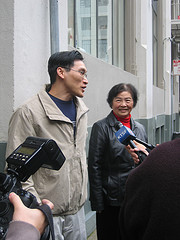
Photo: Eun Sook Lee of NAKASEC
Korean American national civil rights groups like NAKASEC to local groups from LA to Atlanta have issued their statements regarding the Virginia Tech massacre. And, HapiHour's Keith Kamisugi reports that the Korean American Coalition, the Mirae Foundation and the Southern California Korean College Student Association have created a “Virginia Tech Memorial Fund” to support those affected by the recent tragedy at Virginia Tech.
View the complete post at the HapiHour Blog. See also the Korean American Coalition of DC.
-----------
Patty Wada of the National JACL [Japanese American Citizens League] forwarded their response to the Virginia Tech tragedy as well - The JACL Mourns Virginia Tech Tragedy
Washington D.C. The Japanese American Citizens League (JACL) is shocked by the meaningless loss of human life in the killing of over 30 students and faculty at Virginia Tech. The JACL joins the rest of the Nation to express condolences to the families of those who perished in this tragedy and wish for a speedy recovery of those who were injured.
In this tragedy, the JACL also cautioned against reprisals against students, faculty, and others who are of Asian ancestry. While it has been confirmed that the gunman was Asian, there is no evidence that race or ethnicity of the suspected gunman had anything to do with the incident. The JACL emphasizes that this tragedy must be seen as the act of an individual and not that of an ethnic community.
JACL National Director, Floyd Mori stated, “The Asian American community is stunned and outraged that such a horrible incident could occur anywhere, especially in the peaceful atmosphere of an academic institution. We grieve with the families and friends of those who have died, yet we caution against stigmatizing an entire ethnic community. The Asian American community understands well the negative impact of such ethnic stigmatizing, and we hope that authorities will assure the future safety of all students and faculty there at Virginia Tech.”

Will Virginia Tech 'College Columbine' Massacre Lead to Anti-Asian, Anti-Immigrant Backlash?

The 10,000 School Board Members meeting here in San Francisco for our National School Boards Association or NSBA conference are observing moments of silence and reflection on the horrifying Virginia Tech massacre yesterday morning. But many Asian Americans around the country are already bracing for a potential anti-immigrant or anti-Asian backlash.
The Associated Press reported this morning: "A Virginia Tech senior from South Korea killed at least 30 people locked inside a school building in the deadliest shooting rampage in modern U.S. history, the university and police told a news conference Tuesday... Officers identified the classroom shooter as Cho Seung-Hui, 23, a senior from South Korea who was in the English department at Virginia Tech and lived in a different dorm on campus. Cho committed suicide after the attacks, and there was no indication Tuesday of any motive. “He was a loner, and we’re having difficulty finding information about him,” school spokesman Larry Hincker said."
The 'beware of young Asian male" hysteria is already spreading - see Radical Hapa's recent post - VTU Shooting: Targetting the Asian. Jenn's Excellent Reappropriate Blog gives more of the anti-Asian backlash and info on the killer - a 23-year-old South Korean born permanent resident of the United States since 1992 when he immigrated as an eight-year-old.
Numerous websites and blogs are calling the shooter everything from "foreign looking" to "nerdy Asian guy" to even more racist desciptions.

Although many Asian Americans share the horror of the killings and many of us will be working to help the families of those who were injured or killed, we also have to be supportive of Korean and Korean-American communities. In addition, we should also be supportive of the immigrant communities around the Virginia Tech campus and the region to ensure that our communities and all immigrant communities, in particular, are not blamed for the actions of one person.
Keith Kamisugi of the Equal Justice Society says that we have to monitor the mainstream media closely -
The Asian American Journalists Association yesterday issued a press release urging media covering the tragedy to “avoid using racial identifiers unless there is a compelling or germane reason.”“There is no evidence at this early point that the race or ethnicity of the suspected gunman has anything to do with the incident, and to include such mention serves only to unfairly portray an entire people. The effect of mentioning race can be powerfully harmful. It can subject people to unfair treatment based simply on skin color and heritage,” said the release....AAJA reminded members of the media that the standards of news reporting should be universal and applied equally no matter the platform or medium, including blogs.
AAJA is already taking tremendous criticism nationwide for their efforts to ensure responsible journalism.
It seems to me that the recent killings at Virginia Tech and the upcoming 8th anniversary of the Columbine High School massacre on April 20th both serve as a wake up call to end our culture of violence or what Michael Moore and other media watchers call our 'American Gun Culture' and the growing alienation of many young people in our schools and colleges. Hopefully, after the families have been comforted and supported and we have taken a step back from the media hysteria, we can get back to our work supporting our public schools, including more school counselors, mental health services and social workers, and reinvesting in our communities so that we can prevent any future Columbine or VTech Massacres.

Monday, April 16, 2007

SF Bay Area STUDENTS FAST FOR A LIVING WAGE!

Students at Stanford University, 30 miles south of San Francisco, have been fasting since Friday the 13th to support an organizing campaign for stronger living wage policies for workers at their elite campus. Led by the Stanford Labor Action Coalition, students are demanding a Real Living Wage for Stanford workers!
To help, you can sign SLAC's petition endorsing a real living wage policy! or come out to the actions this week.
Students were joined today by Maribel Garcia and Ernesto Garcia, janitors subcontracted through ABM, and two alumni: Sofia Lee and Max Garcia. They also held a BBQ, rally and march at Stanford's Community Day, a big publicity day for the campus.

But the students and workers called theirs "CommUNITY Day: United for a Real Living Wage" and drew a couple hundred workers, students, alumni, and faculty. The rally featured solidarity statements and speeches by new and ongoing fasters. The fasters have moved their fast encampment now to the main quad, right outside Standord President John Hennessy's office. Today's actions secured a meeting with President Hennessy on Monday, April 16th, at 5:00pm with a delegation of six students. Join SLAC for actions this week.
Stanford students have organized for years to build stronger labor/community alliances.
SLAC was founded in 1998 during a student labor conference put on by MEChA (Movimiento Estudiantil Chicano de Aztlán) and SEAS (Students for Environmental justice At Stanford). While we have taken on a variety of campaigns and organized with various groups of campus workers, our long-term project is to ensure that Stanford fulfills the ethical responsibilities laid out in the University charter by adopting just, transparent and accountable employment mechanisms and policies. As described in our Mission Statement (below), this campaign is part of a larger committment to effecting broad social change and challenging all forms and structures of injustice and oppression.
According to the Stanford Daily, the Coalition more recently has been initiated by the Stanford Asian American Activism Committee (SAAAC). Co-organizer Mark Liu has helped build solidarity among students for workers struggles and to pressure their campus adminstration on economic justice issues:

“Students in the past have fought against discrimination and for voting rights,” he claimed. “On this campus, they have fought for ethnic studies and for workers’ rights. Now, it’s become an international movement.”

Thursday, April 12, 2007

NCLB and Monopoly - who's left behind and why?

Thanks to Mike Klonsky's Small Talk blog for keeping us updated on the 'Ownership Society' and corporate agenda in public education and the challenges for Small School organzing and advocacy around the country.
Recently, I have been thinking about the all-American game Monopoly after seeing the recent Sopranos episode [one of the best ever] where the mobsters and their wives compete in a Monopoly game which ends in alcohol-induced mayhem. But Klonsky's blog touches on Monopoly's relationship to Capitalism and the ownership society by highlighting Florida teacher/libranian Richard Morrill's excellent EdWeek piece:

Monopoly, a game and a metaphor for the Ownership Society

Richard Morrill, a librarian and teacher from Sumterville, Florida has a great commentary in the latest Edweek, "Monopoly and No Child Left Behind." He uses a game of monopoly as a real and metaphorical lesson about the Ownership Society. Morrill, who spent 10 years in social-democratic Denmark, gives his perspective on the differnce in attitudes between Danes and Americans, towards the concepts of equality and freedom and the way each country looks after its less fortunate citizens.

Americans say that no child should be left behind, and they seem to think that education is the key to ensuring that children are not left behind. There seems to be little understanding, though, that the schools alone cannot equalize opportunity for children who come from homes and neighborhoods with very different socioeconomic characteristics, nor that schools may, unintentionally, but by their very nature, widen the gap between more-advantaged and less-advantaged children.

Read Morrill's excellent piece.

Wednesday, April 11, 2007

Judge Allows Use of Race in Berkeley's School Desegregation Plan, Chicano Activist/Scholar Carlos Munoz to Keynote Urban School Boards Meeting in SF

As the US Supreme Court is poised to possibly strike down the use of race in school desegregation plans in the next couple of months, a SF Bay Area Superior Court Judge ruled yesterday that Berkeley Unified School District can use race in its voluntary school desegregtion plan. Bob Egelko from the SF Chronicle reported this morning:

The 9,000-student Berkeley Unified School District has taken measures since 1968 to promote racial balance between schools in the largely minority flatlands and the mostly white hillside and UC Berkeley neighborhoods.
Its current plan, adopted in 2004, gives each neighborhood of four to eight blocks a diversity rating, based on parents' income and educational levels and the students' racial composition. The district uses that rating to promote balance at the city's 11 elementary schools and in special academic programs at Berkeley High School.
In her ruling, Smith said the enrollment system does not violate Prop. 209's ban on racial preferences because the district considers race only indirectly, as a factor in a neighborhood's diversity rating, and does not determine individual student placements.
"The district simply takes racial diversity into account, along with other diversity indicators, as a means of achieving its goals of integration of its schools,'' the judge said."
More

Chicano Social Justice Movement Activist/Scholar Carlos Munoz Keynotes the urban school boards national conference in San Francisco 4/13

One of my mentors, Civil Rights, Peace and Social Justice Leader Dr. Carlos Munoz, is giving the keynote at our Council of Urban Boards of Education - CUBE - conference this Friday the 13th at 9am at the Hilton Hotel in San Francisco's Union Square area. As a young educational justice organizer and activist Carlos helped lead the 1968 East Los Angeles youth movements and 'blowouts' dramatized in last year's HBO film Walkout. Here are Munoz' May 20, 2006 remarks to the Chicano/Latino Graduation Ceremony at UC Berkeley last year in the midst of the largest US social justice protests in generations from March-May 2006 for immigrant rights and dignity - texasedequity.blogspot.com/2006/05/dr-carlos-munoz-jr-uc-berkeley.html.

I want to share my Vision for an authentic Multiracial Democracy that I have kept in mind throughout my life of struggle and activism. It is my graduation gift to you to keep in mind as you develop into our nation's leaders.

My vision is that Americans of all colors, religions, sexual preferences, men and women will give birth to an authentic Multiracial Democracy. A Democracy that will promote a true racial and ethnic diversity and equality in everyday life. A Democracy that honors its immigrant legacies and values as equal all immigrant workers whether they are documented or undocumented.

A Democracy that will promote social justice, religious tolerance, non-violence, and peace at home and abroad. A Democracy with a government that will include a representative of every diverse group at the table of political power on behalf of the people, not the military-prison-corporate complex.

A Democracy with a national political multiparty electoral system where candidates for election include the poor and working class, not just those who are rich or middle class. With an electoral system where every vote will in fact be counted. No more Florida's, no more Ohio's, no more Bushes. A Democracy where human needs are prioritized and not the needs of the rich and the corporations. Where health care and education are defined as Human Rights.

A Democracy that prioritizes youth as the most important Investment for the future of our nation and builds more schools instead of prisons.

THIS VISION WILL TAKE A LONG TIME TO MAKE COME TRUE. But What I have learned in my lifetime is that struggle is life and life is struggle. But most importantly, that victory is in the struggle!Congratulations to each and every one of you. Love, Peace, and Justice to you all!

More on Carlos Munoz -
Dr. Carlos Muñoz, Jr. was born in the “segundo barrio” in El Paso , Texas , and raised in the barrios of East Los Angeles , California . He is the son of poor working class Mexican immigrants. He earned his AA from Los Angeles City Community College , his BA with honors in Political Science from California State University at Los Angeles and his Ph.D. in Government from the Claremont Graduate School . He is Professor Emeritus in the Department of Ethnic Studies, University of California , Berkeley . After 37 years of teaching in higher education, he has gained international prominence as political scientist, historian, journalist, and public intellectual.

Dr. Muñoz was the founding chair of the first Chicano Studies department in the nation in 1968 at the California State University at Los Angeles and the founding chair of the National Association of Chicana & Chicano Studies (NACCS). He is a pioneer in the creation of undergraduate and graduate curricula in the disciplines of Ethnic Studies. He is the author of numerous pioneering works on the Mexican American political experience and on African American and Latino political coalitions. His book, Youth, Identity, Power: The Chicano Movement won the Gustavus Myers Book Award for “outstanding scholarship in the study of human rights in the Untied States”. The book is in its 12th printing and was a major resource for the PBS television series “Chicano! History of the Mexican American Civil Rights Movement“. Dr. Muñoz was the senior consultant for the project and was also featured in the series.
Dr. Muñoz is an acknowledged expert on the issues of ethnic and racial politics, multiculturalism and diversity, immigration, civil and human rights, and affirmative action.
As a scholar-activist, Dr. Muñoz has been a central figure in the struggles for civil and human rights, social justice, and peace in the United States and abroad since he was a student activist in the 1960s. He played a prominent leadership role as a founder of the Chicano Civil Rights Movement. Since then he has served as a leading organizer of various multiracial coalitions, including the Faculty for Human Rights in Central America , Faculty Against Apartheid in South Africa , and The Rainbow Coalition. In 1988, he was a key advisor to the Jesse Jackson presidential campaign. He served on the Board of Directors of the American Civil Liberties Union of Northern California and is a co-founder of the Institute for Multiracial Justice in San Francisco , California . He also co-founded Latinos Unidos, a grassroots community organization in Berkeley , California . Dr. Muñoz is a Vietnam Era Veteran and a member of the Veterans for Peace and is active in the Counter-Military Recruitment in the Public Schools Movement as well as in the larger Anti-Iraq War Movement.

Monday, April 09, 2007

Oakland's Coalition of Essential Schools Goes Beyond NCLB's high-stakes-tests - Showcases Alternative Assessments; Happy 4th Birthday June Jordan

At the local level here in the San Francisco- Oakland Bay Area, CES is working with our district to hopefully begin a new Bayview Essential School of Music, Art and Social Justice in the Fall. But on a national level they are promoting an innovative campaign to showcase models of alternative assessments which challenge the NCLB-promoted high-stakes-tests and to hopefully impact policy at the national and state levels.

The Second Annual National Exhibition Month (May, 2007) highlights exhibitions as a preferred form of student assessment and features over 100 public schools in 25 states that will open their doors to the public to showcase student exhibitions.

According to Lewis Cohen, Executive Director of CES, ... exhibitions are presentations that students make in front of outside “experts” to demonstrate what they know and what they have learned. “We are inviting community members and policy makers to witness the deep learning and engagement that this type of assessment requires,” Cohen said.

While standardized tests may show a “slice” of what students have learned, exhibitions offer up the whole pie, providing a 360º look at what students know and what they can do with that knowledge. Unlike machine-graded assessments that test textbook memorization, exhibitions require students to develop and use a wide range of analytical and communication skills.

[see CES' youtube clip -


“You can't get a driver’s license without a road test. Exhibitions, like road tests, demonstrate that the student knows how to put knowledge into practice. This is a better way of certifying competence than a written test alone,” said Marcy Raymond, principal of Metro High School in Columbus , Ohio . “And it is no wonder that students who are required to demonstrate what they've learned are better prepared for college and the professional world, where the ability to synthesize information, think critically and present publicly are paramount.”

More info on CES and their Exhibition Month: http://www.essentialschools.orgl

One San Francisco High School that has developed excellent alternative portfolio assessments is June Jordan High School for Equity. I am proud to say that one of my nieces will be graduating in the first JJSE graduating class. She has been accepted to the University of California, Davis [my alma mater!] and will likely be attending there in the Fall.

SF School Board President Mark Sanchez and I will be honoring June Jordan students, parents and founders Kate Goka, Shane Safir and Matt Alexander at the school's 4th Anniversary Celebration on May 3rd.

Friday, April 06, 2007

Parents, Teachers, School Board Members Challenge NCLB in San Francisco 4/14

4/14 Saturday - 9:30am - San Francisco - Voice your concerns about NCLB!
As thousands of school board members [like me] from all over the country will be meeting in the Annual NSBA [National School Boards Association] conference, hundreds of parents, teachers and community folks [like me] will be picketing outside the Moscone Convention Center to bring attention to the disaster called - NCLB No Child Left Behind [aka No Child Left Untested].
Saturday, April 14th, 2007, 9:30am – 11am
Gather outside the Moscone Center in San Francisco (747 Howard St., SF, between 3rd and 4th ~ at the Lobby Entrance).
We will join teachers, parents, administrators, school board members and students from Fresno, Oakland, San Francisco and elsewhere who will be voicing their concerns over the harmful impact NCLB is having on education, our schools and our future.
Besides our local Teachers for Social Justice and SF Freedom School activists, other organizers include - EPATA - Parents Against Testing Abuse and the Eliminate NCLB Task Force and the Assessment Reform Network Central Valley. Info - email - EliminateNCLB@aol.com
For more info on how to raise your voices against the harms of NCLB join the 29,000 others in protesting NCLB at the Educator Roundtable website.

Muslim High School Student in Davis Suspended for Malcolm X assignment; Remembering Thong Huynh of Davis High and Vincent Chin of Detroit

Photo - RIP - Davis High School Student Thong Huynh May 4, 1983
24 years ago I became an activist not long after a racial violence incident at Davis High School involving the May 4th stabbing death of Thong Huynh, a 17-year old Davis High School student, by another student James Pierman and a group of his colleagues who had racially taunted Huynh for weeks.
I worked with Civil Rights activists Angela Oh, Pattie Fong, Bob Matsueda, Grace Kim, the late Prof. George Kagiwada and others to build a group called Davis Asians for Racial Equality or DARE at the time. The City of Davis now commemorates Huyhn's life with a memorial award. In Northern California, the Huynh case was our local racial violence 'wake up call' on the same level as the Vincent Chin killing was in Detroit and the midwest from 1982-87. Chin was killed June 19, 1982 by Ronald Ebens and Michael Nitz, both unemployed autoworkers who beat him to death with a baseball bat in front of a McDonalds. Neither spent a day in jail and both were given $3000 fines and 3 years probation after they pled guilty to manslaughter in the killing. At the time I worked with other KPFA reporters to interview Huynh's family and activists from Northern California. I always teach about the Vincent Chin and Huynh cases because of their importance to Asian American history and social movements history as well.
Davis city reached SF news headlines again a few years ago after 911 when more hate crimes and racist incidents started growing.
In February, Davis High School students spray-painted the n-word word in large red letters on a sidewalk near the home of an African American couple, two professionals who had moved to Davis three months before to raise their children.

That's why I wasn't that surprised when I read Davis Vanguard's blog today about a reported incident several weeks ago involving a American-born Muslim Davis High School student suspended for 3 days for incidents surrounding his turning in a school assignment on Malcolm X. For the full story see davisvanguard.blogspot.com

Disturbing Incident involving Davis High School - A few weeks ago, a Davis High School student, a 4.0 honors student heavily involved in student government and community causes, turned in a poster for one of his classes on Malcom X. On the poster appeared the phrase, "by any means necessary" along with other phrases from one of Malcom X's most famous speeches. ...The next day, the student came back and found that the poster had been taken down and in front of the class was told that this was a "terrorist" message. A few weeks later, this same student was asked to give a speech in front of the school during Human Relations Week about a civil rights incident that he had experienced. He was given a choice and decided to do it on this specific incident. He then gave them an advanced copy of the speech which they approved. He was told that he could not specifically mention the teacher and he agreed to this.
He then delivered the speech, he did not mention the teacher's name. Apparently the teacher however walked out during the speech, he and his parents were called in by the Vice-Principal.
There were several different meetings between the father and the school, but suddenly unbeknownst to the family, the student was informed that he was suspended for three days. ...
Meanwhile now the student's academic career is in jeopardy because of this suspension. The UC's apparently have a provision that any student suspended for three days or more is ineligible for enrollment....
To me on the surface this seems to have been handled very poorly. The Malcom X quote was clearly not intended to be a "terrorist" message. The teacher clearly overreacted there. I mention this since the terrorist issue arose, that this student is an American-born Muslim. Apparently the ACLU has been contacted, CAIR is involved, and many of the student's peers are outraged.
The three day suspension is a very harsh penalty given the facts involved. Now did he break his word? I do not know. But that seems an extreme punishment for a student involved in an academic exercise who is not dealing drugs or starting fights.---Doug Paul Davis reporting
More
The Blog is an alternative to the daily Davis Enterprise. More - http://media.www.californiaaggie.com/media/storage/paper981/news/2007/01/24/CityNews/Davis.Resident.Utilizes.Blog.To.Broadcast.An.Alternative.Voice-2671239.shtml

Tuesday, April 03, 2007

California Faculty Union Victory! Settlement Reached 21% salary increase over 4 years

Our SF State President Robert Corrigan just announced that our union has won a tremendous victory in settling our contract without having to strike. Our union, the CA Faculty Association's announcement is less definitive -
"CFA and CSU reach deal in principle on contract/Two-day rolling walkouts put on hold while deal is finalized/CFA and the CSU administration have reached a tentative contract agreement and the union’s Board of Directors has voted unanimously to postpone rolling walkouts pending finalized contract language.

Tentative agreements have been signed on the issues of salary, workload, grievances, parking and appointments which have been the most contentiously debated topics in this round of bargaining. The accord was reached using the recommendations of neutral fact finder Sylvia Skratek as framework for the deal.

“We have a tentative agreement that will be good for the CSU, good for our students, good for the faculty,” said CFA President John Travis. “Through this agreement faculty will make real progress toward closing the pay gap between us and our colleagues in other states.”

Should an unforeseen breakdown in these latest talks occur, faculty remain prepared to initiate job actions. The new contract will likely be sent out to the membership for final ratification in late April. Updates will be made to this page as the contract becomes final. "

Here's the info shared by SF State President Corrigan:

April 3, 2007 – The California State University (CSU) today announced it has reached a tentative agreement with the California Faculty Association that provides all CSU faculty with base pay increases of 20.7 percent over a four-year period, as well as step increases for those eligible, making the package worth 24.87 percent.

In addition to these increases, $28 million will be provided in the form of merit and equity increases that will provide raises for senior faculty who have reached the top of the pay scale, as well as boost junior faculty compensation. The CSU will seek an additional 1 percent increase for all employees’ compensation in state budget funds in each of the next three years.

The total pay package, which will cost the CSU more than $400 million over four years, breaks down as follows:
20.7 percent in guaranteed salary increases for all faculty in the form of General Salary Increases; 1 percent step increase (“Service Salary Increase”) in each year
of the contract; because these increases are only paid to approximately one-third of all faculty members each year, these individuals will receive an additional 2.65 percent boost to their salaries when eligible; $28 million set-aside to provide two new merit-based pay programs targeting both junior and senior faculty, and
An additional 1 percent in each of the last three years of the contract, contingent on receipt of additional state budget funds.
The CSU also accepted the fact finder’s recommendations to establish a salary structure committee to examine faculty compensation issues and to increase faculty parking fees commensurate with their General Salary Increases in each year of the agreement.
This tentative agreement must be ratified by the membership of the California Faculty Association. Then it will be submitted to the CSU Board of Trustees for approval. What a relief!
Bravo to our CFA bargaining team and to management's team as well for reaching this agreement and a new 4-year contract for our faculty throughout California!

Monday, April 02, 2007

Parents, Students and Communities Resist St. Louis Public Schools Takeover

St. Louis activist Jamala Rogers says communities are resisting what they call a 'hostile takeover' of their schools by the Missouri State Board of Education.

It came as no surprise that the state Board of Education voted to discredit and discount the wishes of thousands of students, parents, teachers and community leaders last week. The St. Louis Public Schools District was stripped of its accreditation and an overseer appointed. Advocates of public education have not conceded to defeat and, in fact, have vowed to intensify the fight to regain accreditation and their right to vote.
The St. Louis Public Schools students who conducted a 5-day “teach-in” at the mayor’s office won a significant demand. ...
Rick Sullivan, CEO at McBride and Sons, like the overseer given to us in the first “unofficial” takeover by the Department of Elementary and Secondary Education, has NO experience or credentials relative to public education. His job is to make available public coffers for private consumption. In addition to the $400 million budget, it also includes trying to steal the billion-dollar cookie jar - the teachers’ pension fund....
So, consider this a hostile takeover. That is language a corporate CEO understands.
The rest of us must gear up for the battle for public education, self-determination and voting rights and regain our schools by any means necessary.
More on St. Louis Schools - For background on takeovers of urban school districts over the past 10 years see Buffalo School Board President Florence Johnson's article School takeovers deserve a grade of 'F' from the National School Boards Association Magazine.

Across the Bay from us Oakland parents, students and communities have been resisting their takeover for years. See the Data Center's analysis of Oakland, Richmond and other California takeovers and the devastating, anti-democratic impact they have had on schools throughout the state. Organize Da Bay and the Malcolm X Grassroots Movement have been central in building community resistance to the takeover the Oakland Schools.

Friday, March 30, 2007

SF Cesar Chavez Day - Linking Human Rights Struggles Here and Abroad

In San Francisco Cesar Chavez day always starts with a community/labor breakfast and ends with a march, rally and community festival. Thanks to the United Educators of SF for their hospitality and the organizers like Eva Royale of the UFW [in photo above], Karl Kramer of the SF Living Wage Coaltion, and Frank Martin Del Campo of LCLAA and others for another great event.
One of our adminstrators, and former Cesar Chavez Elementary School Principal Pilar Mejia [see photo above] received a rousing standing ovation as she quoted Paulo Freire and asked attendees to support liberatory education and to teach for social justice.


The Coalition on Homelessness, SRO Family Collaborative, and others also linked Chavez and the UFW to the ongoing fight for dignity for the thousands of homeless families in San Francisco. The Chinese Progressive Association, CCDC, Home Away From Homelessness and others also supported the kids and families as they demanded that City Hall fund programs for homeless and near homeless children and families in the City.

Above is Peabody Elementary School parent Jenny Freidenbach who also happens to be the Director of the Coalition on Homelessness speaking out for dignity for homeless children, parents and families at the rally. She said housing rights for homeless people and everyone is a human right.

At Noon, some of my SF State students and Filipino community and anti-war groups also convened a People's Tribunal at the Philippines Consulate to call for an end to US Funding of the human rights abuses in the Philippines.

Donning a black judge's robe community leader Rachel Redondiez read off a number of human rights abuse charges against President Bush and the President of the Philippines. And one by one the crowd gave a guilty verdict. The SF action followed a 13-page verdict read before about 300 people inside a church in the Hague, Netherlands, on March 25 where the Permanent Peoples’ Tribunal (PPT) found both Philippine President Gloria M. Arroyo and U.S. President George W. Bush, Jr. and their respective governments as responsible for gross and systematic violations of human rights, economic plunder and transgression of the Filipino people’s sovereignty. The verdict, read at the conclusion of the five-day second session on the Philippines by François Houtart, Session President, described the extrajudicial killings, forced disappearances, massacres, torture and other atrocities allegedly committed by the Arroyo government as “crimes against humanity”.
Pictured in the photo below is Balboa High School teacher Art Concordia and his son at the San Francisco rally.

Thursday, March 29, 2007

California Faculty Union Preps for Strike - Sets April 9-13 for 6 campuses

As we prepare for the Cesar Chavez holiday and the last week before Spring Break at San Francisco State our student activists are still organizing and preparing for solidarity actions in the event of a possible strike. They are also planning actions to oppose the fee hikes and resist top-down decision-making by Chancellor Charlie Reed and the CSU Trustees. Our union leadership announced today that Cal State Los Angeles , CSU Sacramento , CSU San Marcos , CSU Dominguez Hills, CSU East Bay, and the California Maritime Academy Would be First Campuses Where Faculty Will Strike from April 9-13.
CFA Vice President Kim Geron of CSU East Bay and other leaders of our union will continue working towards a settlement. But if April 6 arrives and we still don't have a fair contract after 23 months of working towards it we will definitely be striking.

If there is no deal, our schedule for the first week of strikes will be:

Tuesday-Wednesday, April 10-11:
Cal State Los Angeles & California Maritime Academy

Wednesday-Thursday, April 11-12:
CSU Dominguez Hills ( Carson / Los Angeles County ), CSU East Bay ( Hayward ), CSU Sacramento & CSU San Marcos ( San Diego County )


Lillian Taiz, CFA Vice President and Professor of History at Cal State Los Angeles stated, “We believe it is in the best interests of everyone, including Chancellor Reed and his administration, to settle this contract. We have the necessary guidance from the fact finding report that we believe makes it possible to reach such a settlement.
“However, we have been disappointed before. We’ve been pushing this rock up the hill for two years. We are 10 feet from the top. We can’t stop now. The Chancellor made a promise; he’s got to live up to it.”
More info - http://www.calfac.org

20 San Francisco Schools with low income kids receive federal academic achievement awards; SF Muralist Josef Norris/Kid Serve's newest school mural


Bravo to 20 of our San Francisco public schools that have been named as recipients of the federal Title I Academic Achievement Award for the year 2006-07! My daughter's school which is over 75% low income [free or reduced lunch eligible] families and mostly English learners is one of the awardees.

Each award-winning school qualifies for Title I funding, a federally-funded program designed to improve the academic achievement of socioeconomically disadvantaged students. There are nearly 6,000 Title I schools in California.

The criteria to qualify for the award have become more rigorous each year. Title I schools must demonstrate the achievement level of twice the schoolwide Academic Performance Index (API) growth target and twice the API growth target for the socioeconomically disadvantaged subgroup for two consecutive years. Schools also must have made Adequately Yearly Progress for two years in a row, and at least 40 percent of the enrolled students in each school must meet the
poverty index.

SFUSD schools receiving the award for 2006-07 are:
Frank McCoppin Elementary - Francis Scott Key Elementary - Robert Louis Stevenson Elementary - Sheridan Elementary
Garfield Elementary - Sherman Elementary - George R. Moscone Elementary - Spring Valley Elementary
Glen Park Elementary - Sunnyside Elementary - Gordon J. Lau Elementary - Sunset Elementary
Guadalupe Elementary - Sutro Elementary - Harvey Milk Elementary - Ulloa Elementary
John Yehall Chin Elementary - Visitacion Valley Elementary - Lafayette Elementary - Yick Wo Elementary

For more information about the Title I Academic Achievement Awards, please visit
http://www.cde.ca.gov/ta/ac/ti/awardsprogram.asp

Josef Norris/Kid Serve Mural Sparkles at Frank McCoppin Elementary School in San Francisco's Ricmond District - District One
That's not Diego Rivera. It's local San Francisco muralist extraordinaire Josef Norris of Kid Serve putting the final touches on a sparkly new mosaic school mural at McCoppin Elementary School in San Francisco's Richmond District. Students in 1st and 3rd grade classes, parents, community volunteers, and a few community artists all lent a hand to create this amazing piece of public art in our City.
As a muralist, Norris is best known for the "Performing Arts Mural" located at the Performing Arts Garage at Gough and Fulton Streets. He just completed a huge mosaic mural overlooking the Kid Power Park at 67 Hoff Street (near the 16th & Mission Street BART Stations.) See his Woody Guthrie Mosaic to the right. Josef Norris has been a recipient of the California Arts Council Artist in Residence Grant for three years from 2000-2003. He has supervised youth murals for the California Consumer Services Agency, California County Fairs, Marin Arts Council and the Ninth District Court of Appeals in San Francisco. Check out Josef Norris' work at: http://www.josefnorris.com.
Norris has created murals at 6 of our San Francisco middle schools, one high school and 13 elementary schools. For a map of his incredible work including the Jefferson Elementary School mural on 19th Ave at Irving, Franklin Middle School/Gateway High School Mural off Geary Blvd in the Fillmore District, or others at Flynn, Moscone, Harvey Milk, Starr King, Visitacion Valley, Buena Vista, Bessie Carmichael, Junipero Serra, Sunset, E.R.Taylor Elementary Schools, Horace Mann, Denman, James Lick, Enola Maxwell, Aptos and Vis Valley Middle Schools - see http://www.kidserve.com/map.html.

The McCoppin Mural began with a field trip to San Francisco's Conservatory of Flowers in Golden Gate Park in January and ended today with the finishing coat added to the mural and clean up. Over the past few months I and hundreds of other parents, students, and community members contributed to the public art piece.

More on Kid Serve Murals - http://www.kidserve.com/index.html
The kids and parents and teachers loved working with Josef. Below Mccoppin PTA president Danny Mangin and Norris work on the huge 2 story mural earlier this week. We took the scaffolding down this morning and will hopefully unveil the mural sometime soon.

Wednesday, March 28, 2007

Beyond Prisons Day - Free Chol Soo Lee and Stop the Deportation of Eddie Zheng

Prisoners Rights groups from all over California have organized activities in Sacramento and up and down the state to raise awareness about the Prison System and the need for alternatives to incarceration and more funding for schools and preventative programs in our communities.
On campus today at SF State former San Quentin death row inmate Chol Soo Lee walked among us and calmly talked to Prof. Grace Yoo and my Asian American Studies students about his life - 10 years of which were ripped from him by the criminal justice system after he was framed for a Chinatown gang murder in 1973. Various universities are planning forums on Chol Soo's life and the history of the movement to free him led by the Chol Soo Lee Defense Committee, Sacramento journalist K.W. Lee, Attorney/Activist Ranko Yamada and the young legal activists in San Francisco, Sacramento leader Jay Yoo, Dr. Luke and Grace Kim of Davis Asians for Racial Equality, former LA School Board member Warren Furatani and many others. Lee is working with community activists and students from UC Davis and SF State to write a book about his experiences. The Defense Committee was one of the first national Pan-Asian coalitions and had strong representation from not only Korean American churches but also militant student and community groups, professional associations, and small businesses.
Lee did not seem bitter for losing 10 years of his life, but he did speak passionately urging students to "give back to your communities." Carry the torch for yourselves and your community. Be successful, but always be able to look back and say 'I did something positive for humanity," he said.
Lee might be known to some in the mainstream from media accounts of his ups and downs since his release in 1983 and from the Hollywood film True Believer with James Woods and Robert Downey Jr. which relegates Lee and other Asian Americans to the margins and our struggles for equality and justice as invisible while glorifying the work of well-meaning white attorneys like SF'sTony Serra. Better representations of Lee and his significance come from award winning Sacramento reporter Sandra Gin Yep's 1984 Chol Soo Lee: A Question of Justice or even 20:20's news clip on the case.

Lee was released almost exactly 24 years ago today and his case is an important one for Ethnic Studies and the broader struggle for a more humane criminal justice system in America.
Like Lee, former prisoner Eddie Zheng also did time at San Quentin. But Eddie wasn't on death row, but he was serving 7 years to life for a crime he committed when he was 16 years old. During the next 16 years Zheng committed himself behind bars to turning his life around and acknowledging his mistakes and the pain he caused to others. He also worked with other inmates to create better educational opportunities and living conditions inside as well. On Saturday night 3/31 many community supporters will be joining Eddie to celebrate his release from prison and to build a stronger community of support for him as he fights to remain in the US as the federal government seeks to deport him.

The Beyond Prisons Day organizations included - All of Us or None, CURB - Californians United for Responsible Budget, Critical Resistance, Books Not Bars/Ella Baker Center, Education Not Incarceration, and many others.

Click here for how you can Help Stop the Deportation of Eddie Zheng

Monday, March 26, 2007

Oakland Teachers Endorse Campaign to Dismantle NCLB

Oakland Education Association Endorses Educator Roundtable’s Drive to Dismantle NCLB
The Educator Roundtable announced yesterday a new partnership with the Oakland Education Association [OEA]. The move marks a historic break from CTA and NEA leadership and may be the beginning of a much larger, national rift in the nation’s largest teacher’s union. Over 28,000 parents, teachers, students and community members nationwide have quickly signed on to the Roundtable.
NEA leadership seeks to modify NCLB, but in Oakland modifications are not enough. NCLB has forced 31 of Oakland’s public schools into restructuring as charter schools.
Oakland is not alone. In California 700 schools face restructuring this year. What OEA wants to know is “where is CTA and NEA leadership?”
“People in Oakland see this as a takeover….Schools that were anchors in their neighborhoods are shutting down, increasing the instability in those neighborhoods,” explains OEA executive board member Jack Gerson.
There is no evidence supporting the claim that “charter schools” educate any better than public schools, nor is there any research supporting NCLB’s requirement that schools use supplemental educational services. There is plenty of evidence showing that NCLB has forced thousands of school districts across the country to outsource public education.
Oakland is the first local teacher’s union to reject NEA leadership and to publicly endorse the Educator Roundtable’s position. The Educator Roundtable seeks to replace NCLB with more democratic models of educational reform.
More on the Educator Roundtable

I also liked Mike Klonsky's Small Talk critique of Senator Ted Kennedy's liberalism and the "bipartisan mess" re NCLB:

Here's all we need to do, according to Sen. Kennedy, to polish up the NCLB diamond:

  • "strengthen our academic standards and assessment methods to ensure that students have the knowledge and skills necessary for today's knowledge-based global economy"
  • "improve accountability by helping states modernize their curriculums from prekindergarten through high school so that all students graduate with the education they need to pursue a college or technical degree, participate in the workforce or serve in the armed forces"
  • "help states develop better assessments to track the progress and growth of all students, including students for whom English is a second language and students with special needs"
  • "We must expand and fortify the teacher workforce...to reach that goal, a greater federal investment is needed"
  • "Finally, we can't just label schools inadequate. We must help them improve"

Well, hell, if that's all that's wrong; I mean if the only "flaws" in the law are that it hasn't really closed the achievement gap, that it just labels schools as "inadequate" and doesn't really help them improve; if it's just immigrant kids and special-need kids who aren't dealt with fairly; if we're just talking poor accountability, outdated curriculum, lack of adequate resources and few provisions for improving teaching and learning, then what's all the fuss about? Tweak it and pass it. More

"Fact Finder" in CA State University Faculty Dispute sides with union - urges raises and settlement

Following yesterday's 10-day extension of our contract, I am hopeful that the California State University administration will now 'face the facts' and settle a fair contract with faculty throughout the state.
We are urging Chancellor Charlie Reed and the Trustees of the CSU system to accept the fact-finder's recommendations and settle the contract now so that we don't have to strike.
“We call on the Chancellor of the CSU to return to the bargaining table and settle an agreement now based on the fact finder’s report,” said John Travis, CFA President. “If he refuses then he forces us to proceed with a strike. That is not what we want and it’s not what the CSU needs.”
To view the fact finder's recommendations as well as the fact finding reports from both CFA and the CSU administration please visit: www.calfac.org/factfinding.html

This is the message I and other faculty from SF State received via email late yesterday from management:
The CSU Board of Trustees today deferred a decision on fact-finding recommendations. The faculty contract has been extended until April 6, 2007 to allow the parties to use the fact-finding panel's report as a basis for settlement. There will be no concerted strike activity during this period.

Saturday, March 24, 2007

Freedom Schooling from SF to Sacramento to Chicago

SF Freedom School founder Kathy Emery blogs about the Sacramento State University Multicultural Conference which featured Duane Campbell and keynote speaker Sonia Nieto. See Emery's Freedom School Blog and her Education and Democracy website.
During the second session, I gave my spiel on how the 1964 Mississippi Freedom School Curriculum was an important topic for those interested in critical pedagogy since it is a study of how theory and practice interact. ...As Myles Horton argues, movements escalate by their nature and one has to be creative and flexible to respond to those moments when it is time to escalate.
Emery has been also working with activists in Chicago to re-establish Freedom Schools there drawing from materials such as the original 1964 Freedom School Curriculum.

Friday, March 23, 2007

CA College Teachers Making History - National Labor Coalitions Join in Support

Although we don’t want to strike, if Chancellor Charlie Reed, CSU Board of Trustees Chair Roberta Achtenberg the CSU Trustees do not come to their senses, we will move forward to historic two-day rolling strike actions at our 23 campuses throughout California.

See the broad support growing for our California Faculty Association or CFA from the Change to Win coalition of the labor movement. See also the letter signed by the presidents of some of the largest and most important unions and academic organizations in the nation NEA, SEIU, CTA and AAUP and the support from John Sweeney, President of the AFL-CIO.
Left in SF is calling for Support for University of California Custodians as well.

Join the Picket to End Poverty Wages for UC Custodians!
Saturday, March 24, 5:30 to 7:00 PM., Ft. Mason, Buchanan and Marina at the UC’s Annual Gala fundraiser
Join members of AFSCME Local 3299 for a picket against poverty wages at the University of California. Custodians from several UC campuses will converge at the UC’s Annual Gala fundraiser for a picket. Help send the message to UC’s donors that the San Francisco community will not tolerate poverty wages here. Your support on the picket line is critical to bring UC workers out of poverty!
The Gala will be held at at Fort Mason in San Francisco. The entrance to Fort Mason is at the intersection of Buchanan St and Marina Blvd, plenty of parking available on site.

Stanford report #4 - Misunderstanding Incentives; Ignoring Reasons for the Evisceration of School Funding

Stanford Report #4
Understanding the Incentives in California’s Education Finance System, Duncombe, William and Yinger, John (2007), Syracuse University.

In two sections -- [my comments in blocks and italics; boldface is my highlighting their text]

I. UNDERSTANDING INCENTIVES [summary of state financing follows the incentive section, which is the reverse of the actual report #4]

[From Appendix D]
A ten percent increase in the API requires a 7.1 percent increase in spending, all else equal. We combine this result with various assumptions about school district efficiency to obtain estimates of the cost of reaching the 800 API target. [and this is useful info how?]

[HOW DO THEY ARRIVE AT THESE KINDS OF CONCLUSION?! Look at a paragraph from another part of the paper below to see how they deal with assumptions upon which they base these math formulas -- notice “but this adds amazing complexity” which they don’t do because they need to keep the math formula “manageable” – so human actions, motives, behavior are simplified so they can fit it into a math formula that predicts human behavior, ie what kind of tax would the voters support????]

. . . Finally, this issue is complicated because it introduces another margin—whether or not to increase property taxes. All existing models have a single margin and that margin determines the tax price. We don’t think it makes sense to have two tax prices. It might it make sense for a voter to pick the smallest tax price (that is, to increase the revenue source with the smallest impact on her). But this adds amazing complexity to the model and to the empirical work. We would have to calculate two tax prices and use the smallest—both in determining monitoring and in the demand model. To keep the analysis manageable, we assume that voters do not perceive borrowing for operating expenses to be the relevant margin when they make their monitoring decisions. Instead, they see money raised through this route as a contribution to augmented income. This assumption is somewhat awkward because the alternative margin, the parcel tax, requires a 2/3 vote and is rarely used. But the restrictions on borrowing for operating expenses are severe and the parcel tax logic is straightforward, so we keep the parcel tax at the core of the model. This leaves open the possibility that borrowing for operating expenses is a “margin” in the demand equation. In other words, the possibility of borrowing for operating expenses might influence the demand for school quality either through a price incentive or though augmented income, depending on voter perceptions. We can estimate it both ways.

An education cost equation indicates the amount of money a district must spend per pupil to obtain a given level of student performance. This type of cost equation is analogous to a cost equation in private production, which is a central tool in economics. [Output = API score, Input = teachers’ salaries. ] . . . A cost equation indicates how much a school district would have to spend to achieve a given performance level if it used the best available technology, that is, the best available teaching methods and management policies. We cannot observe costs in this sense, however, but instead observe actual spending, which may not reflect the best available technology. To put it another way, the dependent variable in our analysis, spending per pupil, is equivalent to educational costs divided by an index of school district efficiency. As a result, we need to control for efficiency to preserve the cost interpretation of student characteristics and other cost variables. . . . . spending on art is likely to a source of inefficiency in the production of mathematics performance. Our main analysis measures school district performance using API.

[I don’t even know where to start with taking apart all the horrific assumptions that underly the statements in the above paragraph]

[do they really believe that this kind of talk is helpful??] School officials in high revenue/high performance districts may work especially hard to maintain the performance level in their district despite the decline in their revenue. Similarly, school officials in low revenue/low performance districts may be able to use the relatively large increases in their revenue limits to increase their relative performance even without being relatively efficient.

II. SUMMARY OF STATE AND LOCAL FUNDING

[the report summarizes prop 13 and Serrano, but doesn’t explain how the commercial real estate loopholes have contributed to an evisceration of school funding – without explaining that, they don’t reveal an important way to increase funding – close the commercial loopholes in prop 13. PICO attempted a campaign to do so several years ago, and CTA began a campaign last year. Both were told by the CBR not to do it and were stopped by the power of CA CEOs]

Proposition 13 sets the parameters of the expected local contribution . . . . In a fundamental sense, these restrictions on local supplementation transform “local” revenue into “state” revenue, that is, they take decisions about the property tax and other local revenue sources out of local control.. . . the Serrano decisions reduced revenue-limit differences across districts . . . . the amount of revenue is much higher in New York, but that, in some cases, the variation in revenue is higher in California. . . . [the variation] shows up in state categorical aid and in federal revenue.

… heavy reliance on categorical aid, as in California, gives state lawmakers more control over the allocation of school district budgets, but it also limits local flexibility and innovation and raises the share of resources that are devoted to bookkeeping instead of education. This trade-off is recognized in California. The six AB 825 block grants, which were passed in 2004, each combine several categorical aid programs and give school districts more flexibility in deciding how to spend the aid funds (Goldfinger, 2006). We believe these block grants were a step in the right direction. . . . . Categorical aid programs may therefore add to district inefficiency not only by adding constraints, but also by being unpredictable.

this “poverty gap” [Ed trust’s study between 25 districts with most and 25 with least poverty] is considerably lower in California than in the average state or the average big state. Nevertheless, this gap is still quite large, $534 per pupil, and it is larger than the gap in other West Coast states, $309 per pupil.8 To some degree, the relatively small absolute poverty gaps in California reflect the state’s relatively low spending per pupil. [and why are there high poverty and low poverty districts to begin with ...? oh, that's not part of the discussion is it?]

Overall, there is still plenty of room for debate about the features of each component in the California state revenue system, but the mix of revenue sources does not appear to be in need of a major overhaul. . . . Table 7 also indicates that taxes other than the property tax make up a very small share of local school revenue in California, as they do in other states. . . . the main source of this difference appears to be that in California, unlike other states, private educational foundations make large contributions to public schools in several school districts. . . . the parcel tax provided 8.0 percent of local non-property-tax revenue in 2002-03, compared with 5.6 percent in 1995-96. This growth in the reliance on this tax is likely to continue, because the parcel tax is one of the few revenue sources with clear expansion possibilities, but the 2/3 voting requirement obviously has minimized reliance on this tax up to now. . . . According to the criteria developed by public finance economists, a parcel tax is a poor substitute for a property tax. First, a parcel tax does not meet basic standards of fairness . . . it is very regressive.

Revenue from private foundations is distributed in a relatively inequitable manner, because districts with richer residents can attract more contributions. Unlike state aid given to wealthy districts, however, these contributions do not come out of the same budget that must provide funds to the neediest districts. Moreover, private contributions may be difficult to regulate; even if contributions directly to schools were prohibited, parents could make equivalent contributions through tutoring, art, music, sports, or other programs run outside the school system.

The foundation amount in California is not adjusted in any way for the higher cost of education in some districts. This situation is consistent with the Serrano guidelines for a minimal revenue-limit deviation across districts, which is expressed in terms of actual spending per pupil, not in terms of real spending per pupil (that is, spending per pupil adjusted for educational costs). The California approach is not consistent, however, with the central normative argument for a foundation formula, which is an education finance system should lead to an adequate student performance in every district. This view requires not only a decision about the resources needed to reach this performance level in a typical district, that is, a decision about the basic foundation amount, but also a decision about the best way to account for variation across districts in the cost of education.

[notice in this paragraph the paradigm IN which they are operating—the criterion for creating an incentive for financing should be “performance level” – in other words, standardized test scores. ]

[photos from Rethinking Schools]

CSU Strike - Student Fee Hikes, Executive Compensation & Perks, Fair Contract for Faculty

As we prepare to strike, California State University Faculty are doing our best to get the word out about our issues -
Scandalous?! Who wants to be a millionaire in the CSU system?
Compare our Executives' Salaries with the rest of us who teach for a living:

More sleuthing at http://www.CSICSU.org

Executive Compensation: What's this I keep hearing about the CSU 'fat cats' and all their Executive Compensation and Perks?

• Last fall, the CSU Trustees awarded campus presidents and the top administrators in the Chancellor’s Office 19% increases in compensation -- including salary increases averaging 13.7% per person.
• At their January 2007 meeting, CSU Trustees will vote on another 4% salary increase proposed for the same executives.
• With these raises:-the average 2-year salary increase = $42,000-salary paid to the top execs in 06/07 will be 19% more than in 04/05
• By contrast, since 2002, CSU faculty received only a 3.5% raise, in July 2005.
• Compensation increases awarded to some executives in 2005 totaled more than the annual salary paid to full-time faculty.
• CPEC estimates that CSU faculty are paid 18% lower, on average, than their peers at similar universities around the country.

Thursday, March 22, 2007

Largest higher education strike in US history - California faculty union builds unity with students and communities

As we prepare for the largest higher education strike in US history, California State University faculty are building stronger long-term alliances with students and communities. Unity is crucial for victory in our fight for a fair contract and our students' fight for a real voice and to stop the huge fee increases recently approved by the CSU trustees.
Our CFA board last night voted unanimously to authorize our strike. Already field organizers are making plans with our student and community allies to shut down our campuses if necessary.
For great student perspectives on how student learning conditions are interconnected with faculty/staff working conditions - see this student produced video - Listen to the Students.
One of my former students Peter Lauterborn who also writes for BeyondChron.com has started a facebook group -" I will not cross the picket line" to help students stay informed about the strike preparations at SF State and all over California. Already numerous student leaders and others are working to build stronger alliances with faculty as well. Student organizers are going class to class to make presentations to inform students of the potential strike and what it means for their future.
While the SF Chronicle seems to be burying the strike story on the back pages, the Sacramento Bee has been featuring great investigative reporting on faculty conditions and executive perks and local organizing at Sac State.

FROM: THE CALIFORNIA FACULTY ASSOCIATION - FACULTY UNITED!
• 94% vote to support a strike; voter turnout is 81%; bargaining crisis inspires 1,300 new members to join the union
Any lingering questions about the solidarity and resolve of the California State University faculty were answered resoundingly Wednesday by the results of the first strike vote in the history of the California Faculty Association.
A stunning 94% of the voters agreed that the CSU’s professors, lecturers, librarians, counselors and coaches should initiate rolling walkouts if the CSU administration continues to reject bringing their salaries in line with their peers across the country.
More than 8,000 voters—an extraordinary 81% of the CFA membership—turned out to send an unmistakable message to Chancellor Charles B. Reed.
...The pro-strike-authorization numbers rang across all 23 CFA chapters. On only one campus was the vote in favor of striking as low as 79%.
An equally telling number is the 1,300 faculty who have been moved to join CFA during the recent months of the bargaining crisis and impasse. Taken together, the landslide strike authorization and the union’s growing ranks leave no doubt that faculty have the capacity to shut down the university if an agreement cannot be reached, and reached quickly, said CFA Vice President Lillian Taiz.
“There will be hundreds of faculty and supporters from other unions on the picket lines,” predicted Taiz, a leader of CFA’s field operations, “and we think they will be joined by students and staff who are as fed up as we are.”

Sampling of the media coverage of today’s historic developments.

CFA’s news release about the strike vote

CFA Board votes to implement rolling strikes on all 23 CSU campuses as 10-day “quiet period” ends
On Wednesday evening the CFA Board of Directors met and, by unanimous vote, made it official, turning the strike authorization into a strike plan with teeth.
The Board empowered the CFA officers and Field Team (who organized the strike vote) to make a final decision on which days and which campuses will begin the two-day walkouts in the initial round of job actions. Out of necessity, planning has been under way for months.
The first walkouts are expected in April but may occur sooner. Once the fact-finder’s recommendations are made public this Sunday, at the conclusion of the 10-day “quiet period” mandated by state law, the faculty are legally entitled to undertake job actions—to go on strike.
The expectation is that Chancellor Reed will ignore the recommendations of the fact-finding report and quite possibly attempt to unilaterally impose working conditions on the faculty.
If he does either, a strike will begin shortly thereafter.
* * *

Wednesday, March 21, 2007

94% of CA Faculty Union members authorize strike in US's largest higher education system

It's now official - we [over 8000 members of our union statewide] voted overwhelming - 94% - to authorize our union leadership to call for and organize rolling strikes as early at the first week of April to win a fair and equitable contract for teachers throughout our California State University system, the largest higher education system in the country. The strike would be a first in the CSU system. CBS is claiming that this could be the largest higher education strike in US history - since the CSU system represents 23 campuses and some 23,000 faculty and 400,000 students.
SF History - But our union went out on strike here at SF State in January 1969 for a fair contract, but also to support the Black Student Union and Third World Liberation Front during the Third World Strike here, the longest student strike in US History.
As Working Californians Blogger Julia Rosen notes, we faculty members from the CSU campuses want to minimize the disruption to our students education so we are planing for rolling strikes sometime in mid-late April. For updates see http://www.calfac.org.

From the SF Chronicle -
California State University faculty members have authorized their union leaders to call a strike if needed to pressure CSU's top executives into a labor contract that the union views as more favorable to the school's 23,000 educators.
If there were a strike, it would be the first at the nation's largest four-year public university.
Ninety-four percent of the union members who participated in the election voted to permit a strike, union President John Travis said today during a news conference at CSU Dominguez Hills. He said that 81 percent of the California Faculty Association's
membership voted in the strike election on the university's 23 campuses. ..
"I call upon this chancellor to return to the table and negotiate in good faith," said state Sen. Gloria Romero, D-Los Angeles, who is also a faculty member of the university but on the leave. "Let's let the negotiation get started."