Wednesday, April 11, 2007

Judge Allows Use of Race in Berkeley's School Desegregation Plan, Chicano Activist/Scholar Carlos Munoz to Keynote Urban School Boards Meeting in SF

As the US Supreme Court is poised to possibly strike down the use of race in school desegregation plans in the next couple of months, a SF Bay Area Superior Court Judge ruled yesterday that Berkeley Unified School District can use race in its voluntary school desegregtion plan. Bob Egelko from the SF Chronicle reported this morning:

The 9,000-student Berkeley Unified School District has taken measures since 1968 to promote racial balance between schools in the largely minority flatlands and the mostly white hillside and UC Berkeley neighborhoods.
Its current plan, adopted in 2004, gives each neighborhood of four to eight blocks a diversity rating, based on parents' income and educational levels and the students' racial composition. The district uses that rating to promote balance at the city's 11 elementary schools and in special academic programs at Berkeley High School.
In her ruling, Smith said the enrollment system does not violate Prop. 209's ban on racial preferences because the district considers race only indirectly, as a factor in a neighborhood's diversity rating, and does not determine individual student placements.
"The district simply takes racial diversity into account, along with other diversity indicators, as a means of achieving its goals of integration of its schools,'' the judge said."
More

Chicano Social Justice Movement Activist/Scholar Carlos Munoz Keynotes the urban school boards national conference in San Francisco 4/13

One of my mentors, Civil Rights, Peace and Social Justice Leader Dr. Carlos Munoz, is giving the keynote at our Council of Urban Boards of Education - CUBE - conference this Friday the 13th at 9am at the Hilton Hotel in San Francisco's Union Square area. As a young educational justice organizer and activist Carlos helped lead the 1968 East Los Angeles youth movements and 'blowouts' dramatized in last year's HBO film Walkout. Here are Munoz' May 20, 2006 remarks to the Chicano/Latino Graduation Ceremony at UC Berkeley last year in the midst of the largest US social justice protests in generations from March-May 2006 for immigrant rights and dignity - texasedequity.blogspot.com/2006/05/dr-carlos-munoz-jr-uc-berkeley.html.

I want to share my Vision for an authentic Multiracial Democracy that I have kept in mind throughout my life of struggle and activism. It is my graduation gift to you to keep in mind as you develop into our nation's leaders.

My vision is that Americans of all colors, religions, sexual preferences, men and women will give birth to an authentic Multiracial Democracy. A Democracy that will promote a true racial and ethnic diversity and equality in everyday life. A Democracy that honors its immigrant legacies and values as equal all immigrant workers whether they are documented or undocumented.

A Democracy that will promote social justice, religious tolerance, non-violence, and peace at home and abroad. A Democracy with a government that will include a representative of every diverse group at the table of political power on behalf of the people, not the military-prison-corporate complex.

A Democracy with a national political multiparty electoral system where candidates for election include the poor and working class, not just those who are rich or middle class. With an electoral system where every vote will in fact be counted. No more Florida's, no more Ohio's, no more Bushes. A Democracy where human needs are prioritized and not the needs of the rich and the corporations. Where health care and education are defined as Human Rights.

A Democracy that prioritizes youth as the most important Investment for the future of our nation and builds more schools instead of prisons.

THIS VISION WILL TAKE A LONG TIME TO MAKE COME TRUE. But What I have learned in my lifetime is that struggle is life and life is struggle. But most importantly, that victory is in the struggle!Congratulations to each and every one of you. Love, Peace, and Justice to you all!

More on Carlos Munoz -
Dr. Carlos Muñoz, Jr. was born in the “segundo barrio” in El Paso , Texas , and raised in the barrios of East Los Angeles , California . He is the son of poor working class Mexican immigrants. He earned his AA from Los Angeles City Community College , his BA with honors in Political Science from California State University at Los Angeles and his Ph.D. in Government from the Claremont Graduate School . He is Professor Emeritus in the Department of Ethnic Studies, University of California , Berkeley . After 37 years of teaching in higher education, he has gained international prominence as political scientist, historian, journalist, and public intellectual.

Dr. Muñoz was the founding chair of the first Chicano Studies department in the nation in 1968 at the California State University at Los Angeles and the founding chair of the National Association of Chicana & Chicano Studies (NACCS). He is a pioneer in the creation of undergraduate and graduate curricula in the disciplines of Ethnic Studies. He is the author of numerous pioneering works on the Mexican American political experience and on African American and Latino political coalitions. His book, Youth, Identity, Power: The Chicano Movement won the Gustavus Myers Book Award for “outstanding scholarship in the study of human rights in the Untied States”. The book is in its 12th printing and was a major resource for the PBS television series “Chicano! History of the Mexican American Civil Rights Movement“. Dr. Muñoz was the senior consultant for the project and was also featured in the series.
Dr. Muñoz is an acknowledged expert on the issues of ethnic and racial politics, multiculturalism and diversity, immigration, civil and human rights, and affirmative action.
As a scholar-activist, Dr. Muñoz has been a central figure in the struggles for civil and human rights, social justice, and peace in the United States and abroad since he was a student activist in the 1960s. He played a prominent leadership role as a founder of the Chicano Civil Rights Movement. Since then he has served as a leading organizer of various multiracial coalitions, including the Faculty for Human Rights in Central America , Faculty Against Apartheid in South Africa , and The Rainbow Coalition. In 1988, he was a key advisor to the Jesse Jackson presidential campaign. He served on the Board of Directors of the American Civil Liberties Union of Northern California and is a co-founder of the Institute for Multiracial Justice in San Francisco , California . He also co-founded Latinos Unidos, a grassroots community organization in Berkeley , California . Dr. Muñoz is a Vietnam Era Veteran and a member of the Veterans for Peace and is active in the Counter-Military Recruitment in the Public Schools Movement as well as in the larger Anti-Iraq War Movement.

Monday, April 09, 2007

Oakland's Coalition of Essential Schools Goes Beyond NCLB's high-stakes-tests - Showcases Alternative Assessments; Happy 4th Birthday June Jordan

At the local level here in the San Francisco- Oakland Bay Area, CES is working with our district to hopefully begin a new Bayview Essential School of Music, Art and Social Justice in the Fall. But on a national level they are promoting an innovative campaign to showcase models of alternative assessments which challenge the NCLB-promoted high-stakes-tests and to hopefully impact policy at the national and state levels.

The Second Annual National Exhibition Month (May, 2007) highlights exhibitions as a preferred form of student assessment and features over 100 public schools in 25 states that will open their doors to the public to showcase student exhibitions.

According to Lewis Cohen, Executive Director of CES, ... exhibitions are presentations that students make in front of outside “experts” to demonstrate what they know and what they have learned. “We are inviting community members and policy makers to witness the deep learning and engagement that this type of assessment requires,” Cohen said.

While standardized tests may show a “slice” of what students have learned, exhibitions offer up the whole pie, providing a 360º look at what students know and what they can do with that knowledge. Unlike machine-graded assessments that test textbook memorization, exhibitions require students to develop and use a wide range of analytical and communication skills.

[see CES' youtube clip -


“You can't get a driver’s license without a road test. Exhibitions, like road tests, demonstrate that the student knows how to put knowledge into practice. This is a better way of certifying competence than a written test alone,” said Marcy Raymond, principal of Metro High School in Columbus , Ohio . “And it is no wonder that students who are required to demonstrate what they've learned are better prepared for college and the professional world, where the ability to synthesize information, think critically and present publicly are paramount.”

More info on CES and their Exhibition Month: http://www.essentialschools.orgl

One San Francisco High School that has developed excellent alternative portfolio assessments is June Jordan High School for Equity. I am proud to say that one of my nieces will be graduating in the first JJSE graduating class. She has been accepted to the University of California, Davis [my alma mater!] and will likely be attending there in the Fall.

SF School Board President Mark Sanchez and I will be honoring June Jordan students, parents and founders Kate Goka, Shane Safir and Matt Alexander at the school's 4th Anniversary Celebration on May 3rd.

Friday, April 06, 2007

Parents, Teachers, School Board Members Challenge NCLB in San Francisco 4/14

4/14 Saturday - 9:30am - San Francisco - Voice your concerns about NCLB!
As thousands of school board members [like me] from all over the country will be meeting in the Annual NSBA [National School Boards Association] conference, hundreds of parents, teachers and community folks [like me] will be picketing outside the Moscone Convention Center to bring attention to the disaster called - NCLB No Child Left Behind [aka No Child Left Untested].
Saturday, April 14th, 2007, 9:30am – 11am
Gather outside the Moscone Center in San Francisco (747 Howard St., SF, between 3rd and 4th ~ at the Lobby Entrance).
We will join teachers, parents, administrators, school board members and students from Fresno, Oakland, San Francisco and elsewhere who will be voicing their concerns over the harmful impact NCLB is having on education, our schools and our future.
Besides our local Teachers for Social Justice and SF Freedom School activists, other organizers include - EPATA - Parents Against Testing Abuse and the Eliminate NCLB Task Force and the Assessment Reform Network Central Valley. Info - email - EliminateNCLB@aol.com
For more info on how to raise your voices against the harms of NCLB join the 29,000 others in protesting NCLB at the Educator Roundtable website.

Muslim High School Student in Davis Suspended for Malcolm X assignment; Remembering Thong Huynh of Davis High and Vincent Chin of Detroit

Photo - RIP - Davis High School Student Thong Huynh May 4, 1983
24 years ago I became an activist not long after a racial violence incident at Davis High School involving the May 4th stabbing death of Thong Huynh, a 17-year old Davis High School student, by another student James Pierman and a group of his colleagues who had racially taunted Huynh for weeks.
I worked with Civil Rights activists Angela Oh, Pattie Fong, Bob Matsueda, Grace Kim, the late Prof. George Kagiwada and others to build a group called Davis Asians for Racial Equality or DARE at the time. The City of Davis now commemorates Huyhn's life with a memorial award. In Northern California, the Huynh case was our local racial violence 'wake up call' on the same level as the Vincent Chin killing was in Detroit and the midwest from 1982-87. Chin was killed June 19, 1982 by Ronald Ebens and Michael Nitz, both unemployed autoworkers who beat him to death with a baseball bat in front of a McDonalds. Neither spent a day in jail and both were given $3000 fines and 3 years probation after they pled guilty to manslaughter in the killing. At the time I worked with other KPFA reporters to interview Huynh's family and activists from Northern California. I always teach about the Vincent Chin and Huynh cases because of their importance to Asian American history and social movements history as well.
Davis city reached SF news headlines again a few years ago after 911 when more hate crimes and racist incidents started growing.
In February, Davis High School students spray-painted the n-word word in large red letters on a sidewalk near the home of an African American couple, two professionals who had moved to Davis three months before to raise their children.

That's why I wasn't that surprised when I read Davis Vanguard's blog today about a reported incident several weeks ago involving a American-born Muslim Davis High School student suspended for 3 days for incidents surrounding his turning in a school assignment on Malcolm X. For the full story see davisvanguard.blogspot.com

Disturbing Incident involving Davis High School - A few weeks ago, a Davis High School student, a 4.0 honors student heavily involved in student government and community causes, turned in a poster for one of his classes on Malcom X. On the poster appeared the phrase, "by any means necessary" along with other phrases from one of Malcom X's most famous speeches. ...The next day, the student came back and found that the poster had been taken down and in front of the class was told that this was a "terrorist" message. A few weeks later, this same student was asked to give a speech in front of the school during Human Relations Week about a civil rights incident that he had experienced. He was given a choice and decided to do it on this specific incident. He then gave them an advanced copy of the speech which they approved. He was told that he could not specifically mention the teacher and he agreed to this.
He then delivered the speech, he did not mention the teacher's name. Apparently the teacher however walked out during the speech, he and his parents were called in by the Vice-Principal.
There were several different meetings between the father and the school, but suddenly unbeknownst to the family, the student was informed that he was suspended for three days. ...
Meanwhile now the student's academic career is in jeopardy because of this suspension. The UC's apparently have a provision that any student suspended for three days or more is ineligible for enrollment....
To me on the surface this seems to have been handled very poorly. The Malcom X quote was clearly not intended to be a "terrorist" message. The teacher clearly overreacted there. I mention this since the terrorist issue arose, that this student is an American-born Muslim. Apparently the ACLU has been contacted, CAIR is involved, and many of the student's peers are outraged.
The three day suspension is a very harsh penalty given the facts involved. Now did he break his word? I do not know. But that seems an extreme punishment for a student involved in an academic exercise who is not dealing drugs or starting fights.---Doug Paul Davis reporting
More
The Blog is an alternative to the daily Davis Enterprise. More - http://media.www.californiaaggie.com/media/storage/paper981/news/2007/01/24/CityNews/Davis.Resident.Utilizes.Blog.To.Broadcast.An.Alternative.Voice-2671239.shtml

Tuesday, April 03, 2007

California Faculty Union Victory! Settlement Reached 21% salary increase over 4 years

Our SF State President Robert Corrigan just announced that our union has won a tremendous victory in settling our contract without having to strike. Our union, the CA Faculty Association's announcement is less definitive -
"CFA and CSU reach deal in principle on contract/Two-day rolling walkouts put on hold while deal is finalized/CFA and the CSU administration have reached a tentative contract agreement and the union’s Board of Directors has voted unanimously to postpone rolling walkouts pending finalized contract language.

Tentative agreements have been signed on the issues of salary, workload, grievances, parking and appointments which have been the most contentiously debated topics in this round of bargaining. The accord was reached using the recommendations of neutral fact finder Sylvia Skratek as framework for the deal.

“We have a tentative agreement that will be good for the CSU, good for our students, good for the faculty,” said CFA President John Travis. “Through this agreement faculty will make real progress toward closing the pay gap between us and our colleagues in other states.”

Should an unforeseen breakdown in these latest talks occur, faculty remain prepared to initiate job actions. The new contract will likely be sent out to the membership for final ratification in late April. Updates will be made to this page as the contract becomes final. "

Here's the info shared by SF State President Corrigan:

April 3, 2007 – The California State University (CSU) today announced it has reached a tentative agreement with the California Faculty Association that provides all CSU faculty with base pay increases of 20.7 percent over a four-year period, as well as step increases for those eligible, making the package worth 24.87 percent.

In addition to these increases, $28 million will be provided in the form of merit and equity increases that will provide raises for senior faculty who have reached the top of the pay scale, as well as boost junior faculty compensation. The CSU will seek an additional 1 percent increase for all employees’ compensation in state budget funds in each of the next three years.

The total pay package, which will cost the CSU more than $400 million over four years, breaks down as follows:
20.7 percent in guaranteed salary increases for all faculty in the form of General Salary Increases; 1 percent step increase (“Service Salary Increase”) in each year
of the contract; because these increases are only paid to approximately one-third of all faculty members each year, these individuals will receive an additional 2.65 percent boost to their salaries when eligible; $28 million set-aside to provide two new merit-based pay programs targeting both junior and senior faculty, and
An additional 1 percent in each of the last three years of the contract, contingent on receipt of additional state budget funds.
The CSU also accepted the fact finder’s recommendations to establish a salary structure committee to examine faculty compensation issues and to increase faculty parking fees commensurate with their General Salary Increases in each year of the agreement.
This tentative agreement must be ratified by the membership of the California Faculty Association. Then it will be submitted to the CSU Board of Trustees for approval. What a relief!
Bravo to our CFA bargaining team and to management's team as well for reaching this agreement and a new 4-year contract for our faculty throughout California!

Monday, April 02, 2007

Parents, Students and Communities Resist St. Louis Public Schools Takeover

St. Louis activist Jamala Rogers says communities are resisting what they call a 'hostile takeover' of their schools by the Missouri State Board of Education.

It came as no surprise that the state Board of Education voted to discredit and discount the wishes of thousands of students, parents, teachers and community leaders last week. The St. Louis Public Schools District was stripped of its accreditation and an overseer appointed. Advocates of public education have not conceded to defeat and, in fact, have vowed to intensify the fight to regain accreditation and their right to vote.
The St. Louis Public Schools students who conducted a 5-day “teach-in” at the mayor’s office won a significant demand. ...
Rick Sullivan, CEO at McBride and Sons, like the overseer given to us in the first “unofficial” takeover by the Department of Elementary and Secondary Education, has NO experience or credentials relative to public education. His job is to make available public coffers for private consumption. In addition to the $400 million budget, it also includes trying to steal the billion-dollar cookie jar - the teachers’ pension fund....
So, consider this a hostile takeover. That is language a corporate CEO understands.
The rest of us must gear up for the battle for public education, self-determination and voting rights and regain our schools by any means necessary.
More on St. Louis Schools - For background on takeovers of urban school districts over the past 10 years see Buffalo School Board President Florence Johnson's article School takeovers deserve a grade of 'F' from the National School Boards Association Magazine.

Across the Bay from us Oakland parents, students and communities have been resisting their takeover for years. See the Data Center's analysis of Oakland, Richmond and other California takeovers and the devastating, anti-democratic impact they have had on schools throughout the state. Organize Da Bay and the Malcolm X Grassroots Movement have been central in building community resistance to the takeover the Oakland Schools.

Friday, March 30, 2007

SF Cesar Chavez Day - Linking Human Rights Struggles Here and Abroad

In San Francisco Cesar Chavez day always starts with a community/labor breakfast and ends with a march, rally and community festival. Thanks to the United Educators of SF for their hospitality and the organizers like Eva Royale of the UFW [in photo above], Karl Kramer of the SF Living Wage Coaltion, and Frank Martin Del Campo of LCLAA and others for another great event.
One of our adminstrators, and former Cesar Chavez Elementary School Principal Pilar Mejia [see photo above] received a rousing standing ovation as she quoted Paulo Freire and asked attendees to support liberatory education and to teach for social justice.


The Coalition on Homelessness, SRO Family Collaborative, and others also linked Chavez and the UFW to the ongoing fight for dignity for the thousands of homeless families in San Francisco. The Chinese Progressive Association, CCDC, Home Away From Homelessness and others also supported the kids and families as they demanded that City Hall fund programs for homeless and near homeless children and families in the City.

Above is Peabody Elementary School parent Jenny Freidenbach who also happens to be the Director of the Coalition on Homelessness speaking out for dignity for homeless children, parents and families at the rally. She said housing rights for homeless people and everyone is a human right.

At Noon, some of my SF State students and Filipino community and anti-war groups also convened a People's Tribunal at the Philippines Consulate to call for an end to US Funding of the human rights abuses in the Philippines.

Donning a black judge's robe community leader Rachel Redondiez read off a number of human rights abuse charges against President Bush and the President of the Philippines. And one by one the crowd gave a guilty verdict. The SF action followed a 13-page verdict read before about 300 people inside a church in the Hague, Netherlands, on March 25 where the Permanent Peoples’ Tribunal (PPT) found both Philippine President Gloria M. Arroyo and U.S. President George W. Bush, Jr. and their respective governments as responsible for gross and systematic violations of human rights, economic plunder and transgression of the Filipino people’s sovereignty. The verdict, read at the conclusion of the five-day second session on the Philippines by François Houtart, Session President, described the extrajudicial killings, forced disappearances, massacres, torture and other atrocities allegedly committed by the Arroyo government as “crimes against humanity”.
Pictured in the photo below is Balboa High School teacher Art Concordia and his son at the San Francisco rally.

Thursday, March 29, 2007

California Faculty Union Preps for Strike - Sets April 9-13 for 6 campuses

As we prepare for the Cesar Chavez holiday and the last week before Spring Break at San Francisco State our student activists are still organizing and preparing for solidarity actions in the event of a possible strike. They are also planning actions to oppose the fee hikes and resist top-down decision-making by Chancellor Charlie Reed and the CSU Trustees. Our union leadership announced today that Cal State Los Angeles , CSU Sacramento , CSU San Marcos , CSU Dominguez Hills, CSU East Bay, and the California Maritime Academy Would be First Campuses Where Faculty Will Strike from April 9-13.
CFA Vice President Kim Geron of CSU East Bay and other leaders of our union will continue working towards a settlement. But if April 6 arrives and we still don't have a fair contract after 23 months of working towards it we will definitely be striking.

If there is no deal, our schedule for the first week of strikes will be:

Tuesday-Wednesday, April 10-11:
Cal State Los Angeles & California Maritime Academy

Wednesday-Thursday, April 11-12:
CSU Dominguez Hills ( Carson / Los Angeles County ), CSU East Bay ( Hayward ), CSU Sacramento & CSU San Marcos ( San Diego County )


Lillian Taiz, CFA Vice President and Professor of History at Cal State Los Angeles stated, “We believe it is in the best interests of everyone, including Chancellor Reed and his administration, to settle this contract. We have the necessary guidance from the fact finding report that we believe makes it possible to reach such a settlement.
“However, we have been disappointed before. We’ve been pushing this rock up the hill for two years. We are 10 feet from the top. We can’t stop now. The Chancellor made a promise; he’s got to live up to it.”
More info - http://www.calfac.org

20 San Francisco Schools with low income kids receive federal academic achievement awards; SF Muralist Josef Norris/Kid Serve's newest school mural


Bravo to 20 of our San Francisco public schools that have been named as recipients of the federal Title I Academic Achievement Award for the year 2006-07! My daughter's school which is over 75% low income [free or reduced lunch eligible] families and mostly English learners is one of the awardees.

Each award-winning school qualifies for Title I funding, a federally-funded program designed to improve the academic achievement of socioeconomically disadvantaged students. There are nearly 6,000 Title I schools in California.

The criteria to qualify for the award have become more rigorous each year. Title I schools must demonstrate the achievement level of twice the schoolwide Academic Performance Index (API) growth target and twice the API growth target for the socioeconomically disadvantaged subgroup for two consecutive years. Schools also must have made Adequately Yearly Progress for two years in a row, and at least 40 percent of the enrolled students in each school must meet the
poverty index.

SFUSD schools receiving the award for 2006-07 are:
Frank McCoppin Elementary - Francis Scott Key Elementary - Robert Louis Stevenson Elementary - Sheridan Elementary
Garfield Elementary - Sherman Elementary - George R. Moscone Elementary - Spring Valley Elementary
Glen Park Elementary - Sunnyside Elementary - Gordon J. Lau Elementary - Sunset Elementary
Guadalupe Elementary - Sutro Elementary - Harvey Milk Elementary - Ulloa Elementary
John Yehall Chin Elementary - Visitacion Valley Elementary - Lafayette Elementary - Yick Wo Elementary

For more information about the Title I Academic Achievement Awards, please visit
http://www.cde.ca.gov/ta/ac/ti/awardsprogram.asp

Josef Norris/Kid Serve Mural Sparkles at Frank McCoppin Elementary School in San Francisco's Ricmond District - District One
That's not Diego Rivera. It's local San Francisco muralist extraordinaire Josef Norris of Kid Serve putting the final touches on a sparkly new mosaic school mural at McCoppin Elementary School in San Francisco's Richmond District. Students in 1st and 3rd grade classes, parents, community volunteers, and a few community artists all lent a hand to create this amazing piece of public art in our City.
As a muralist, Norris is best known for the "Performing Arts Mural" located at the Performing Arts Garage at Gough and Fulton Streets. He just completed a huge mosaic mural overlooking the Kid Power Park at 67 Hoff Street (near the 16th & Mission Street BART Stations.) See his Woody Guthrie Mosaic to the right. Josef Norris has been a recipient of the California Arts Council Artist in Residence Grant for three years from 2000-2003. He has supervised youth murals for the California Consumer Services Agency, California County Fairs, Marin Arts Council and the Ninth District Court of Appeals in San Francisco. Check out Josef Norris' work at: http://www.josefnorris.com.
Norris has created murals at 6 of our San Francisco middle schools, one high school and 13 elementary schools. For a map of his incredible work including the Jefferson Elementary School mural on 19th Ave at Irving, Franklin Middle School/Gateway High School Mural off Geary Blvd in the Fillmore District, or others at Flynn, Moscone, Harvey Milk, Starr King, Visitacion Valley, Buena Vista, Bessie Carmichael, Junipero Serra, Sunset, E.R.Taylor Elementary Schools, Horace Mann, Denman, James Lick, Enola Maxwell, Aptos and Vis Valley Middle Schools - see http://www.kidserve.com/map.html.

The McCoppin Mural began with a field trip to San Francisco's Conservatory of Flowers in Golden Gate Park in January and ended today with the finishing coat added to the mural and clean up. Over the past few months I and hundreds of other parents, students, and community members contributed to the public art piece.

More on Kid Serve Murals - http://www.kidserve.com/index.html
The kids and parents and teachers loved working with Josef. Below Mccoppin PTA president Danny Mangin and Norris work on the huge 2 story mural earlier this week. We took the scaffolding down this morning and will hopefully unveil the mural sometime soon.

Wednesday, March 28, 2007

Beyond Prisons Day - Free Chol Soo Lee and Stop the Deportation of Eddie Zheng

Prisoners Rights groups from all over California have organized activities in Sacramento and up and down the state to raise awareness about the Prison System and the need for alternatives to incarceration and more funding for schools and preventative programs in our communities.
On campus today at SF State former San Quentin death row inmate Chol Soo Lee walked among us and calmly talked to Prof. Grace Yoo and my Asian American Studies students about his life - 10 years of which were ripped from him by the criminal justice system after he was framed for a Chinatown gang murder in 1973. Various universities are planning forums on Chol Soo's life and the history of the movement to free him led by the Chol Soo Lee Defense Committee, Sacramento journalist K.W. Lee, Attorney/Activist Ranko Yamada and the young legal activists in San Francisco, Sacramento leader Jay Yoo, Dr. Luke and Grace Kim of Davis Asians for Racial Equality, former LA School Board member Warren Furatani and many others. Lee is working with community activists and students from UC Davis and SF State to write a book about his experiences. The Defense Committee was one of the first national Pan-Asian coalitions and had strong representation from not only Korean American churches but also militant student and community groups, professional associations, and small businesses.
Lee did not seem bitter for losing 10 years of his life, but he did speak passionately urging students to "give back to your communities." Carry the torch for yourselves and your community. Be successful, but always be able to look back and say 'I did something positive for humanity," he said.
Lee might be known to some in the mainstream from media accounts of his ups and downs since his release in 1983 and from the Hollywood film True Believer with James Woods and Robert Downey Jr. which relegates Lee and other Asian Americans to the margins and our struggles for equality and justice as invisible while glorifying the work of well-meaning white attorneys like SF'sTony Serra. Better representations of Lee and his significance come from award winning Sacramento reporter Sandra Gin Yep's 1984 Chol Soo Lee: A Question of Justice or even 20:20's news clip on the case.

Lee was released almost exactly 24 years ago today and his case is an important one for Ethnic Studies and the broader struggle for a more humane criminal justice system in America.
Like Lee, former prisoner Eddie Zheng also did time at San Quentin. But Eddie wasn't on death row, but he was serving 7 years to life for a crime he committed when he was 16 years old. During the next 16 years Zheng committed himself behind bars to turning his life around and acknowledging his mistakes and the pain he caused to others. He also worked with other inmates to create better educational opportunities and living conditions inside as well. On Saturday night 3/31 many community supporters will be joining Eddie to celebrate his release from prison and to build a stronger community of support for him as he fights to remain in the US as the federal government seeks to deport him.

The Beyond Prisons Day organizations included - All of Us or None, CURB - Californians United for Responsible Budget, Critical Resistance, Books Not Bars/Ella Baker Center, Education Not Incarceration, and many others.

Click here for how you can Help Stop the Deportation of Eddie Zheng

Monday, March 26, 2007

Oakland Teachers Endorse Campaign to Dismantle NCLB

Oakland Education Association Endorses Educator Roundtable’s Drive to Dismantle NCLB
The Educator Roundtable announced yesterday a new partnership with the Oakland Education Association [OEA]. The move marks a historic break from CTA and NEA leadership and may be the beginning of a much larger, national rift in the nation’s largest teacher’s union. Over 28,000 parents, teachers, students and community members nationwide have quickly signed on to the Roundtable.
NEA leadership seeks to modify NCLB, but in Oakland modifications are not enough. NCLB has forced 31 of Oakland’s public schools into restructuring as charter schools.
Oakland is not alone. In California 700 schools face restructuring this year. What OEA wants to know is “where is CTA and NEA leadership?”
“People in Oakland see this as a takeover….Schools that were anchors in their neighborhoods are shutting down, increasing the instability in those neighborhoods,” explains OEA executive board member Jack Gerson.
There is no evidence supporting the claim that “charter schools” educate any better than public schools, nor is there any research supporting NCLB’s requirement that schools use supplemental educational services. There is plenty of evidence showing that NCLB has forced thousands of school districts across the country to outsource public education.
Oakland is the first local teacher’s union to reject NEA leadership and to publicly endorse the Educator Roundtable’s position. The Educator Roundtable seeks to replace NCLB with more democratic models of educational reform.
More on the Educator Roundtable

I also liked Mike Klonsky's Small Talk critique of Senator Ted Kennedy's liberalism and the "bipartisan mess" re NCLB:

Here's all we need to do, according to Sen. Kennedy, to polish up the NCLB diamond:

  • "strengthen our academic standards and assessment methods to ensure that students have the knowledge and skills necessary for today's knowledge-based global economy"
  • "improve accountability by helping states modernize their curriculums from prekindergarten through high school so that all students graduate with the education they need to pursue a college or technical degree, participate in the workforce or serve in the armed forces"
  • "help states develop better assessments to track the progress and growth of all students, including students for whom English is a second language and students with special needs"
  • "We must expand and fortify the teacher workforce...to reach that goal, a greater federal investment is needed"
  • "Finally, we can't just label schools inadequate. We must help them improve"

Well, hell, if that's all that's wrong; I mean if the only "flaws" in the law are that it hasn't really closed the achievement gap, that it just labels schools as "inadequate" and doesn't really help them improve; if it's just immigrant kids and special-need kids who aren't dealt with fairly; if we're just talking poor accountability, outdated curriculum, lack of adequate resources and few provisions for improving teaching and learning, then what's all the fuss about? Tweak it and pass it. More

"Fact Finder" in CA State University Faculty Dispute sides with union - urges raises and settlement

Following yesterday's 10-day extension of our contract, I am hopeful that the California State University administration will now 'face the facts' and settle a fair contract with faculty throughout the state.
We are urging Chancellor Charlie Reed and the Trustees of the CSU system to accept the fact-finder's recommendations and settle the contract now so that we don't have to strike.
“We call on the Chancellor of the CSU to return to the bargaining table and settle an agreement now based on the fact finder’s report,” said John Travis, CFA President. “If he refuses then he forces us to proceed with a strike. That is not what we want and it’s not what the CSU needs.”
To view the fact finder's recommendations as well as the fact finding reports from both CFA and the CSU administration please visit: www.calfac.org/factfinding.html

This is the message I and other faculty from SF State received via email late yesterday from management:
The CSU Board of Trustees today deferred a decision on fact-finding recommendations. The faculty contract has been extended until April 6, 2007 to allow the parties to use the fact-finding panel's report as a basis for settlement. There will be no concerted strike activity during this period.

Saturday, March 24, 2007

Freedom Schooling from SF to Sacramento to Chicago

SF Freedom School founder Kathy Emery blogs about the Sacramento State University Multicultural Conference which featured Duane Campbell and keynote speaker Sonia Nieto. See Emery's Freedom School Blog and her Education and Democracy website.
During the second session, I gave my spiel on how the 1964 Mississippi Freedom School Curriculum was an important topic for those interested in critical pedagogy since it is a study of how theory and practice interact. ...As Myles Horton argues, movements escalate by their nature and one has to be creative and flexible to respond to those moments when it is time to escalate.
Emery has been also working with activists in Chicago to re-establish Freedom Schools there drawing from materials such as the original 1964 Freedom School Curriculum.

Friday, March 23, 2007

CA College Teachers Making History - National Labor Coalitions Join in Support

Although we don’t want to strike, if Chancellor Charlie Reed, CSU Board of Trustees Chair Roberta Achtenberg the CSU Trustees do not come to their senses, we will move forward to historic two-day rolling strike actions at our 23 campuses throughout California.

See the broad support growing for our California Faculty Association or CFA from the Change to Win coalition of the labor movement. See also the letter signed by the presidents of some of the largest and most important unions and academic organizations in the nation NEA, SEIU, CTA and AAUP and the support from John Sweeney, President of the AFL-CIO.
Left in SF is calling for Support for University of California Custodians as well.

Join the Picket to End Poverty Wages for UC Custodians!
Saturday, March 24, 5:30 to 7:00 PM., Ft. Mason, Buchanan and Marina at the UC’s Annual Gala fundraiser
Join members of AFSCME Local 3299 for a picket against poverty wages at the University of California. Custodians from several UC campuses will converge at the UC’s Annual Gala fundraiser for a picket. Help send the message to UC’s donors that the San Francisco community will not tolerate poverty wages here. Your support on the picket line is critical to bring UC workers out of poverty!
The Gala will be held at at Fort Mason in San Francisco. The entrance to Fort Mason is at the intersection of Buchanan St and Marina Blvd, plenty of parking available on site.

Stanford report #4 - Misunderstanding Incentives; Ignoring Reasons for the Evisceration of School Funding

Stanford Report #4
Understanding the Incentives in California’s Education Finance System, Duncombe, William and Yinger, John (2007), Syracuse University.

In two sections -- [my comments in blocks and italics; boldface is my highlighting their text]

I. UNDERSTANDING INCENTIVES [summary of state financing follows the incentive section, which is the reverse of the actual report #4]

[From Appendix D]
A ten percent increase in the API requires a 7.1 percent increase in spending, all else equal. We combine this result with various assumptions about school district efficiency to obtain estimates of the cost of reaching the 800 API target. [and this is useful info how?]

[HOW DO THEY ARRIVE AT THESE KINDS OF CONCLUSION?! Look at a paragraph from another part of the paper below to see how they deal with assumptions upon which they base these math formulas -- notice “but this adds amazing complexity” which they don’t do because they need to keep the math formula “manageable” – so human actions, motives, behavior are simplified so they can fit it into a math formula that predicts human behavior, ie what kind of tax would the voters support????]

. . . Finally, this issue is complicated because it introduces another margin—whether or not to increase property taxes. All existing models have a single margin and that margin determines the tax price. We don’t think it makes sense to have two tax prices. It might it make sense for a voter to pick the smallest tax price (that is, to increase the revenue source with the smallest impact on her). But this adds amazing complexity to the model and to the empirical work. We would have to calculate two tax prices and use the smallest—both in determining monitoring and in the demand model. To keep the analysis manageable, we assume that voters do not perceive borrowing for operating expenses to be the relevant margin when they make their monitoring decisions. Instead, they see money raised through this route as a contribution to augmented income. This assumption is somewhat awkward because the alternative margin, the parcel tax, requires a 2/3 vote and is rarely used. But the restrictions on borrowing for operating expenses are severe and the parcel tax logic is straightforward, so we keep the parcel tax at the core of the model. This leaves open the possibility that borrowing for operating expenses is a “margin” in the demand equation. In other words, the possibility of borrowing for operating expenses might influence the demand for school quality either through a price incentive or though augmented income, depending on voter perceptions. We can estimate it both ways.

An education cost equation indicates the amount of money a district must spend per pupil to obtain a given level of student performance. This type of cost equation is analogous to a cost equation in private production, which is a central tool in economics. [Output = API score, Input = teachers’ salaries. ] . . . A cost equation indicates how much a school district would have to spend to achieve a given performance level if it used the best available technology, that is, the best available teaching methods and management policies. We cannot observe costs in this sense, however, but instead observe actual spending, which may not reflect the best available technology. To put it another way, the dependent variable in our analysis, spending per pupil, is equivalent to educational costs divided by an index of school district efficiency. As a result, we need to control for efficiency to preserve the cost interpretation of student characteristics and other cost variables. . . . . spending on art is likely to a source of inefficiency in the production of mathematics performance. Our main analysis measures school district performance using API.

[I don’t even know where to start with taking apart all the horrific assumptions that underly the statements in the above paragraph]

[do they really believe that this kind of talk is helpful??] School officials in high revenue/high performance districts may work especially hard to maintain the performance level in their district despite the decline in their revenue. Similarly, school officials in low revenue/low performance districts may be able to use the relatively large increases in their revenue limits to increase their relative performance even without being relatively efficient.

II. SUMMARY OF STATE AND LOCAL FUNDING

[the report summarizes prop 13 and Serrano, but doesn’t explain how the commercial real estate loopholes have contributed to an evisceration of school funding – without explaining that, they don’t reveal an important way to increase funding – close the commercial loopholes in prop 13. PICO attempted a campaign to do so several years ago, and CTA began a campaign last year. Both were told by the CBR not to do it and were stopped by the power of CA CEOs]

Proposition 13 sets the parameters of the expected local contribution . . . . In a fundamental sense, these restrictions on local supplementation transform “local” revenue into “state” revenue, that is, they take decisions about the property tax and other local revenue sources out of local control.. . . the Serrano decisions reduced revenue-limit differences across districts . . . . the amount of revenue is much higher in New York, but that, in some cases, the variation in revenue is higher in California. . . . [the variation] shows up in state categorical aid and in federal revenue.

… heavy reliance on categorical aid, as in California, gives state lawmakers more control over the allocation of school district budgets, but it also limits local flexibility and innovation and raises the share of resources that are devoted to bookkeeping instead of education. This trade-off is recognized in California. The six AB 825 block grants, which were passed in 2004, each combine several categorical aid programs and give school districts more flexibility in deciding how to spend the aid funds (Goldfinger, 2006). We believe these block grants were a step in the right direction. . . . . Categorical aid programs may therefore add to district inefficiency not only by adding constraints, but also by being unpredictable.

this “poverty gap” [Ed trust’s study between 25 districts with most and 25 with least poverty] is considerably lower in California than in the average state or the average big state. Nevertheless, this gap is still quite large, $534 per pupil, and it is larger than the gap in other West Coast states, $309 per pupil.8 To some degree, the relatively small absolute poverty gaps in California reflect the state’s relatively low spending per pupil. [and why are there high poverty and low poverty districts to begin with ...? oh, that's not part of the discussion is it?]

Overall, there is still plenty of room for debate about the features of each component in the California state revenue system, but the mix of revenue sources does not appear to be in need of a major overhaul. . . . Table 7 also indicates that taxes other than the property tax make up a very small share of local school revenue in California, as they do in other states. . . . the main source of this difference appears to be that in California, unlike other states, private educational foundations make large contributions to public schools in several school districts. . . . the parcel tax provided 8.0 percent of local non-property-tax revenue in 2002-03, compared with 5.6 percent in 1995-96. This growth in the reliance on this tax is likely to continue, because the parcel tax is one of the few revenue sources with clear expansion possibilities, but the 2/3 voting requirement obviously has minimized reliance on this tax up to now. . . . According to the criteria developed by public finance economists, a parcel tax is a poor substitute for a property tax. First, a parcel tax does not meet basic standards of fairness . . . it is very regressive.

Revenue from private foundations is distributed in a relatively inequitable manner, because districts with richer residents can attract more contributions. Unlike state aid given to wealthy districts, however, these contributions do not come out of the same budget that must provide funds to the neediest districts. Moreover, private contributions may be difficult to regulate; even if contributions directly to schools were prohibited, parents could make equivalent contributions through tutoring, art, music, sports, or other programs run outside the school system.

The foundation amount in California is not adjusted in any way for the higher cost of education in some districts. This situation is consistent with the Serrano guidelines for a minimal revenue-limit deviation across districts, which is expressed in terms of actual spending per pupil, not in terms of real spending per pupil (that is, spending per pupil adjusted for educational costs). The California approach is not consistent, however, with the central normative argument for a foundation formula, which is an education finance system should lead to an adequate student performance in every district. This view requires not only a decision about the resources needed to reach this performance level in a typical district, that is, a decision about the basic foundation amount, but also a decision about the best way to account for variation across districts in the cost of education.

[notice in this paragraph the paradigm IN which they are operating—the criterion for creating an incentive for financing should be “performance level” – in other words, standardized test scores. ]

[photos from Rethinking Schools]

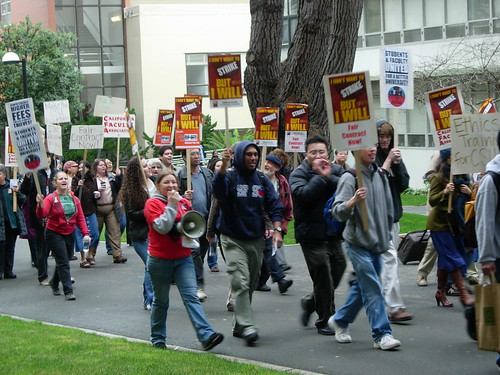
CSU Strike - Student Fee Hikes, Executive Compensation & Perks, Fair Contract for Faculty

As we prepare to strike, California State University Faculty are doing our best to get the word out about our issues -
Scandalous?! Who wants to be a millionaire in the CSU system?
Compare our Executives' Salaries with the rest of us who teach for a living:

More sleuthing at http://www.CSICSU.org

Executive Compensation: What's this I keep hearing about the CSU 'fat cats' and all their Executive Compensation and Perks?

• Last fall, the CSU Trustees awarded campus presidents and the top administrators in the Chancellor’s Office 19% increases in compensation -- including salary increases averaging 13.7% per person.
• At their January 2007 meeting, CSU Trustees will vote on another 4% salary increase proposed for the same executives.
• With these raises:-the average 2-year salary increase = $42,000-salary paid to the top execs in 06/07 will be 19% more than in 04/05
• By contrast, since 2002, CSU faculty received only a 3.5% raise, in July 2005.
• Compensation increases awarded to some executives in 2005 totaled more than the annual salary paid to full-time faculty.
• CPEC estimates that CSU faculty are paid 18% lower, on average, than their peers at similar universities around the country.

Thursday, March 22, 2007

Largest higher education strike in US history - California faculty union builds unity with students and communities

As we prepare for the largest higher education strike in US history, California State University faculty are building stronger long-term alliances with students and communities. Unity is crucial for victory in our fight for a fair contract and our students' fight for a real voice and to stop the huge fee increases recently approved by the CSU trustees.
Our CFA board last night voted unanimously to authorize our strike. Already field organizers are making plans with our student and community allies to shut down our campuses if necessary.
For great student perspectives on how student learning conditions are interconnected with faculty/staff working conditions - see this student produced video - Listen to the Students.
One of my former students Peter Lauterborn who also writes for BeyondChron.com has started a facebook group -" I will not cross the picket line" to help students stay informed about the strike preparations at SF State and all over California. Already numerous student leaders and others are working to build stronger alliances with faculty as well. Student organizers are going class to class to make presentations to inform students of the potential strike and what it means for their future.
While the SF Chronicle seems to be burying the strike story on the back pages, the Sacramento Bee has been featuring great investigative reporting on faculty conditions and executive perks and local organizing at Sac State.

FROM: THE CALIFORNIA FACULTY ASSOCIATION - FACULTY UNITED!
• 94% vote to support a strike; voter turnout is 81%; bargaining crisis inspires 1,300 new members to join the union
Any lingering questions about the solidarity and resolve of the California State University faculty were answered resoundingly Wednesday by the results of the first strike vote in the history of the California Faculty Association.
A stunning 94% of the voters agreed that the CSU’s professors, lecturers, librarians, counselors and coaches should initiate rolling walkouts if the CSU administration continues to reject bringing their salaries in line with their peers across the country.
More than 8,000 voters—an extraordinary 81% of the CFA membership—turned out to send an unmistakable message to Chancellor Charles B. Reed.
...The pro-strike-authorization numbers rang across all 23 CFA chapters. On only one campus was the vote in favor of striking as low as 79%.
An equally telling number is the 1,300 faculty who have been moved to join CFA during the recent months of the bargaining crisis and impasse. Taken together, the landslide strike authorization and the union’s growing ranks leave no doubt that faculty have the capacity to shut down the university if an agreement cannot be reached, and reached quickly, said CFA Vice President Lillian Taiz.
“There will be hundreds of faculty and supporters from other unions on the picket lines,” predicted Taiz, a leader of CFA’s field operations, “and we think they will be joined by students and staff who are as fed up as we are.”

Sampling of the media coverage of today’s historic developments.

CFA’s news release about the strike vote

CFA Board votes to implement rolling strikes on all 23 CSU campuses as 10-day “quiet period” ends
On Wednesday evening the CFA Board of Directors met and, by unanimous vote, made it official, turning the strike authorization into a strike plan with teeth.
The Board empowered the CFA officers and Field Team (who organized the strike vote) to make a final decision on which days and which campuses will begin the two-day walkouts in the initial round of job actions. Out of necessity, planning has been under way for months.
The first walkouts are expected in April but may occur sooner. Once the fact-finder’s recommendations are made public this Sunday, at the conclusion of the 10-day “quiet period” mandated by state law, the faculty are legally entitled to undertake job actions—to go on strike.
The expectation is that Chancellor Reed will ignore the recommendations of the fact-finding report and quite possibly attempt to unilaterally impose working conditions on the faculty.
If he does either, a strike will begin shortly thereafter.
* * *

Wednesday, March 21, 2007

94% of CA Faculty Union members authorize strike in US's largest higher education system

It's now official - we [over 8000 members of our union statewide] voted overwhelming - 94% - to authorize our union leadership to call for and organize rolling strikes as early at the first week of April to win a fair and equitable contract for teachers throughout our California State University system, the largest higher education system in the country. The strike would be a first in the CSU system. CBS is claiming that this could be the largest higher education strike in US history - since the CSU system represents 23 campuses and some 23,000 faculty and 400,000 students.
SF History - But our union went out on strike here at SF State in January 1969 for a fair contract, but also to support the Black Student Union and Third World Liberation Front during the Third World Strike here, the longest student strike in US History.
As Working Californians Blogger Julia Rosen notes, we faculty members from the CSU campuses want to minimize the disruption to our students education so we are planing for rolling strikes sometime in mid-late April. For updates see http://www.calfac.org.

From the SF Chronicle -
California State University faculty members have authorized their union leaders to call a strike if needed to pressure CSU's top executives into a labor contract that the union views as more favorable to the school's 23,000 educators.
If there were a strike, it would be the first at the nation's largest four-year public university.
Ninety-four percent of the union members who participated in the election voted to permit a strike, union President John Travis said today during a news conference at CSU Dominguez Hills. He said that 81 percent of the California Faculty Association's
membership voted in the strike election on the university's 23 campuses. ..
"I call upon this chancellor to return to the table and negotiate in good faith," said state Sen. Gloria Romero, D-Los Angeles, who is also a faculty member of the university but on the leave. "Let's let the negotiation get started."

Tuesday, March 20, 2007

Stanford report #3 - Power, CEO's and 'Getting Along to Go Along'

Evolution of California State School Finance with Implications from Other States, Kirst, Michael, Goertz, Margaret, and Odden, Allan. (2007), Consortium for Policy Research In Education (CPRE).

[by the way, Kirst wrote a paper a while back about how educators could influence policy: tell the legislatures what they want to hear in short sound bites!!]

[below are quotations from this report -- my comments in brackets - my research is at my website]

California has created an aligned system of standards based reform in numerous ways, but has never integrated its basic finance system with what students are expected to know and do.

California has one of the highest academic standards of any state (Education Week, 2006.) However, there needs to be some explicit linkage between state finance design and state academic standards policies.

Public opinion studies by Rich Neimand (2006) suggest that California public opinion may respond positively to a comprehensive finance plan clearly focused on high standards and individual outcomes.

a coherent comprehensive solution and compelling message has the best chance of convincing a skeptical, but concerned, public. Themes such as standards, accountability, transparency, and efficiency should accompany proposals for more money. Policy framing needs to emphasize children rather than the needs of the education system.

In sum, California’s school accountability and finance systems that are both centralized should be linked to each other.

[no challenge of the standards based system here – makes one think, who is the real audience for this paper? Whose agenda is this study promoting? Certainly those who support high stakes testing – since this paper’s stance was, how can we change the finance system so that it makes high stakes testing policy more effective, more legitimate. The author compares others states but doesn’t really point out that the overall trend throughout the US is decreased spending on education - - it is just most dramatic in CA. I think there is a relationship between standards based reform and the financial mess we are in – and that relationship is embedded in the rhetoric that says that you don’t need a lot of money when you have high expectations in the form of terror by testing]

But the first step must be to throw the current system out and not try to patch it. There is nothing much that is useful to start with in the current non-system.

[the most frightening statement in this report]: only a handful of experts understand the intricacies of the current finance system.

Legislation in 1972 established the basis for the current state general aid formula, but the state has been transformed in many ways since then.

The finance system is more centralized than almost any state system in the nation.

The result of Proposition 13 is even more state control of all school policy, because state politicians believe that they need to regulate a system that is state financed, but traditionally locally- controlled in other policy areas.

Moreover, state assumption of control of about 80% of total school funding meant that local schools became hostage to the state's volatile sales- and income-tax revenue streams. Even the 1995-2000 economic boom did not raise the state's per-student spending enough to reach the national average. Some districts have resorted to non-profit fundraising foundations and parcel taxes, but these fund-raising devices are not widespread and serve relatively affluent small districts. Voters recognized the schools' plight, and in 1988 passed Proposition 98, which earmarks a specific proportion (about 40 percent) of the state's general-fund revenues for K-12 schools and community colleges. But when state revenues decline, the school-aid guarantee declines as well despite Proposition 98.

Categorical aid represents about a third of the money Sacramento spends on schools. Each categorical program created a constituency of beneficiaries that lobbies to preserve it….Local school officials lack money to clean bathrooms, but have some categorical funds for adult education they cannot spend easily within the school year.

After Prop. 13, some California parents concluded they should use private money to help finance local schools. California foundations sprouted all over the state, but particularly in high income suburbs. Public school foundations have grown steadily since the early 1980s (foundations raised more than $70 million in 2004). Now California has nearly 600 local school foundations, by far the most in the nation.

California has never seriously considered a weighted pupil formula like Florida or Kentucky uses to adjust for different pupil needs. Pupil weights allow local discretion in program design in other states, but state lack of confidence in local policymakers has resulted in state specification of education interventions through categorical programs.

[but WSF doesn’t guarantee increased per pupil spending and could be used to justify continuing underfunding!!]

This state confidence issue has deepened and continued to build for many years. For example, Democratic Governor Gray Davis in 2000 said local control of education was a “disaster” and created many new categoricals. Some of these were incentive programs for local school bonuses if school test scores went up. But the incentive programs did not have much impact on local teacher behavior (PACE, 2000), and were eliminated when the state budget declined in 2001. In 2006, Republican Governor Schwarzenegger created 22 new categorical programs in such areas as art, music, and counseling. These new categorical program requirements add to a gigantic and bloated state education code.


But why has such an outcry not led to a substantial overhaul similar to New Jersey, Kentucky, Arkansas, and Wyoming?

[perhaps because California is much, much bigger than these states and the political power structure is very different??? This report says that the problem fundamentally lies with these reasons:]

1. Who must, and who has the right to, initiate state policy action?
Experience reveals that policymakers’ answers focus especially on the roles of the legislature and governor. In California, leadership by the governor has become crucial for a large-scale change in school finance.

2. What are the unacceptable policy initiatives? Again, experience shows that unacceptable state policy ideas trample on group, regional, or big- city interests; challenge dominant economic interests; or promote unorthodox approaches. Even limited inquiry among top state policymakers will provide agreed-on accounts of what policy ideas will not be feasible. In California, Prop. 13 is viewed as immutable and categorical aid is a prime state intervention tool. Rarely are finance incentives related to pupil performance utilized. Proposals to reorganize most categorical grants into a few bloc grants have been rejected by the state political system for decades.

[notice that these factors are all implied to be of equal influence – but why is prop 13 seen as immutable? When CTA attempted to challenge it, the large property owners association told them to scuttle it and CTA backed down in the face of overwhelming political power – academics don’t talk about POWER. High stakes testing was the promotion of an “unorthodox approach” – no?]

3. What are the appropriate state policy actions? Experience again points to such rules as: to get along, go along; carry out informal rituals that will recognize and define the boundaries of power; mobilize everyone who can benefit from a proposed policy, or conversely mobilize those who stand to lose something. Many of the major interest groups are used to Proposition 98 as the key framework and underpinning for California school finance. Interest group politics result in policy that the public may not endorse or feel involves them (Neimand, 2006).

[no 3 applies to those coopted by the system – those who want to climb up the ladder, who place “getting along to go along” as their primary strategy for self promotion – who created and runs that system? CEO’s!!!! – who are effectively organized in CA in the CBRT or CBEE]

In California and other states, such attitudes about acceptable policy ideas have a dual effect; they keep the policy environment predictable, and they help policymakers build group cohesion that produces incremental education finance changes.

[again, CEO’s want the landscape to be predictable – hence their hostility to democracy—since capitalism is unpredictable, they want to control their costs, their labor pool as much as possible]

A majority of the public thinks the school finance problem is too big and complex to be addressed by the current mélange of politicians and entrenched interest groups. California has 6.3 million pupils and spends over $60 billion for K-12 operations. The public believes education problems are caused more by inadequate parenting than school finance shortcomings. Moreover, the public does not trust that money raised by state taxes and sent to Sacramento will come back to their local classrooms. The public believes there is substantial waste in local public schools, and want a finance system focused on pupil outcomes. The California public does not respond much to current finance reform symbols like equity, adequacy, or the need to fully fund Prop. 98. Equity implies redistribution of state funds among school districts with a lowest common denominator result. The public believes that adequacy is a minimum standard that will not enable high enough pupil outcomes.

[“the public” – those polled – voters? Who shapes public opinion? What were the assumptions of the pollers? How were the questions asked? These “opinions” are very gross generalizations at best, inaccurate and highly manipulated at worst]

Monday, March 19, 2007

California State University Faculty Strike Looming - I don't want to strike, but I will!

San Francisco State and our California State University System is the largest system of higher education in the US with some 400,000 students and 46,000 faculty and staff spread out onto 23 campuses throughout our state. On Thursday we wrapped up a strike vote within our union that many predict will overwhelmingly authorize our union leadership to set strike dates throughout the state sometime in April.
Our students are taking the lead in building solidarity with faculty in support of a fair contract and our mutual opposition to the huge fee hikes just approved by the CSU Trustees on Wednesday. We are building stronger faculty/staff/student alliances to ensure a brighter future for our communities and the CSU system.

For more info on the CFA Strike: STRIKE VOTE CONTINUES ON LAST SET OF CAMPUSES—
Voting by CFA members on whether to authorize a strike against the CSU administration continued yesterday, March 12, and runs through Thursday, March 15, on the Fresno, Fullerton, Long Beach, Northridge, San Francisco, San Jose and San Luis Obispo campuses.
These seven CFA chapters, which include some of the largest, supplement the 16 where voting concluded last week. The final vote tally will be announced next Wednesday, March 21.
To review, nearly two years of talks on a new collective bargaining agreement broke down over the summer. Chancellor Charles B. Reed has misrepresented both the size of the pay raise offered and the strings attached to it. Under the current offer, the salaries of CSU professors, lecturers, librarians, counselors and coaches would continue to lag seriously behind those at comparable institutions—this despite a consensus that the pay gap, documented by the California Postsecondary Education Commission, should be eliminated.
Throughout our impasse, the CSU administration and Trustees continue to hammer students with fee increases and hand out executive raises, perks and golden parachutes in a pattern that has sparked statewide citizen and media outrage.
For more context on the scandals within the top eshelons of the CSU systems and their pro-big business boosters - see the www.csicsu.org site. See also info on SF State grad and now State Senator Leland Yee's efforts to bring sunshine into the CSU decision-making process.
On Wednesday we [CFA] will announce the outcome of the strike vote. We have spent the last 22 months negotiating for a labor agreement with the CSU Administration and has not been able to reach a labor agreement. According to the California Postsecondary Education Commission, the CSU faculty is paid 18% less than comparable institution salaries around the country. Since 2002, faculty salaries have remained stagnant while the Administration has raised its own salary 23%.