Wednesday, February 20, 2013
There is no democracy here !
Wednesday, November 14, 2012
Teachers' Unions and School Reform - Diane Ravitch
How Teachers Unions Lead the Way to Better Schools . Diane Ravitch upends the "bad teachers" narrative.
By Amy Dean
I have a concern: Teachers are getting pummeled. Too often,
they are being demonized in the media and blamed by
politicians for being the cause of bad schools. Right-wing
governors, power-hungry mayors and corporate "reformers" -
all ignoring root issues such as poverty and inequality -
have scapegoated the people who have devoted their lives to
educating our children. Moreover, these forces are seeking
to destroy the collective organizations formed by educators:
teachers unions.
The stakes for our country could not be more profound. The
labor movement and the public education system are two
critical institutions of American democracy. And they are
two that go hand in hand. Teachers unions have played a
critical role in advocating for public education, but you'd
never know it from mainstream media coverage. Therefore,
there is a great need to lift up this tradition and
highlight the efforts of teachers to collectively push for
top-notch public schools.
To figure out how we can push forward on this issue, I
talked with Diane Ravitch, one of the country's leading
education historians and public school advocates. A
professor at New York University, Ravitch is a former
Assistant Secretary of Education and the author of several
books, including 2010's The Death and Life of the Great
American School System: How Testing and Choice Are
Undermining Education.
Tuesday, May 15, 2012
Proposal to close 25% of Philadelphia Schools
by Jody Sokolower
Philadelphia teachers and parents—and educators throughout the country—were horrified a few weeks ago when Thomas Knudsen, the School District of Philadelphia’s chief recovery officer, unveiled a five-year plan to close 64 schools (25 percent of the system), move 40 percent of students into charters, slash the central office to 20 percent of its former capacity, and divide the rest of the district into “achievement networks” run by third-party operators.
Mayor Michael Nutter said the district faced near “collapse” and that the plan was something Philadelphians needed to “grow up and deal with.” Can you believe that city officials later admitted that the charters and achievement networks wouldn’t actually save the district any money?
We are proud that one of the voices of sanity and resistance came from Helen Gym, a Rethinking Schools editorial associate and longtime parent activist in Philly. We are reposting her open letter to Knudsen here—not only because it analyzes so articulately what is happening and what is at stake in Philly—but also because Philly is not alone. Similar “saving the district from collapse” scenarios have already played out or are in progress in cities as widespread as New Orleans, Detroit, and Chicago.
Commentary: You’re not speaking to me, Mr. Knudsen
by Helen GymI am the mother of three children in District and charter schools in this city. I have been actively involved in stopping good schools from decline and helping low-performing, violent schools turn around. I believe in the essential role that a high-quality public school system plays and have fought for that vision. My 7th grade son will soon have outlasted four superintendencies, including yours. And I’m here to tell you that you’re not speaking to me.
You’re not speaking to me with this brand of disaster capitalism that tries to shock a besieged public with unproven, untested, and drastic action couched as “solutions.” You’re not speaking to me when you invoke language like “achievement networks,” “portfolio management,” and “rightsizing” our schools – and say not a word about lower class sizes or increasing the presence of loving support personnel or enriching our curriculum.
You’re not speaking to me when you plan to close 25 percent of our schools before my son graduates high school. You’re not speaking to me when you equate closing down 64 schools – many of them community anchors – as “streamlining operations,” yet you’ll expand charter populations willy-nilly despite a national studyshowing two-thirds of Philly charters are no better or worse than District-managed schools.
Friday, April 20, 2012
Save Our Schools: SOS
By Deborah Meier,
Dear Diane,
HELP!!! SOS!!! "Reformed" schools are literally becoming reform schools for the poor. It's a sign of "the future" as some people envision it. Although, of course, these are not the schools for the reformers' kids.
Mitt Romney "declared that this century must be an American century," and President Barack Obama insists that "anyone who tells you that America is in decline ... doesn't know what they are talking about." Well, it's hard to argue with Romney since his "must" is a preference, not a prediction. But I do worry about Obama's statement because it contains truth, and it covers up a potential falsehood. (See "America's Place in the New World," by Charles A. Kupchan in The New York Times.)
But why should we care if we're first? (See last week's letter!) If the first is a nation we respect, being second is just fine. What we care about is the health and welfare of our nation's people and their future prospects both economically and politically, not our place in somebody's ranking system. We might also like a president who hopes for the best for other nations' people, too. And, while American business may not be in decline, it has the advantage of transferring its own future health and welfare to almost any nation it chooses. The American people have a harder time following suit. Indeed, global business has no country. Our inventiveness won't help if we off-shore the production of the inventions "made in America"—to nations that operate with 19th century sweat-shop wages and working conditions.
Under our unequal circumstances (99/1) it seems hard to envision how we will once again have an economy that works for everyone, not just the top 1 percent. And given the options of who might replace us, democracy doesn't seem likely to be the winner either way. Our own democracy is fast crumbling—and for the very same reason: the inequality of power in our society run amok ... and fueled by fear.
So, Kupchan may be right that "the democratic, secular, and free-market model" challenged by state capitalism and religious fundamentalism will succeed in dominating the 2lst century.
As Henry A. Giroux writes in the Truthout blog:
"Under such circumstances, all bets are off regarding the future of democracy. Besides a growing inability to translate private matters into public concerns, what is also being lost in the current historical conjuncture is the very idea of the public good, the notion of connecting learning to social change and developing modes of civic courage infused by the principles of social justice. Under the regime of a ruthless economic Darwinism which emphasizes a survival-of-the-fittest ethic, concepts and practices of community and solidarity have been replaced by a world of cutthroat politics, financial greed, media spectacles, and a rabid consumerism."Is there another way?
Yes. That's why I'm stuck trying to both hold onto the idea of "public space" and a public to go with it! Public education is one of several much besieged institutions that may soon disappear—think about replacing post offices and our local letter-carriers. Consider, too, an army made up of mercenaries, and who knows? Private police? Firefighters? Libraries? Highways? Where can "we" go to "hang out" together?
In schools (that) we trust *—that "belong" in some direct form to "we the people"—is part of my answer. So go read the book by that name, especially Chapters 9 and 10 on scaling up reform for democracy. Do you have a suggestion on a book laying out why we need public police, firefighters, libraries, et al?
Of course, the present system is not all it should be, re. democracy, especially for minority groups, and in our much too large urban districts with their tendency to become centralized in the hands of the local elite. Few are the mayors or appointed school board members who send their own kids to their local schools.
See also Will Standards Save Public Education? which I wrote in 2000 (foreword by Jonathan Kozol). I agree with virtually everything I said there, except that I was oblivious to the attack on the idea of a public system itself. I wasn't yet noticing what lay ahead, and now that it's so front and center, could it be too late?
The future is not yet written—when it is, there will still be those of us fighting for the next future. Which reminds me, read No Citizen Left Behind by Meira Levinson—a forthright defense of schools as institutions for teaching about democracy and justice. Democracy was never a foregone conclusion. It's perhaps amazing that it remains a lively option, if not a foregone conclusion.
Many of us will be in Washington, D.C., from Aug. 3-5 (thanks to Save Our Schools) to once again show our support for public education and to produce an education agenda that we can share at both upcoming conventions. Over the coming months I'll try to keep folks informed about how it's shaping up, with input, we hope, from one and all. Will you be joining us?
Can we build a response that doesn't rest on fear, but rather on hope?
Deb
Friday, January 21, 2011
Rhee opens office in Sacramento- a response
Sunday, June 08, 2008
Bill Moyers, Media Democracy
I am unable to copy the embeded script. Follow the link.
http://www.freepress.net/conference
Wednesday, March 19, 2008
Obama Transcends Racial Divisiveness with Historic Philadelphia Speech; Bill Fletcher on Movement Building
"A More Perfect Union" speech in Philadelphia. He spoke again about the unfulfilled promise of Brown v. Board of Education and the intensifying inequality in our schools and the need for a multiethnic coalition involving immigrants and everyone to come together to meet the challenges of our time.
But he caught me off guard when talking about Rev. Wright.
He resisted the tremendous political pressures to disassociate himself from his pastor and the African American community. He did this through an incredibly brilliant framing of his 'progressive' values through the telling of human stories which were connected to our nation's founding in Philly and our future with the story of young white campaign volunteer Ashley Baia. He managed to embrace both Rev. Wright and Obama's own white grandmother who he said had expressed prejudice and discriminatory attitudes at times that made him cringe. "These people are a part of me. And they are a part of America, this country that I love."
Obama also masterfully transcended the divisiveness of petty racial politics and individual racism to point the finger at the institutional racism and classism in American society and the “real culprits of the middle class squeeze – a corporate culture rife with inside dealing, questionable accounting practices, and short-term greed; a Washington dominated by lobbyists and special interests; economic policies that favor the few over the many.”
It is also encouraging to me that, like JFK, Chuck D, KRS-One or Malcolm X before him, Obama always manages to tie the future of our nation also to the energy and idealism of young people and their movements. He concluded:
"I believe deeply that we cannot solve the challenges of our time unless we solve them together – unless we perfect our union by understanding that we may have different stories, but we hold common hopes; that we may not look the same and we may not have come from the same place, but we all want to move in the same direction – towards a better future for of children and our grandchildren."
Thinking more long-term beyond the November election longtime movement and labor leader Bill Fletcher identifies 2 important goals for progressive activists -
Burning Cane: Bill Fletcher: Obama, Enthusiasm, & Movement Building
But when the campaign is over, whether it is at the Democrat convention or in November, if there is nothing to build upon, the enthusiasm will evaporate as it has on so many other occasions after energizing electoral campaigns. I would suggest two steps:1. Progressives for Obama:
While there are many progressives who have entered into the Obama campaign and are doing good work, there needs to be an independent voice and location to push progressive politics. I spoke the other day with someone working in the campaign that - as enthusiastic as she is - acknowledged that a number of the proposals her committee has been developing have simply been overlooked. My guess is that more of that will happen and the candidate will be increasingly influenced by financial
contributors and those forces he believes to be most significant. If the
progressive voice is only one among many, it will be drowned out. Progressives need to figure out where they can make a difference in the larger campaign as well as explain to their respective constituencies why they are taking the step of supporting Obama; what to expect and what not to expect from the candidate; and what can be done now.
2. Build locally-based, independent political organizations:
Electoral activism and energy is so easily and quickly lost. For those who have become motivated through this campaign, they should be
encouraged to build organizations in their communities and social movements that reflect progressive politics. Such organizations should be grassroots based and, among other things, aim to identify, train and run progressives for local elected office. Holding a President of the USA accountable - be it Obama, Clinton, McCain or Huckabee - will necessitate organization at the base, organizations capable of both putting people into the streets as well as getting them to the polls.
There are tremendous dangers AND opportunities in this election season. Casting caution to the wind and uncritically supporting any
candidate is a recipe for disaster. We must expect that there will be immense tugs to the Right on any elected official. If progressives are not prepared to push back and keep Obama’s feet to the fire then every reservation that many of us have about his candidacy will become a self-fulfilling prophecy.
Tuesday, March 18, 2008
Burning Cane: Obama's Crisis - learning from Martin Luther King and Malcolm X
Millions of Barack Obama’s supporters are asking, “What does he do now?” Everyone following the Presidential campaign has heard sound bites of his pastor Jeremiah Wright condemning American racism and imperialism in the harshest tone possible. In response, Obama has once again been forced to distance himself from a close associate, but this time he has had to do so more forcefully and urgently.
The first thing we need to do is to put this development into context. On the surface level, it is a critical moment in a bitterly contested campaign that has devolved into a back-and-forth match of denouncing and rejecting surrogates. But on a deeper level, it is a reflection of how Obama’s success has forced him to rise to bigger and bigger challenges. And for this reason, a moment like this was sadly inevitable, for there is no Obama path to the Presidency that does not require him to rise above charges that he is unpatriotic or that he is a Black extremist. Such is the inescapable reality of running for President as a progressive African American whose formative experiences came as an inner-city community organizer on the South Side of Chicago.
When confronting a moment of crisis, great leaders are those who can see through the fog of conflict and contradiction to envision a concrete path forward for the nation. What must also be understood is that great leaders do so not as individuals; they do so with the encouragement, involvement, and constructive criticism of millions of supporters. This is why there is a need not only for Obama and his aides to do some serious strategizing. Anyone invested in the short-term and long-term success of his campaign must do some soul searching and some deep thinking about the past, present, and future of America.
To challenge Obama and his supporters in this way, regardless of whether it is fair to do so, is to provoke an unprecedented debate that escalates the stakes beyond any election in recent memory. In order for his campaign to move beyond this crisis, he must do far more than prove that he does not stand for inflammatory rhetoric. Obama must redefine the meaning of love for America.
Thursday, February 28, 2008
Los Angeles Educational Equity Leader Karen Bass Rises to CA Assembly Speaker
Bass was elected in 2004 to represent California's 47th Assembly District which includes parts of Westwood, West L.A., Culver City, Baldwin Hills, Leimert Park, Hyde Park, Crenshaw and Mid-City. She is the former Executive Director of the Community Coalition, a South LA-based grassroots community organization, which she founded in 1990, to change public policy and improve the quality of life in South Los Angeles.
In a 2005 interview with the LA Business Journal Bass described her influences:
Q: You call yourself an activist. How did that happen?In Cal State LA's Women's Magazine LOUDMOUTH Bass described her Educational Justice roots in policy-making and grassroots leadership development just before she joined the state Assembly in 2004 :
A: I grew up in South Central L.A. during the civil rights movement and the Vietnam era, so being an activist was second nature. In fact, there was a whole group of people who grew up in L.A. when I did who have now moved on to public office, union leadership and the non-profit world. There was Antonio Villaraigosa (city councilman), Gil Cedillo and Gloria Romero(state senators), Mark Ridley-Thomas (assemblyman), Anthony Thigpenn (president of Strategic Concepts in Organizing and Policy Education), Julie Butcher and Maria Elena Durazo (union local presidents). We all knew each other when we were in our 20s and early 30s and have worked together for the last 25 years to build coalitions.
What public-policy efforts have you worked on in the past,Read the Full Interview!
and what policy do you hope to work on in Sacramento?
Before I get up there I’m going to have to focus, because there are really a lot of areas of public policy that I’m interested in and that I have a background in. Education reform is one of them. One of the first things I did when I started the Community Coalition is form a youth arm of the coalition. That was really designed after how I was raised as a teenager.
I was active in high school in the anti-war effort and in the electoral arena, and there were always adults around me who helped nurture my activism and also kept me out of trouble. And so that’s what we did with a group of teenagers, because I believe that teenagers absolutely have the capacity to understand and interact in public policy and that if you give kids the opportunity to lead in that way, then they won’t lead in a negative way. In my opinion, gang leaders — gang involvement is negative leadership, but it is leadership. And it is organization. And so the question is, Can you get kids to organize in a constructive way? And being an activist fits in with adolescent rebellion anyway because you’re rebelling, and if you channel that in a proper way, then you really win on several fronts.
You win academically because you really do have to study to be an activist, and you win personally because you gain a lot of confidence and positive skills, and you win in the community because you’re getting involved in positive change. Anumber of the young people that we’ve recruited over the years actually stayed with us throughout their whole adolescence and they’re who I’m handing the organization over to, because they’ve grown up now. Fourteen years later, they’re in their late 20s now, and they’re running things.
So, education reform is an issue area that I’d be involved in.
Foster care is another area. Criminal justice is huge. As I mentioned, when I started the coalition, its origins were a response to the war on drugs. Every issue I just named is related to the drug issue. If you don’t make it in our society, you know, you either participate in the legal economy or you participate in the illegal economy. Certainly the major employer in the illegal economy is the drug industry on one level or another, and when they get pushed out of school, kids are left to the illegal economy.
All of these issues are interconnected. What I have to do in this period is a very serious analysis of Sacramento to see where I can be most effective. I’m in the process of doing that now.
Tuesday, February 26, 2008
Grace Lee Boggs on the Authenticity of Obama's Leadership - WE ARE THE LEADERS WE'VE BEEN LOOKING FOR
Obama is providing the authentic, visionary leadership we needin this period when our challenges are so great and our politics (as he puts it in The Audacity of Hope) so small.
That kind of leadership is very precious.
26 year-old MLK provided it in 1955 when he inspired Montgomery blacks, sick and tired of being sick and tired, to go beyond protest and manifest a more advanced humanity in their yearlong non-violent boycott.
Jimmy Boggs anticipated it when he said in his last speech to University of Michigan students in 1991 "I don't believe nobody can run this country better than me. I'm saying you better think that way. You need to stop thinking of yourself as a minority because thinking like a minority means you're thinking like an underling. Everyone is capable of going beyond where they are."
Liberals and radicals tend to be skeptical of this kind of leadership....
Labor/Change to Win - Fired Up and Ready to Go with OBAMA
Our members and the 40 million workers in our industries are real people who work hard picking the crops, stocking the shelves, preparing and serving our food, building, cleaning and guarding the skyscrapers of our big cities. They drive our buses and trucks.
They care for the sick and elderly and help us raise our children. They are the infrastructure of our society
For them, this election is about changing America to win a better future for our children.
We want a president who shares our vision and is committed to a practical program to translate that vision into action.
Action that will fix what happens at work by:
Protecting the right of workers to have a voice in their workplaces
Health care for every man, woman and child in America
Fair trade policies to promote job growth
Creating good jobs through rebuilding and expanding our nation’s infrastructure
Most importantly, we want a president who shares our dream and unites Americans in building a movement for change. ….a movement with the power to turn that dream into reality.
Today, Change to Win is proud to endorse Senator Barack Obama.
Monday, February 25, 2008
Is Obama Progressive? - From Burning Cane/John Delloro
Check out John's views, along with Howard Zinn, Grace Lee Boggs, Bill Fletcher, Scott Kurashige, others.
Delloro is Executive Director, Dolores Huerta Labor Institute and a teacher in UCLA's Asian American Studies Department.
I met John in the early 90's through his student activism in LA and his leadership in APALA [Asian Pacific American Labor Alliance].
Scott Kurashige wonders if there are similarities between the negativity expressed by some of the "Old Left" of the "New Left" in the past with the criticism leveled against the Obama campaign by some of the "New Left. " Howard Zinn argues that the current concerted public attention with the elections is disproportionate to the amount of energy that needs to be given to direct action. Bill Fletcher suggests a measured "critical support" of the Obama Campaign.
Both Howard Zinn and Bill Fletcher raise valid points when one considers Obama's policy positions. However, Scott is also correct when you step back and examine the Obama campaign as a whole. Do we restrict the possibilities for social transformation if we limit our understanding of the Obama campaign to the legislative stands of the candidate? Are there opportunities offered by the Obama campaign to build real movement?
Saturday, December 29, 2007
Obama is Our Best Chance to "Keep Hope Alive" in 2008
Though Obama has nowhere near the grassroots field campaign, or progressive vision/politics as Jackson had in the 80's, I believe his campaign gives our movements another historic opportunity, as Wong states, to "build bridges across constituencies and generations" and "for (progressive) change, for hope and for a better America."
Twenty years ago, as I stood in the bitter cold in a parking lot in Sioux City, Iowa, I saw a sight I thought I’d never see. A crowd of white meat-packers, big beefy men and their wives and children, shuffled their feet in quiet anticipation. They shielded their eyes against the low winter sun, stamping their feet for warmth on the frozen ground. They were waiting to hear my boss, the Reverend Jesse L. Jackson, a candidate for the Democratic nomination for president of the United States.
No one knew what to expect from this unlikely meeting of the Southern-born civil rights veteran and these heartland folk who had been on strike for months and were now down to their last savings. As Jackson began to speak, I could see heads nodding as he told them that their sacrifice was redemptive, and that they were not alone in their fight for fair wages and safe working conditions. He took their strike and cast it against the larger economic violence that came out of President Reagan’s
union-busting practices, and the failures of a trickle-down economy that brought wealth to the rich and poverty to the working poor. As Jackson spoke, he ignited a sense of pride and dignity in these men and women. He brought them to their feet with tears in their eyes with the cry, “Keep hope alive!”
Now, Senator Barack Obama is standing with the workers, farmers, students, elderly and others in Iowa, preaching a similar message of hope and offering a new way forward for our country. Just as Jackson offered a break from Reaganomics and repression, Obama would take us away from the destruction of Bush’s war policies and restore our democracy. Just as Jackson offered a message of hope across racial and class divides, Obama is building a bridge across generations and constituencies.
Obama is the new messenger of hope, justice and equality. His call for ordinary people to take back their government from the lobbyists and big business clients, who have reaped mega-profits through backroom deals, is exactly what we need at this critical moment when economic inequality is at an all-time high. His pledge to engage directly with foreign leaders who oppose us and with allies who should be our partners in solving intractable conflicts is exactly what we need. We need to build bridges and tear down walls.This moment in United States history poses a turning point that can set the course
for decades. The crises posed by global warming, a protracted struggle against Islamic extremists, the deepening inequality in our country, our deteriorating infrastructure and declining educational system, and our tarnished international reputation cry out for new answers and new approaches. Obama is the best person to meet the challenges of this historical moment. He has shown a deep grasp of issues and, more importantly, exhibited the ability to listen to other points of view and find ways to build alliances across historic barriers.
Obama is the man with the vision, clarity and ability to meet the challenges of our times. He is the man, and this is the moment — for change, for hope, for a better
America.
Eddie Wong is a member of the Asian American and Pacific Islander Leadership Council for Senator Obama. He was the national field director of the 1988 Jesse Jackson for President campaign. He is a media and political consultant based in Oakland, Calif.
More on Obama
Also see Shelby Steele, of all people, on this topic in Time Magazine.
Rather than dismissing Obama, or relying upon others views, I urge readers to look at what he is actually saying. His campaign, for example, is far from color blind. It is not “beyond race” at all.
There are important articles from the campaign and about the campaign on my blog;
http://choosingdemocracy.blogspot.com
Also, there are articles for and against at our electoral activism blog at
http://www.sacramentopa.blogspot.com/
Duane Campbell
Friday, December 28, 2007
The Obama Effect
"[Obama] is being consumed as the embodiment of color blindness," says Angela Davis, professor of history of consciousness at the University of California, Santa Cruz. "It's the notion that we have moved beyond racism by not taking race into account. That's what makes him conceivable as a presidential candidate. He's become the model of diversity in this period...a model of diversity as the difference that makes no difference. The change that brings no change."
Friday, September 21, 2007
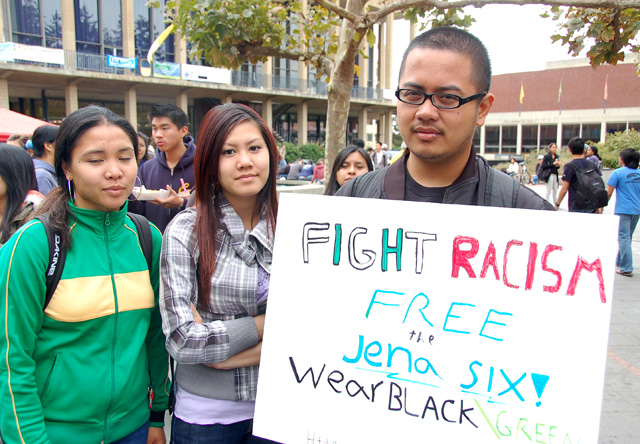
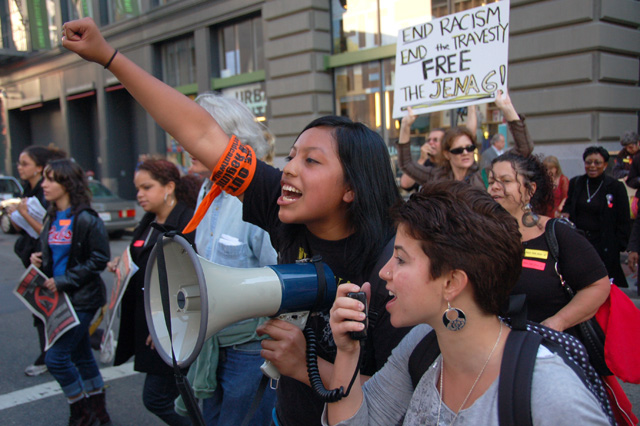
Students Rising Up in SF and East Bay to Support the Jena 6 in Louisiana
See/hear/view also the independent media coverage at Indybay.org and Democracy Now.
Over 20,000 people from across the country gathered in Jena, Louisiana on
Thursday, September 20th, from across the country to protest the pending charges against six African American high school students (Protest Details). The six students were charged with felonies after a fight that started after nooses were hung outside their high school. Protests were also held in cities across the United States. At UC Berkeley, over 1,000 protesters gathered in Sproul Plaza at 12pm. In San Francisco, over 200 people rallied at Powell and Market.
Last week the Louisiana Third Circuit Court of Appeals threw out the conviction of 17 year old Mychal Bell. The court ruled that he should not have been tried as an adult. Bell was supposed to have been sentenced for attempted second-degree battery this Thursday.Mychal Bell and five other students were arrested for beating a white student during a schoolyard fight last year. The fight occurred after white students hung three nooses on a tree in the schoolyard. Bell has been jailed since January unable to meet his $90,000 bond. As of this morning he remains in prison waiting for his new bond to be posted. The District Attorney plans to appeal Bell's overturned conviction at the Louisiana Supreme Court.
Thursday, September 13, 2007
SF's Richmond District Activism stops STARBUCKS in our Neighborhood
This was my post to the blog I set up with the other activists -
Thank you so much to everyone who wrote, called, rallied and spoke out at the 9/11 Board of Supervisors meeting to stop the Starbucks in the Inner Richmond District.
The SF Examiner and SF Chronicle coverage didn't adequately acknowlege the tremendous groundswell of support we built from our Richmond District community and other neighboring communities to stop the STARBUCKS:
Starbucks' effort to flood San Francisco with coffee shops ground to a halt Tuesday when the Board of Supervisors blocked a new outlet in the Richmond District under chain store regulations passed by voters last fall.
The board voted 9-1 to overturn the Planning Commission's June approval of a Starbucks at the corner of Geary Boulevard and Fifth Avenue, killing the proposal.
Jesse Fink, who has owned a nearby cafe for 25 years, filed the appeal on behalf of the Clement Street Merchants Association, which represents approximately 30 merchants in the area.
"I don't want San Francisco to lose its character and become a city of strip malls. ... That's what Starbucks is all about," Fink said in a hearing before the board.
Tuesday, June 12, 2007
David Bacon: Who Killed the Immigration Bill, and Who Wants it to Come Back?
In San Francisco alone, seven were arrested in the office of Senator Diane Feinstein, during the recess that preceded the June 7 vote. Dozens more debated the senator in front of her home the morning after the arrests. Around the country, similar demonstrations did what they could to kill the bill. The National Day Labor Organizing Network called it a "cynical and mean-spirited effort of those Senators that seek to poison the immigration reform debate yet again," and warned, "we are fearful that an insufficient Senate bill cannot be adequately repaired in the House of Representatives or in a conference session." It was no surprise that many greeted the (perhaps temporary) death of comprehensive immigration reform as a necessary move to protect immigrants themselves. These groups saw in the bill a threat of more contract labor programs, more enforcement and raids, greater militarization of the border and erosion of basic due process rights.
Filipinos for Affirmative Action, voicing a criticism common in Asian American and Latino communities, said the bill "moved away from permanent, family-based immigration toward a temporary employment system." As debate in the Senate proceeded, even the bill's promise of legalization for the nation's 12 million undocumented residents proved so restrictive that only a small percentage eventually would have qualified. Migrants without status would have had to place their families in jeopardy just to apply.
After the vote in the Senate defeating cloture, killing the bill at least for the moment, John Sweeney, head of the AFL-CIO, declared it "plagued by anti-family, anti-worker provisions," and called it " doomed at the onset. The bill abandoned long-standing U.S. policy favoring the reunification of families and failed to protect workers' most basic rights." Despite the fact that the bill was brokered by the Bush administration, many of its proponents were not Republicans, but liberal Democrats, most prominently Senator Edward Kennedy.
Supporting it was a network of lobbyists referred to in the press as "immigration advocates," large employers, and conservative think tanks. For two years this alliance advocated a strategy of trading legalization of undocumented immigrants for increased immigration enforcement and guest worker programs. The National Immigration Forum and the DC umbrella group it initiated, the Coalition for Comprehensive Immigration Reform, were key players in this strategy. Behind them was the Essential Worker Immigration Coalition, which brought together over 40 of the largest corporate trade and manufacturing associations in the country, under the aegis of the U.S. Chamber of Commerce. EWIC head John Gay, also head of the National Restaurant Association, chairs the NIF board.
These Washington groups supported all the compromise bills embodying the legalization/enforcement/guest worker tradeoff, beginning with the original Kennedy/McCain bill in 2005. The same argument was used to justify them all: "It's not possible to get legalization without including more enforcement and guest worker programs." While the groups occasionally disagreed with individual provisions of the proposals that followed, they not only agreed with the basic structure and architecture of these bills, but became their ardent advocates in meetings around the country.
As the proposals moved through negotiations with the administration and Congressional Republicans, legalization schemes became more restrictive, enforcement provisions more ferocious, and contract labor schemes more extensive. Yet the recently defeated Senate compromise was greeted as a "good starting point." Even at the end, the DC groups called on immigrant communities to urge defeat of "bad" amendments to it, while continuing to urge Senators to support the comprehensive immigration reform, or tradeoff, framework.
While Congress considered this series of proposals, the Bush administration embarked on a series of highly publicized immigration raids and workplace firings, to put pressure on immigrant communities and unions to accept its reform program. The bills themselves called for giving the Immigration and Customs Enforcement agency, part of the Department of Homeland Security, more enforcement authority to conduct these raids. The administration, for instance, proposed that employers be required to fire any worker whose Social Security number didn't match the agency's database. Although Bush never actually issued this regulation, and the bills obviously hadn't passed, ICE and employers began using it as the basis for enforcement actions.
Workers at the Woodfin Suites in Emeryville, California, were fired after they tried to enforce the city's living wage ordinance. At the Smithfield pork plant in Tar Heel, North Carolina, hundreds were fired, and many then deported, during the hardest-fought union organizing drive in years. Similar raids and firings swept the country, as the administration set ICE loose on immigrant communities, implementing the very language in the comprehensive reform bills. Beltway lobbying groups often expressed alarm over the raids, but didn't withdraw their support for bills that would have made such raids more widespread.
After coordinated raids at Swift meatpacking plants in November, in which over a thousand workers were picked up for deportation, Homeland Security Secretary Michael Chertoff told reporters the enforcement actions would show Congress the need for "stronger border security, effective interior enforcement and a temporary-worker program.'' Bush wants, he said, "a program that would allow businesses that need foreign workers, because they can't otherwise satisfy their labor needs, to be able to get those workers in a regulated program." Within weeks of Chertoff's statement, the Southern Poverty Law Center issued a report, "Close to Slavery," which provided exhaustive documentation that current guest worker programs, like those the administration proposed, systematically violated workers' rights. Abuse in H-2 programs was so extensive, and government enforcement of existing labor protections so completely absent, that SPLC called them "fundamentally flawed."
The SPLC and other exposes gave guest worker programs such a bad reputation that DC-based groups took pains to disassociate themselves from the term. The bills they supported would "break the mold," they claimed, by creating contract labor programs that wouldn't exploit workers. They invented new terms: "essential worker" or "new worker" plans. Behind the semantic fog, however, the bills preserved the two crucial characteristics of all employment-based guest worker schemes: new migrants could only come if recruited by an employer or labor contractor, and people had to remain employed to stay. Migrants losing a job and unable to find another within a short time would be deported.
To justify contract labor programs, the DC coalition asserted constantly that U.S. corporations face dire labor shortages. The Bureau of Labor Statistics, however, estimates the May, 2007 unemployment rate at 4.5%, and says over 7 million workers were unemployed in 2006. Most unions believe these are serious undercounts. Unemployment in African American and Chicano communities is much higher, over double digits even during economic booms. Yet instead of raising wage and benefits to attract workers, or paying more taxes to improve education and training in working class communities, employers held that only huge guest worker programs could meet their labor needs. In an joint oped piece for Politico.com, Thomas Donahue, CEO of the U.S. Chamber of Commerce, and Andy Stern, President of the Service Employees International Union (one of two unions that supported the tradeoff bills) stated that "we need legislation that will create a carefully monitored essential worker program," and called it "a system that provides U.S. businesses with the workers it needs."
Meanwhile, legalization proposals in the same tradeoff bills were presented as the payoff for immigrant communities. Yet many of the legalization schemes threatened to disqualify immigrants guilty of document fraud. ICE now says this includes anyone who's given a false SS number to get a job, something almost all undocumented workers have done. Other proposals would have imposed employment requirements, imposed high fines difficult for most working families to pay, and required people to take an undetermined amount of time off work to return to their home countries to apply for readmittance, with no guarantee they could pass a host of bureaucratic checks. Most proposals would have had people wait at least a decade before they could get a green card for permanent legal residence (not citizenship). Legalization programs wouldn't even take effect until the U.S. gained "operational control" of the border, leaving the door open for years of increased enforcement with no change at all in the status of the undocumented.
Many organizations outside DC did not support this approach to immigration reform. Instead they called for a positive agenda focusing on human and workplace rights, legal status and equality. They proposed reforms that didn't criminalize migration, work or the border itself, and that instead protected families and communities. The National Network for Immigrant and Refugee Rights urged that "we work for a different "starting point" for immigration reform that protects the rights of all immigrant families, workers and communities."
The beltway lobbying strategy started by asking what employers and a Republican administration would be willing to accept. Groups like NDLON, however, proposed building a popular movement to change the political terrain in Washington, like the civil rights movement of the 1960s. Responding to lobbyists who called the Senate bill the only chance to reform immigration law for years, NDLON said "We know the struggle for justice and immigration reform requires a long view of history, and we will not be pressured into accepting an insufficient compromise simply for sake of political expediency. We owe it to this and future generations to pass a bill that we can all be proud of."
"The best way to guarantee the rights and wages of all workers in this country," added the AFL-CIO's John Sweeney, "is to give every immigrant the opportunity to become a citizen, with all the rights and duties that entails. At the same time, Congress must revise our immigration system so that in the face of labor shortages, future foreign workers may enter this country not as dispensable units of production but as permanent residents with the same rights and protections as all other U.S. workers."
Basic differences have divided the immigrant rights and labor movements, not just over tactics and strategy, but also over goals. Should immigrant rights groups and unions support increased enforcement? Should they allow employers to recruit hundreds of thousands of workers a year, on visas which condition their right to stay in the US on continued employment? Should temporary or contract labor programs be the condition under which the undocumented are allowed to stay?
This division, between Washington-based organizations, and grassroots coalitions outside the beltway, has existed for over a decade. In 1996 many community-based coalitions around the country withdrew from the National Immigration Forum when it insisted it was not possible to save the rights of undocumented immigrants in the Clinton-backed immigration bill. The DC-based strategy tacitly called for saving the rights of legal immigrants by telling Congress that while the country needed to do something about illegal immigration, legal residents shouldn't be punished in the same bill. The strategy failed, and according to Filipinos for Affirmative Action, "the Illegal Immigration Reform and Immigrant Responsibility Act undermined the basic rights of all immigrants, denied their right to due process, and expanded the reasons for detention and deportation." The starting point for immigration reform should be instead an agreement that "all immigrants have a right to be treated equally, with full legal, employment, human and civil rights."
Today's disagreements are similar. They are in part over strategy and tactics, but also raise a deeper issue: Should U.S. immigration policy become a labor supply system for corporations, or should it support families and communities? In the mainstream press, this question gets little coverage because the framework proposed in Congress so heavily sets the media agenda. Anger over exclusion from the debate provoked the Mexican American Political Association to declare that "We are totally opposed to the off-handed declarations made by compromising individual Latino television commentators or organizations that advocate - NOTHING IS WORSE [than failure to pass an immigration bill]. In fact, NOTHING WILL BE WORSE [than the proposed Senate legislation] in terms of the millions of individuals and families who will be criminalized in perpetuity."
Moving from an effort to defeat anti-immigrant legislation to an agenda that can win more progressive reforms requires an open debate over those disagreements. As Silicon Valley and other employer groups move to bring the Senate bill back, that discussion is more urgent than ever.
Monday, May 28, 2007
SF Progressives Gear Up for '07 Mayoral Race and the Future of our Communities
Next Saturday I and other progressive activists and organizers are mobilizing for a major progressive summit at our Tenderloin Community Elementary School. We are trying to reinvigorate the spirit of the 1974 San Francisco Community Congress efforts in neighborhoods throughout the City. On June 2nd progressive elected officials and grassroots activists will join together to plan for the November 07 elections and beyond.Former Mayoral Candidates Matt Gonzalez and Tom Ammiano and Supervisors Chris Daly, Aaron Peskin and Ross Mirkarimi may address the convention sometime after 2pm along with Board of Education President Mark Sanchez and me.
Please join us!
----
Dear Progressive Friends and Allies,
Please reserve Saturday, June 2nd on your calendar for the most important progressive gathering of the year.
To set the stage for our progressive campaigning this summer and fall, we will be convening to consolidate our platform, train in the nuts and bolts of electioneering, launch our candidate(s) for Mayor of San Francisco, and have lots of fun!
Saturday, June 2, 10-5
Tenderloin Community School
627 Turk Street (Van Ness), San Francisco
Wednesday, May 09, 2007
Popular Education Conference
Free Minds, Free People will bring together teachers, youth, parents, researchers and community-based educators from across the country to begin building a movement to develop and promote Education for Liberation. Education for Liberation is an umbrella term we use to describe the work of people who are trying to link education, social justice and activism.
This conference features dozens of workshops by and for educators and youth on topics including social justice schools, action research, arts and liberatory education, Freedom Schools, youth organizing, teaching critical consciousness and much more. It will take place in Chicago at Little Village/Lawndale High School.
The SF Freedom School will be represented on a panel entitled, "Freedom Schools, Then and Now"
Please consider going!!! REGISTER TODAY!!!