Monday, April 01, 2013
Education activists Opt Out
Friday, January 25, 2013
Governor Brown's views on school reform
Friday, October 22, 2010
Problems with using student test scores
Wednesday, April 30, 2008
California schools: Students First?
This is not a problem of our unique demographics. California White students rank 29th. in 4th. grade reading when compared to White students in other states, Black students rank 29th. when compared to Black students in other states, and California Latino students rank 43rd. when compared to other Latino students.
That is, our schools are in crisis, particularly our schools serving Black, Latino and economically disadvantaged students. And, after 20 years of “school reform,” there has been no real progress.
So, what does the Legislature, the Commission on Teacher Credentialing, and the state’s Schools of Education do about this crisis?
They create a new video based test for new teachers (TPA or PACT). This new test no relationship to the crisis in school achievement. It will cost over $10 million per year. It does, however, provide career advancement for test writers and professors at Stanford and elsewhere, and keep them from having to work with real teachers in real classrooms to deal with the problems of real schools.
The Commission on Teacher Preparation has advises, and the Legislature has bought the notion that the testing-accountability model which hasn’t worked for the last 20 years in the k-12 system should be applied to teacher preparation. ( Fuller, 2007)
Duane Campbell
Professor of Education
Calif. State U-Sacramento
Thursday, February 28, 2008
Los Angeles Educational Equity Leader Karen Bass Rises to CA Assembly Speaker
Bass was elected in 2004 to represent California's 47th Assembly District which includes parts of Westwood, West L.A., Culver City, Baldwin Hills, Leimert Park, Hyde Park, Crenshaw and Mid-City. She is the former Executive Director of the Community Coalition, a South LA-based grassroots community organization, which she founded in 1990, to change public policy and improve the quality of life in South Los Angeles.
In a 2005 interview with the LA Business Journal Bass described her influences:
Q: You call yourself an activist. How did that happen?In Cal State LA's Women's Magazine LOUDMOUTH Bass described her Educational Justice roots in policy-making and grassroots leadership development just before she joined the state Assembly in 2004 :
A: I grew up in South Central L.A. during the civil rights movement and the Vietnam era, so being an activist was second nature. In fact, there was a whole group of people who grew up in L.A. when I did who have now moved on to public office, union leadership and the non-profit world. There was Antonio Villaraigosa (city councilman), Gil Cedillo and Gloria Romero(state senators), Mark Ridley-Thomas (assemblyman), Anthony Thigpenn (president of Strategic Concepts in Organizing and Policy Education), Julie Butcher and Maria Elena Durazo (union local presidents). We all knew each other when we were in our 20s and early 30s and have worked together for the last 25 years to build coalitions.
What public-policy efforts have you worked on in the past,Read the Full Interview!
and what policy do you hope to work on in Sacramento?
Before I get up there I’m going to have to focus, because there are really a lot of areas of public policy that I’m interested in and that I have a background in. Education reform is one of them. One of the first things I did when I started the Community Coalition is form a youth arm of the coalition. That was really designed after how I was raised as a teenager.
I was active in high school in the anti-war effort and in the electoral arena, and there were always adults around me who helped nurture my activism and also kept me out of trouble. And so that’s what we did with a group of teenagers, because I believe that teenagers absolutely have the capacity to understand and interact in public policy and that if you give kids the opportunity to lead in that way, then they won’t lead in a negative way. In my opinion, gang leaders — gang involvement is negative leadership, but it is leadership. And it is organization. And so the question is, Can you get kids to organize in a constructive way? And being an activist fits in with adolescent rebellion anyway because you’re rebelling, and if you channel that in a proper way, then you really win on several fronts.
You win academically because you really do have to study to be an activist, and you win personally because you gain a lot of confidence and positive skills, and you win in the community because you’re getting involved in positive change. Anumber of the young people that we’ve recruited over the years actually stayed with us throughout their whole adolescence and they’re who I’m handing the organization over to, because they’ve grown up now. Fourteen years later, they’re in their late 20s now, and they’re running things.
So, education reform is an issue area that I’d be involved in.
Foster care is another area. Criminal justice is huge. As I mentioned, when I started the coalition, its origins were a response to the war on drugs. Every issue I just named is related to the drug issue. If you don’t make it in our society, you know, you either participate in the legal economy or you participate in the illegal economy. Certainly the major employer in the illegal economy is the drug industry on one level or another, and when they get pushed out of school, kids are left to the illegal economy.
All of these issues are interconnected. What I have to do in this period is a very serious analysis of Sacramento to see where I can be most effective. I’m in the process of doing that now.
Thursday, February 14, 2008
Math and Social Justice Activists Unite! 4/4 Brooklyn
Conference on Math Education & Social Justice
http://www.radicalmath.org/conference
April 4 - 6, 2008 · Brooklyn, NYLong Island University, Downtown Brooklyn Campus
School Visits
"Justice, Not Just Tests" event, co-sponsored by the New York Collective of Radical Educators (NYCORE). Featuring: Monty Neill, Executive Director of FairTest; youth slam poets from Urban Word; and 8 mini-workshops led by young people from around the country on alternatives to standardized testing.
28 workshops to choose from, including: "Beyond the Math Classroom: Financial Literacy as a Social Justice Tool," "Discounting Iraqi deaths: A societal and educational scandal," and "The Mathematics of Marriage Inequality."
Keynote Speaker
Networking Lunch
Action Groups
Saturday, January 26, 2008
Math and Social Justice Teaching? AFSC's New Cost of War Project
See also these great tips, resources and suggestions on how to teach math with a social justice approach from Milwaukee Math Teacher and Rethinking Schools leader Bob Peterson:
As a math teacher I try to integrate social issues into math on a daily basis. Unfortunately the Iraq War provides way too many opportunities. I just happened upon a new web site that might be very helpful for teachers and others concerned about the war.
I am sure many of you already know of the website: http://www.nationalpriorities.org/costofwar_home
They calculate the cost using the current Congressional expenditures. I have used this site a lot as part of math and social studies lessons in my fifth grade classroom. I've written some of them up for Rethinking Schools -- for example see "Bring the War Home to Our Classrooms".But now there is a new site that I think is very helpful --actually it's a whole new campaign initiated by the American Friends Service Committee. Check it out at: http://www.afsc.org/cost/
They calculate the cost based not only one what is being spent today,
but also future costs -- on debt, on taking care of wounded soldiers, etc.
So instead of $280 million dollars a day, they estimate $720 million a day and then they have a short video to got with it explaining what we could fund in one day's Iraq War expenditure. They have also launched a petition drive -- a form of protest that has been used by all social movements in our nation's history, and one that is very accessible to students of all ages.In terms of current events the use of the video is obvious. In terms of math instruction it could also be a powerful tool. Whether it's large numbers, place value, statistics, multidigit multplication and division, the short video could be a useful spark for some deeper mathematical thinking. It also points out to students the absolute necessity for people to be "mathematically literate" if we are going to change the direction of this country and put it on a more just footing.
As usual, I'd be interested in hearing from people who are infusing
social justice issues into their math instruction.
Sincerely,
Bob Peterson
co-editor, Rethinking Mathematics: Teaching Social Justice by the Numbers
Friday, October 26, 2007
Building our Movements with Popular Education! - New Race, Poverty & the Environment Issue Features Grassroots Organizations
And, our public school system in SF is definitely in a time of crisis today as the draconian No Child Left Behind law is being reauthorized in the next weeks with even more punitive changes like 'pay for performance' for teachers and a continuation of the high stakes testing system that is destroying education as we know it and furthering the opportunity gap for low income kids of color.
It's also a crisis because of the ongoing de-funding of the public education system while President Bush backed by House Democrats this week have appropriated $46 billion more for the war and the occupation of Iraq. [Hopefully our October 27th Anti-war demonstrations around the country help to counter this]
On the bright side, the 'extraordinary things' going on include many grassroots organizing campaigns and efforts highlighted in the new issue of the incredible journal Race Poverty and the Environment which is published by the Oakland-based Urban Habitat.
SF Freedom School founder Kathy Emery and I contributed a piece on "Democratizing the Public School System" with lessons from our work in the San Francisco Unified School District and our histories as teachers and activists in using popular education to build our people's movements for social change.
The articles are all online but editor extraodinaire Ben Jesse Clark would kill us if we didn't encourage folks to subscribe and support the Race Poverty and the Environment Journal and Urban Habitat's important and strategic work to deepen our understanding of social issues and help build stronger movements for our future.
This past Wednesday night, Kathy and I and my 7 year daughter Jade had the pleasure of sharing food and dialogue with teachers, students, parents and longtime community organizers at the Urban Habitat offices in downtown Oakland to celebrate the new issue. When I am feeling 'beaten down' by No Child Left Behind, Bush's War Spending, and my own teaching load and worsening working conditions, it's community gatherings and anti-war marches that keep me inspired and moving forward.
Friday, September 21, 2007
Students Rising Up in SF and East Bay to Support the Jena 6 in Louisiana
See/hear/view also the independent media coverage at Indybay.org and Democracy Now.
Over 20,000 people from across the country gathered in Jena, Louisiana on
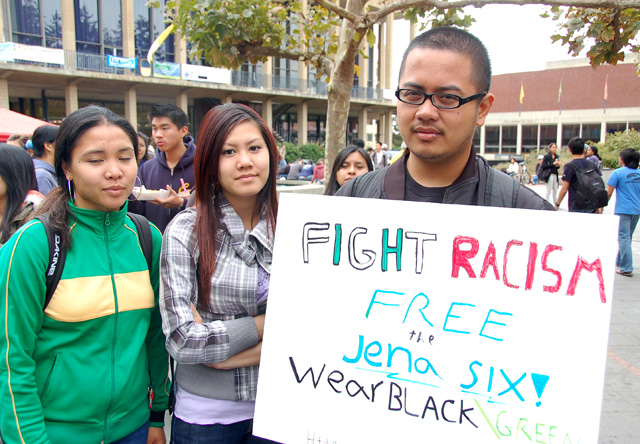
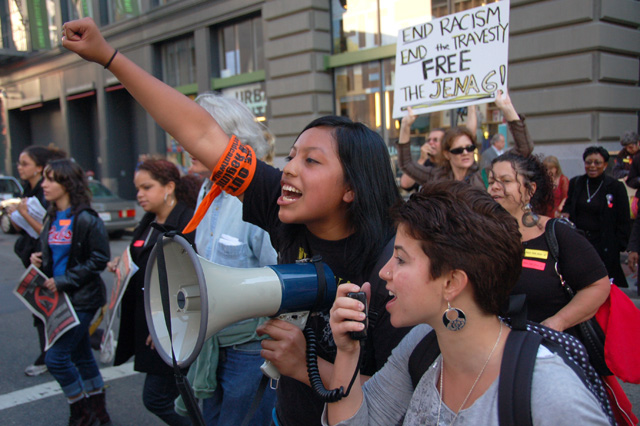
Thursday, September 20th, from across the country to protest the pending charges against six African American high school students (Protest Details). The six students were charged with felonies after a fight that started after nooses were hung outside their high school. Protests were also held in cities across the United States. At UC Berkeley, over 1,000 protesters gathered in Sproul Plaza at 12pm. In San Francisco, over 200 people rallied at Powell and Market.
Last week the Louisiana Third Circuit Court of Appeals threw out the conviction of 17 year old Mychal Bell. The court ruled that he should not have been tried as an adult. Bell was supposed to have been sentenced for attempted second-degree battery this Thursday.Mychal Bell and five other students were arrested for beating a white student during a schoolyard fight last year. The fight occurred after white students hung three nooses on a tree in the schoolyard. Bell has been jailed since January unable to meet his $90,000 bond. As of this morning he remains in prison waiting for his new bond to be posted. The District Attorney plans to appeal Bell's overturned conviction at the Louisiana Supreme Court.
Wednesday, September 19, 2007
Teachers Support Justice for the Jena 6 - Six young black men are headed for 20+ year prison sentences in a clear case of Jim Crow "justice"
Thursday 9/20 is a national day of action in solidarity with the Jena 6 in Louisiana.Tuesday, September 18, 2007
Fighting Lennar Development and Environmental Racism in SF Schools and Hunters Point Community
San Francisco Board of Education Resolution
In Opposition to Lennar Corporation’s Hunters Point Naval Shipyard Development and In Support of the Community’s Demand for a Temporary Stoppage and an Independent Health and Safety Assessment to Protect Our Students and Their Families
- Commissioners Eric Mar and Kim-Shree Maufas
[will move to suspend the rules to vote on First Reading 9/25]
WHEREAS: Patterns of environmental racism, inequity and injustice exist within San Francisco, where schools in communities like Bayview Hunters Point bear the brunt of environmental health problems; and
WHEREAS: Since October 2006, when a young worker blew the whistle on Lennar Corporation’s Hunters Point Naval Shipyard development, large numbers of students, teachers, educators, workers, and families of the Bayview Hunters Point area have been voicing their concerns about the construction-related dust at the Hunters Point Shipyard site and the dangerous health impact that the dust and toxics in it, including asbestos, heavy metals and other inorganics, are having on our SFUSD students, staff and members of the community; and
WHEREAS: Lennar Corporation is a Florida-based Fortune 500 company which reportedly had revenues of $16.3 billion in 2006 from development projects throughout the country like the 1500-unit condominium development planned for Hunters Point; and
WHEREAS: Lennar Bayview Hunters Point LLC was involved in large scale grading that reportedly caused untold amounts of toxic dust and Asbestos Structures to migrate over its boundary and into areas were children and families live, work and play; and
WHEREAS: In response to these health dangers and conerns, a broad grassroots coalition of Bayview Hunters Point and social justice community organizations has been demanding a temporary stoppage in Lennar Corporation’s construction so that an independent health assessment can be conducted; and
WHEREAS: There has been a history of problems with implementing the City’s dust-mitigation plan since the soil grading and disposal process began that has included: an absence of air monitoring for the first four months of the project during heavy grading; malfunctioning air monitors; a Notice of Violation from the Air Quality Management District; and when the monitors started working, routine exceedances of the agreed-upon allowance of asbestos prevalence in the air – 16,000 structures per cubic meter [SF Department of Health Regulations, Article 31] including 9 exceedances in June alone; and very poor communication of these exceedances to adjacent neighbors; and
WHEREAS: Numerous studies have documented that Bayview Hunter's Point and other communities in Southeast San Francisco are overburdened with the cumulative impacts of a multitude of environmental health threats that impact the health and well-being of children and other residents who are overwhelmingly African American and other people of color. These impacts include exposure to toxic air pollution, carcinogens, and other inorganic substances from industrial facilities, power plants, sewage treatment and solid and hazardous waste facilities and diesel particulate from trucks, trains and other vehicles. Additionally, these impacted children and residents are more vulnerable to environmental toxics due to their limited access to quality health care and healthy foods and other social and cultural factors. And, this disproportionate impact has a damaging effect on our students academic achievement and opportunities for success in school and in their lives; and
WHEREAS: San Francisco public schools such as Malcolm X Academy, George Washington Carver, Bret Harte, and Dr. Charles Drew College Prep Academy, other schools, childcare centers, and playgrounds are in the immediate vicinity of the Lennar development site; and
WHEREAS: Three African American employees of Lennar Corporation filed a whistle blower lawsuit in SF Superior Court on March 16, 2007, alleging that they suffered retaliation after reporting asbestos dust exposure and racial discrimination and that the company failed to contain asbestos dust while drilling into the Shipyard site, endangering the local community, including the school children of the neighboring Muslim University;
WHEREAS: The World Health Organization reports that there is no evidence for a threshold for the carcinogenic effect of asbestos and that increased cancer risks have been observed in populations exposed to very low levels of asbestos; However, there are tests for lead, chromium, radon, arsenic, etc., which are toxic chemicals that are present in the dirt on the affected site; and
WHEREAS: The ‘Precautionary Principle’ has been adopted by a growing number of cities, including San Francisco, as well as the Los Angeles Unified School District, as a proactive approach to promote the safest, lowest risk approach to protecting people’s health, the environment, and property; and
WHEREAS: The Precautionary Principle as adopted by the City and County of San Francisco includes the following “essential elements:” :
Anticipatory Action: There is a duty to take anticipatory action to prevent harm. Government, business, and community groups, as well as the general public, share this responsibility.
Right to Know: The community has a right to know complete and accurate information on potential human health and environmental impacts associated with the selection of products, services, operations or plans. The burden to supply this information lies with the proponent, not with the general public.
Alternatives Assessment: An obligation exists to examine a full range of alternatives and select the alternative with the least potential impact on human health and the environment including the alternative of doing nothing.
Full Cost Accounting: When evaluating potential alternatives, there is a duty to consider all the reasonably foreseeable costs, including raw materials, manufacturing, transportation, use, cleanup, eventual disposal, and health costs even if such costs are not reflected in the initial price.
Short-and long-term benefits and time thresholds should be considered when making decisions.
Participatory Decision Process: Decisions applying the Precautionary Principle must be transparent, participatory, and informed by the best available information. (City of San Francisco, Precautionary Principle Ordinance, Section 101, August 2003, http://temp.sfgov.org/sfenvironment/aboutus/innovative/pp/sfpp.htm)
BE IT FURTHER RESOLVED: That the Board of Education of the San Francisco Unified School District calls on the Mayor, Board of Supervisors, Redevelopment Agency, Department of Public Health and other relevant City agencies to require an immediate halt of Lennar Corporation’s development of Parcel A in the Hunter’s Point Shipyard until an immediate and independent health and safety assessment can be conducted in coordination with the Superintendent and the School District’s School Health Programs Office and relevant community organizations and City task forces like the SF Asthma Task Force; and
BE IT FURTHER RESOLVED: That the Board directs the Superintendent to coordinate with City officials to ensure the health of our students and their families in the affected area and report back to the full Board with an environmental safety action plan and timelines to ensure the safety of our students and their families no later than the Board’s October 23rd meeting.
Wednesday, August 08, 2007
Supreme Court Limits School District’s Ability to Desegregate: It’s Up to Teachers and Communities to Ensure Educational Equity
San Francisco teacher, parent and civil rights organizations are now debating the impact of the decision on our schools. Our Board, new Superintendent Carlos Garcia and legal staff are closely analyzing the decision and its implications for our future desegregation efforts.
In the complex split decision, the Court’s most conservative four justices - Roberts, Scalia, Alito and Thomas - argued that race cannot be used in student assignment plans or even as a factor in developing policy. Chief Justice Roberts wrote, “The way to stop discrimination on the basis of race is to stop discriminating on the basis of race."
While the new swing vote on the court Justice Anthony Kennedy wrote a concurring opinion supporting the other four conservatives in striking down the Jefferson County and Seattle plans, he importantly joined the four liberal justices in recognizing educational diversity and overcoming our history of segregation to be “compelling governmental interests” – among our country’s highest priorities – that communities can pursue through careful race-conscious efforts.
Kennedy’s opinion further defined new limits on just how race may be used in school districts with defacto segregation like ours. “This Nation has a moral and ethical obligation to fulfill its historic commitment to creating an integrated society that ensures equal opportunity to all its children.”
The ruling seems to allow the following to achieve a more integrated educational environment for districts: recruitment of school teachers and staff of diverse backgrounds; collection of data on student performance using race; and the use race as a general factor to guide decisions for new school construction and in determining attendance boundaries for a school.
Despite the striking down of the Seattle and Louisville desegregation plans, Kennedy’s 5th vote IN FAVOR OF the limited use of race in desegregation plans was at least a shred of a silver lining in an otherwise devastating decision that many civil rights advocates say has dramatically turned back the clock of civil rights and educational equity efforts many decades.
The ruling will have an impact on our desegregation and educational equity efforts in San Francisco and on hundreds of school districts throughout the country. We filed a friend of the court brief in support of both the Seattle and Jefferson County desegregation plans. Our Consent Decree monitor Stuart Biegel and many community groups have decried the rapid re-segregation and growing inequality in our district over the past 6 years and urged the San Francisco Board to reintroduce race into the student assignment system.
Our Board has been in intense discussions with our lawyers since the end or our own 1983 SFUSD Consent Decree in late 2005 – a federal court order which required SFUSD to desegregate our schools. We are now studying our existing race-neutral ‘diversity index’ and our now outdated ‘Excellence for All’ [2001] desegregation plan and are likely to decide on a new approach in the coming months after we have heard from teachers, staff, parents and other stakeholder groups.
It seems to me that the 2007 Seattle/Louisville schools decision will be remembered historically as a dark day in civil rights history. But, I agree with SF Freedom School founder and author Kathy Emery that “legal decisions in and of themselves do not create change.” The law though can contribute to fundamental social change when teachers, parents, and students use such landmarks as Brown or the Seattle decision as leverage in our organizing and fighting for broader changes like adequate funding for all schools and educational equity and equality for all of our students. Ultimately, it’s up to us – teachers, parents and communities united - to ensure equality of opportunity to all San Francisco students.
Wednesday, June 13, 2007
SF Chooses New Schools Superintendent Carlos Garcia; African Americans and Immigrant Rights Groups Build Alliances
San Francisco Unified School District's 2-year nationwide search for a new superintendent concluded last night at our Board of Education meeting and this morning with our official announcement of Carlos Garcia as our new Superintendent.
Garcia is a veteran urban school district superintendent with 11 years experience overseeing districts with enrollments ranging from 7,800 to 300,000 students including two large urban school districts - Fresno , California , and Clark County , Nevada . Clark County District is the 5th largest school district in the country.
Garcia was principal at San Francisco's Horace Mann Middle School - in the Mission District - from 1988 to 1991. During his tenure, the school was restructured, student achievement improved, and the school was designated as both a California Distinguished school and a Blue Ribbon school. Under his leadership Mann was one of the first middle schools in the country to implement block scheduling and there was a long waiting list of families seeking admission.
June Jordan School for Equity teacher Giulio Sorro, a former student of Garcia's at Horace Mann, said Garcia brings a strong sense of community and compassion to his leadership. Sorro and hundreds of district staff welcomed Carlos back home today with open arms. Outgoing superintendent Gwenn Chan who is retiring this summer passed a torch to Garcia and wished him good luck in taking the reins of SFUSD.
To me, Carlos brings the spirit of a 'street fighter' who will challenge all our students to reach their full potential. Our board and district staff will be working him as well to aggressively fight for equity and social justice and to move our district forward for all our communities.
Mainstream press coverage about Garcia's record, accomplishments and challenges -
- SF Chronicle 6/13
SF Examiner 6/13
SF Bay Guardian Opinion 0606
---------------
UNITY -
In the tradition of building stronger unity within and between communities of color, San Francisco Bay Area African American and immigrant rights groups are building bridges for racial justice and human rights this evening.
Please join The Black Alliance for Just Immigration and the Bay AreaImmigrant Rights Coalition
A Forum and Report Back from: Braving Borders, Building Bridges: A Journey for Human Rights
An African American Tour of the U.S.-Mexico Border
Wednesday, June 13, 2007
Dinner: 5:30 p.m.
Program: 6:00 to 8:00 p.m.
Laney College Forum
900 Fallon Street, Oakland
Donations accepted
African American leaders will share their experiences on a human rights tour of the US-Mexico border. They include Rev. Phil Lawson, San Pablo City Councilmember Leonard McNeil, former Peralta Community College Board Member Alona Clifton, Liz Derias of the Malcolm X Grassroots Movement and BAJI Coordinator Gerald Lenoir.
We will hear music, have dinner and begin creating relationships necessary to foster true positive change for all our communities.
For more information, contact Gerald Lenoir at bajimail@yahoo. com, (510) 849-9940 or Larisa Casillas at 510-839-7598, larisa@immigrantrig hts.org.
MORE INFO on Bay Area Immigrant Rights Coalition
Monday, May 28, 2007
SF Progressives Gear Up for '07 Mayoral Race and the Future of our Communities
Next Saturday I and other progressive activists and organizers are mobilizing for a major progressive summit at our Tenderloin Community Elementary School. We are trying to reinvigorate the spirit of the 1974 San Francisco Community Congress efforts in neighborhoods throughout the City. On June 2nd progressive elected officials and grassroots activists will join together to plan for the November 07 elections and beyond.Former Mayoral Candidates Matt Gonzalez and Tom Ammiano and Supervisors Chris Daly, Aaron Peskin and Ross Mirkarimi may address the convention sometime after 2pm along with Board of Education President Mark Sanchez and me.
Please join us!
----
Dear Progressive Friends and Allies,
Please reserve Saturday, June 2nd on your calendar for the most important progressive gathering of the year.
To set the stage for our progressive campaigning this summer and fall, we will be convening to consolidate our platform, train in the nuts and bolts of electioneering, launch our candidate(s) for Mayor of San Francisco, and have lots of fun!
Saturday, June 2, 10-5
Tenderloin Community School
627 Turk Street (Van Ness), San Francisco
Wednesday, May 09, 2007
Popular Education Conference
Free Minds, Free People will bring together teachers, youth, parents, researchers and community-based educators from across the country to begin building a movement to develop and promote Education for Liberation. Education for Liberation is an umbrella term we use to describe the work of people who are trying to link education, social justice and activism.
This conference features dozens of workshops by and for educators and youth on topics including social justice schools, action research, arts and liberatory education, Freedom Schools, youth organizing, teaching critical consciousness and much more. It will take place in Chicago at Little Village/Lawndale High School.
The SF Freedom School will be represented on a panel entitled, "Freedom Schools, Then and Now"
Please consider going!!! REGISTER TODAY!!!
Sunday, May 06, 2007
Connecting the Chinese Exclusion Act with Today's Racism and Nativism; Slowing Down to Catch up with my Family
Amidst the historic celebrations/protests and dialogue around May Day, Cinco de Mayo and China's Revolutionary May 4th Movement, SF Chronicle reporter Vanessa Hua wrote an excellent piece on the significance also of the 125th Anniversary of the Chinese Exclusion Act - May 6, 1882.
SAN FRANCISCO - Anti-Chinese law had effect for generations: Exclusion Act forced many immigrants to lie in order to stay
In 1881, an 11-year-old boy in China named Yung Wah Gok begged for a chance to go to the United States like the thousands of other Chinese workers who had already left to seek their fortune on the railroad, in laundries and working other jobs.
A year later, immigration laws swung the door shut by barring Chinese laborers from entering the United States or naturalizing as citizens if they already were here. If Wah Gok had not persuaded his uncle to take him, he might never have emigrated.
This first attempt at regulating immigration to the United States tore apart families, cut the Chinese population in the United States in half, and forced many Chinese Americans to perpetuate secrets and even lies well into the 20th century.
"It created total exclusion from American life," said Wah Gok's granddaughter Connie Young Yu, 65, a Bay Area native. "If they could never be citizens, how could they participate?"
Today is the 125th anniversary of the signing of the 1882 Chinese Exclusion Act, and the Chinese Historical Society of America in San Francisco is hosting commemorative events all month.
Growing up, Young Yu heard many stories about how the act affected her family. To find a wife, her grandfather had to return to China because of laws that prevented him from marrying here. And he waited 14 years to bring his wife home; he had to prove he had become a merchant, a loophole that admitted very few.
Other Chinese people managed to squeeze through another exception to the Exclusion Act affording people born in China the right to enter the United States if one of their parents was American-born. Many Chinese Americans brought in people who weren't their children, people who came to be known as "paper sons."
For decades, many Chinese American families had two surnames: their real one, used in the Chinese community, and the name used in the official, white world to conform with their paperwork. In San Francisco, after the 1906 earthquake and fire, when government buildings containing birth and immigration records were destroyed, even more Chinese immigrants began claiming they'd been born here and bringing in paper children.
Congress had debated whether excluding people based on race violated the principles of fair play and Christian behavior, said Anna Naruta, director of collections at the Chinese Historical Society. But Nativists rallied to ensure the act's victory.
Loud support for the act came from California's then-Gov. George Perkins, who called a state holiday to allow workers to demonstrate in favor of it, "conveying to Congress and to our Eastern brethren the deep interest which inspires us to check this evil and stop this curse."
Chinese immigrants immediately challenged the Exclusion Act, saying it violated international law. But the U.S. Supreme Court ruled that Congress had the right to determine immigration laws.
By 1892, Chinese laborers had to carry a certificate proving they were here legally or risk deportation. No one else had to carry such proof.
Foreign-born people accounted for 13 percent of the population of the United States in 1880, according to the U.S. Census. That's compared with 10 percent in 2000.
"The law was a codification of racism, a microcosm of what was happening in society," said Eric Mar, a San Francisco school board member who teaches Asian American studies at San Francisco State University. Mar and other Chinese American leaders and educators in the Bay Area see parallels between the targeting of the Chinese and the current sentiment toward illegal immigrants in the United States.
"There's a long history of anti-immigrant sentiment in the United States. We have made a lot of shameful mistakes over the years about who we decide we should welcome as Americans," said Bill Ong Hing, a professor of law and Asian American studies at UC Davis. "We're treading down the same road today."
Only after volunteering in Chinatown after law school -- and seeing client after client with false identities because they were paper sons or descended from them -- did Hing understand how much the act had affected the Chinese American community and begin to clear up some of the mysteries in his life.
"Then it made sense, with my parents and relatives -- why a lot of them were worried, and why I had uncles that weren't really my uncles," said Hing, 58. "You realize how this affected the community. They had to lie and cheat to get into the country, to do what is natural for many people -- to seek a better life."
Congress repealed the act in 1943, when China and the United States became allies during World War II, but large-scale Chinese immigration wasn't allowed until the passage of the Immigration and Nationality Act in 1965.
Each new generation of Chinese Americans rediscovers the Exclusion Act -- and its lessons.
Lisa Chen, 17, a senior at Galileo High School in San Francisco, was shocked to learn about the act in history class. But she didn't connect it to her personal experience as the American-born daughter of Chinese immigrants who arrived in the 1980s.
"My family was not involved in and doesn't really think about it," Cheng said on a recent weekday in Chinatown, where she works as a counselor in training in the employment program at Community Educational Services.
But Allen Cheung, 22, who just recently learned that his great-grandfather had worked and died in the United States, now directly connects the act to his immigrant parents, himself and the future. After he visited China in the winter, his mother finally began to reveal the family's history. She thought he was finally old enough to understand, said Cheung, a student at San Francisco State who leads its Asian Student Union.
"Before that, I didn't see how I fit into the grand narrative of 1882, 1906 and paper sons," said Cheung. "Now I've learned a lot more. To know my great-grandfather was here, I start to feel connected to a lot of history. My life, my struggle, is in America."
Tuesday, May 01, 2007
San Francisco Students and Teachers Marching on May Day; Protecting Students Rights in Walkouts

Today - May Day - I will be proudly marching with many of our
students and teachers who support dignity for all
immigrants and economic justice for everyone. Last
week I authored a resolution in solidarity with
immigrant student and community efforts to uphold our
local Sanctuary Ordinance and other local human rights
for immigrants policies.
To deal with the large numbers of students that plan
to walkout out sometime around noon today our district
is doing our best to protect their safety. To me,
International Workers Day always serves as an
important learning moment to teach about economic
justice, democracy, civil rights and immigrant rights
as well.
Initial reports from student organizers show that many
San Francisco schools will be participating in the
rallies and walkouts, including Lowell High, Mission
High, June Jordan School for Equity, John O’Connell
High, Gateway High, International Studies Academy or
ISA, Leadership High, Balboa High. Last year a number
of middle schools also participated in the May Day
marches and rallies as well.
To ensure district awareness of board and district
policies, on Friday the superintendent and staff
reminded every school site that if a student decides
to participate in the march, that staff should not
attempt any physical restraint of students. But the
sites can inform parents or guardians that the student
left the school for that purpose.
Larger WALKOUTS - if a large number or critical mass
of students at a school attend the march, then a
teacher or certificated staff person from the site
will be accompanying students to protect the safety
of our students.
Some of our school resource officers will not be at
their sites today. They too will be monitoring the
march. We are expecting reports beginning at 11am. I
will be marching from Mission High School with
students and teachers to Dolores Park at Noon and then
on to the Civic Center by 1pm or so.
More on Protecting Students' Rights to Protest
http://edjustice.blogspot.com/2006/03/protecting-students-rights-to-protest.html
Monday, April 30, 2007
Students throughout California planning for Massive Walkouts May 1st
Campuses planning walkouts -
California
Lowell High – San Francisco
Mission High - San Francisco
June Jordan School for Equity - San Francisco
John O’Connell - San Francisco
Urban - San Francisco
Gateway - San Francisco
ISA - San Francisco
Leadership High - San Francisco
The Bay School - San Francisco
Balboa High - San Francisco
City College – San Francisco
Santa Rosa High – Santa Rosa
Piner High – Santa Rosa
Elsie Allen – Santa Rosa
San Rafael High – Marin
Drake High – Marin
Tamalpais High – Marin
Marin Academy – Marin
Terranova High – Marin
Dominican – Marin
College of Marin - Marin
De Anza -
Westmont High – Los Gatos
San Lorenzo High – San Lorenzo
San Jose State – San Jose
UCSC – Santa Cruz
UCSB – Santa Barbara
UCB – Berkeley
UCD -Davis
UCI – Irvine
UCSD – San Diego
Roosevelt High School - Los Angeles
Garfield High School - East Los Angeles
Hollenbeck Middle School - Los Angeles
Manual Arts High School - Los Angeles
Bravo Medical Magnet High School - Los Angeles
Audobon Middle School - Los Angeles
LA Leadership Academy - Los Angeles
James Marshall High School - Los Angeles
Westminster High School - Los Angeles
Belvedere Middle School - East Los Angeles
King Drew Medical Magnet High School - Los Angeles
Elizabeth Learning Center - Cudahy
Banning High School - Wilmington
Warren High School - Downey
Jefferson High School - Daly City
Roosevelt High School - Fresno
Montgomery High School - Santa Rosa
San Pedro High School - San Pedro
Long Beach Poly High School - Long Beach
Azusa High School - Azusa
Gladstone High School - Azusa
Sierra High School - Azusa
Colton High School - Colton
Lynwood High School - Lynwood
Morse High School - San Diego
Hoover High School - San Diego
Monroe Clark High School - San Diego
Serra Senior High - San Diego
El Cajon High School - El Cajon
Moreno Valley High School - Moreno Valley
Escondido High School - Escondido
Don Antonio Lugo High School - Chino
Magnolia High School - Anaheim
Berkeley High School - Berkeley
Oakland Technical High School – Oakland
College Prep - Oakland
Fremont High School - Fremont
Freemont High School - Oakland
Hiram Johnson High School - Sacramento
Richmond High School - Richmond
Lindhurst High School - Yuba City
Acalanes High School - Lafayette
Nevada
Western High School - Las Vegas
Gibson Middle School - Las Vegas
Cimmaron High School - Las Vegas
Garside Middle School - Las Vegas
Bonanza High School - Las Vegas
Clark High School - Las Vegas
Mojave High School - Las Vegas
Washington
Renton High School
Texas
Dahlstrom Middle School
Hays High School
Chapa Middle School
Lehman high school
More on Revolution Youth
Friday, April 27, 2007
Join Immigrant Workers and Students for May Day 2007 ; SF State Students Walkout 4/26 to Oppose Fee Hikes and Cuts to EOP
May 1st International Day of the Worker - May 1st marches across the Bay Area
Oakland - 10:00 am gather at the Fruitvale BART station and march to the federal buildingin downtown Oakland. For more information, Claudia Reyes mailto:claudia@mujeresunidas.net.
San Francisco - 12:00 pm people will be gathering at Dolores Street Park (Dolores Street & 18th) and start marching to Civic Center Plaza at 1:00 pm.
Berkeley - Gather at 11 am in Sproul Plaza for a danza blessing At 12:00 PM in Upper Sproul there will be a program with speakers and march to Berkeley City Hall At 1:00 PM from City Hall people will either meet up with the rally at Oakland or in San Francisco.For more information Ruben Cabrera, 510 388 0173 or rubcab@gmail.com.
Martinez - March and vigil begins at the Martinez Marina on Court Street at 5:30 pm at ends at the Contra Costa Court House. The event is sponsored by CCISCO: Contra Costa Interfaith Supporting Community Organization. Organizers ask that participants dress in white and bring American flags. For more information, 925-313-0206.
San Jose - MARCH with Youth, Students, Artists Gather at 4:00 PM by Shakeys/Mi Pueblo Shopping Center/Story & King Rd). Asking people to wear a white shirt and a brown arm band for solidarity/ Use una camisa blanca y una banda café en su brazo. For more information: maiz_mex@hotmail.com408.250.9245, www.myspace.com/maiz_mex
Santa Rosa - Gather at 11:00 am at the old Albertsons Shopping Center - 665 Sebastopol Road. There will be some entertainment, speakers and immigration attorneys. Please wear a white shirt. For more information, 707-206-6889. In Mountain ViewGather at 5:00 pm at 1880 California Street. March to the Civic Plaza where there will be a rally. For more information, Maria Marroquin (650-291-1021) or Gail Sredanovic (650-521-6956).
Wednesday, April 25, 2007
Hayward Teachers Announce Victory - 10 Day Strike Ends
Steve Rubenstein and Nanette Asimov of the SF Chronicle just reported that Hayward Teachers have reached a tentative settlement with their district.
"All 1,300 teachers are expected to return to their classrooms Thursday, which will be a minimum day with early dismissal, according to union spokesman Mike Myslinski.
The agreement between the Hayward Education Association and the Hayward Unified School District came at around 9:30 p.m., after a round of talks that followed a large protest at the Hayward school board meeting.
When the strike began on April 5, teachers were demanding a 16 percent raise over 2 years and the school district was offering a one-time raise of 5.5 percent. It was not clear which side made additional concessions, if any, to reach the agreement tonight.
"After months of telling the district how the low pay for teachers is hurting our schools, the district finally agreed to do something about the problem," said Kathleen Crummey, president of the union. "This salary agreement isn't perfect, but it acknowledges that Hayward teachers are underpaid. It will help retain and recruit more dedicated educators for our classrooms."
...During the strike, only about a fifth of the district's 20,000 students were showing up for class. They were being taught by 180 substitutes and non-striking district employees."
Full Story and More at Bay Area Independent Media Center or Hayward Education Association