Thursday, February 24, 2011

Thousands take stand in Sacramento for Wisconsin Workers' Rights


By Steve Smith, California Labor Federation
When Wisconsin’s new right-wing Governor decided to make it his personal mission to eliminate the rights of teachers, nurses, bus drivers and other public servants, he probably thought it would be a cakewalk. After all, Gov. Scott Walker has a Republican-controlled legislature that is on board with his radical plan to eliminate collective bargaining for public sector workers. What he didn’t count on was the extraordinary resolve of working people to stop his assault on our values. For more than a week, tens of thousands have protested at the Wisconsin Capitol. The fight back spread to Ohio, Indiana and other states where politicians are attempting to strip workers of their voice. And it didn’t stop there. All over the country, workers are standing in solidarity to beat back these attacks.

Last night, the spirit of solidarity was tangible in Sacramento, as more than 3,000 workers – teachers, Teamsters, nurses, ironworkers, janitors and many others – descended on the State Capitol to send a message loud and clear across California and the country: An attack on one of us is an attack on all of us.
Workers gathered on the West Steps of the Capitol for a candlelight vigil, but it turned into much more than that. Initial projections of 1,000 people turning out quickly dissolved as more and more folks poured onto the Capitol grounds.

California Labor Federation Executive Secretary-Treasurer Art Pulaski kicked off the vigil by putting the Wisconsin battle into context:
This protest is bigger than one bill. It is bigger than one state. This protest is not just about the public sector workers. It is not just about unions. This is about an assault on the working class values of this country. This is a fight for democracy that we cannot afford to lose. Not in Wisconsin, not in Sacramento and not anywhere in America.
Carrying signs with messages like “We Are ALL Wisconsin Workers” and “United We Bargain, Divided We Beg” the vigil attendees were energized and unified to fight back against any and all Wisconsin-style attacks on workers. Here in California, we’re fortunate to have a Governor who supports the rights of working people. In fact, Brown has been a staunch advocate for workers’ rights throughout his 40-year career. Brown, unlike Walker, has sought to bring people together to deal with our state’s challenges, rather than divide us. But if Meg Whitman would have won in November, it would be a whole other story.
California Nurses Association Executive Director Rose Ann DeMoro:
We had our brush with Meg Whitman already. Now they have her in Wisconsin, in Ohio, in Michigan. You know where they’re not? California! We kicked their ass. We stood together, we stand together, and we will never stop standing in California. If you take on one of us, you take on all of us. We’re in this with workers around the country.
AFSCME member and University of California employee Katherine Barker reminded the crowd what’s at stake:
We are fighting for nothing less than basic freedom and democracy. We are fighting for the rights of working people to organizing and bargain for better working conditions. We are fighting for our rights. The bottom has fallen out for private sector workers. Now they are trying to drag the bottom out from under us. When you have your back against the wall, you stand together or you fall together. And you fight together. When the call is made, we have to answer the call.
Teachers have been among the most visible protesters in Wisconsin, and many California teachers turned out last night to show their support for all Wisconsin workers.
California Teachers Association President David Sanchez:
Organized labor did not create the financial crisis. Wall Street banks did. But public employees are being scapegoated. They are under attack. We will be with you today. We will be with you tomorrow. We will stand and fight together.
Sanchez later called on the crowd of thousands to raise candles in solidarity and joined labor musician Francisco Herrera in starting a rousing rendition of the song “Solidarity Forever.” Thousands joined in.
California workers are no strangers to being scapegoated for problems they didn’t create. Just ask state workers who had to live through seven years of Gov. Arnold Schwarzenegger.
SEIU 1000 President Yvonne Walker:
Governor Schwarzenegger thought he was going to break public employee unions here in California. We said: Hell No! We stood strong and beat back the attacks. We beat them back here in California. We will beat them back in Wisconsin. We will beat them back in Michigan. We will beat them back in Ohio and any damn place.
In the final analysis, the battle in Wisconsin comes down to one word: Freedom.
AFSCME’s Willie Pelote:
This is our country. We built it brick by brick from the bottom to the top. Their dollars cannot buy the labor movement. We need to create jobs not take away workers’ rights. It is time to let freedom ring for working people.
Dozens of elected officials -- including Lt. Governor Gavin Newsom, Assembly Speaker John Perez, Senate President Darrell Steinberg, Senators Pavley, Liu, DeSaulnier, Hancock and Evans, Assembly Members Wieckowski, Mendoza, Alejo, V Manuel Perez, Solorio, Bradford, Torres, Buchanan, Lowenthal, Skinner and Yamada – all came out to show their solidarity and light a candle for the Wisconsin workers.
To show their solidarity, hundreds of California workers signed a special banner reading “We Stand with Wisconsin Workers” that will be delivered directly to the State House in Wisconsin as protests there continue. View photos here and here, and check out video from the vigil here and here
.
The show of support for Wisconsin workers wasn't limited to Sacramento, and it didn’t stop last night. More than 200 people gathered in downtown Oakland for a corresponding vigil, and last Friday, 150 came together for a rally in San Diego. More solidarity events are scheduled for this weekend. Click here to find an event in your area.

Monday, February 21, 2011

Lessons from Labor History about the Wisconsin Struggle


Lessons for Wisconsin From the Flint Sit Down Strikes of 1936-37
Dr Mark Naison
Fordham University
 
   With the state legislature in Wisconsion occupied and surrounded by thousands of state workers and their supporters, and with schools closed throughout the state because of teachers calling in sick, I cannot help but think of the greatest strike and building occupation in the history of the American labor movement- the Flint Sit Down Strikes of 1936-37.  Though the Wisconsin struggle is being led by government workers, and the Flint Strikes involved workers involved in automobile production, both movements took place during the worst economic crisis of their era and were fighting for the same goal- collective bargaining rights for working people through a union of their own choosing- and were much more about dignity and respect than about income.   
 
      The Flint Strike, which involved the occupation of 9 General Motors automobile plants over a  six week period, transformed the history of the industrial labor movement.  During December of 1936, when the first GM plant was seized and occupied, the entire automobile and steel industries in the United States were union free. When the strike was finally settled, both General Motors and United States Steel agreed to bargain collectively with the CIO ( Congress of Industrial Organizations) unions seeking to organize their industries.   
 
      The Flint Strike , though it was precipitated by local conditions- a fierce unrelenting speed up on the GM assembly line , the involvement of a Ku Klux Klan like organization called the Black Legion in suppressing labor unrest in GM plants- was part of a national movement to win bargaining rights for industrial workers. As a result, the Flint workers were supported by the national leadership of the CIO-led by the formidable John L Lewis- as well as their own national union, and numerous leftwing organizations including the Communist Party.  Though only GM workers actually occupied the factories, at key points in the strike, thousands of union workers  were mobilized to come down from other cities to make sure that right wing Citizens Committees were unable to storm the plants, and that food and medical supplies were delivered to the striking workers.  There were also doctors, nurses, lawyers, and journalists who came from all over the country to help the strikers.    By the second week of the sit-down strikes, it was clear to everyone involved that this had become a truly national movement
 
    The same dynamic must operate if the Wisconsin movement is to achieve its main goal- removal from the governor’s legislative program of any effort to weaken the bargaining rights of public workers in the state.  Unions around the nation who face similar initiatives ( in Ohio, Tennessee and New Jersey) must send delegations to join the occupation and the protests and give whatever financial and legal support is necessary to teachers who are keeping the local schools closed.  National union leaders who have a high public profile, people like Richard Trumka and Randy Weingarten, must not only come to Madison to offer their support of the movement, they must head straight to the White House to demand that President Obama and Democratic Congressional leaders come out aggressively in support of the Madison movement. Student social justice organizations must send delegations to Madison to join the thousands of students at the state’s public universities who have been a central part of this movement from the beginning.

Wednesday, February 16, 2011

Race to the Bottom: Obama school reform gone wrong

By Roger Bybee


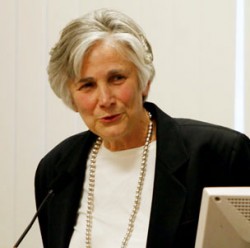
Diane Ravitch, author of The Death and Life of the Great American School System.  
President Barack Obama and Education Secretary Arne Duncan have
formed an alliance with billionaire "school reformers" whose agenda
is to downgrade U.S. public education and blame its shortcomings on
"bad teachers," warns educational historian Diane Ravitch.

Ravitch spoke Thursday night before a crowd of more than 1,000 education professors, students, public school teachers, and community activists at the
University of Wisconsin.

"These corporate reformers are pursuing a strategy based on ideology, not on evidence," she charged. "It is demoralizing teachers and setting up public schools to be de-legitimized, as they are called upon to meet impossible goals. This is not an improvement strategy, it is a privatization strategy."
Ravitch, once assistant secretary of education under George W.
Bush, has undergone a remarkable transformation after observing how
the education system became fixated on test results, the scapegoating of teachers and the promoting of a privatized approach to education.
She has now emerged as one of the leading critics of the Obama-Duncan approach to public education, which has been driven by funding from several huge foundations--the Bill and Melinda Gates Foundation, the Eli and Edith Broad Foundation, and the Walton Family foundation.

The essence of this corporatized approach to public education is "choice, competition, deregulation, accountability, and data-based decision-making," as Joanne Barkan summarizes it an important Dissent article.
With progressive reforms for education generating little attention, the corporate model has managed to make surprising inroads among some  liberals who have become persuaded that a market-driven education system is key to America's future.

Friday, February 11, 2011

Save Our Schools March

The message we want to get out to as many people on Valentine’s Day is that everyone who cares about young people should also care about our public schools. Our best schools nurture our children and make them feel safe and able to take the risks they need to in order to learn. But our schools are in danger of becoming even more narrowly focused on test preparation while class sizes rise and teachers are blamed for the ravages poverty inflicts on their students.

We are responding. We love our schools. We declare the week of Valentine’s Day, 2011, to be
I  Love Public Education Blog Day. On this day we will write our hearts out, about why public education is so important to us, to our children, and to our democratic society. If you or your readers will join us and tell why you love public education too, send your comments and posts tosaveourschoolsmarch@gmail.com.

Writing will be displayed at the www.SaveOurSchoolsmarch.org website, and will be tweeted with the hashtag #LovePublicEd. We offer the march and events of July 28 to 31st in Washington, DC, as a focal point for this movement, and we ask participants to link to this event, so that we can build momentum for our efforts. If your readers wish to repeat this post on their own blog, we would welcome it. We would love if you could use our attached graphic to indicate that this is part of our campaign.

Thursday, February 10, 2011

Obama Admin misleads on education reform - Krashen

The feds have spelled out their plans in detail, in their technology report, in the Blueprint, and in Duncan's speeches. It is a top-down, purely data-driven system with more testing than ever seen in history, with all tests, interim, summative, and maybe even pre-tests in the fall, closely linked to national standards. If the LEARN Act is ever part of this, we will also have a skills + test approach to everything in language arts, K-12. That's what in the documents.

In response, the professional organizations are eagerly supporting this brutal approach, or saying nothing. When challenged, they say they want a "seat at the table," which I suspect also means "a piece of the pie."

Instead of leading the way in education, they are doing what they can to allow the ignorant and uninformed to prescribe educational practice.

Don't take my word for it. Read the documents. A few samples: 

1. Transforming American Education: Learning Powered by Technology (http://www.ed.gov/technology/netp-2010)
Discussion of ongoing assessment during the school day, an unprecedented amount of control, even keeping track of how much time students take to solve parts of a problem:
"Learning science and technology combined with assessment theory can provide a foundation for new and better ways to assess students in the course of learning (xvii)"
There will be "technologies to “instrument” the classroom in an attempt to find out what students are thinking" while doing projects ("Assessing in the classroom" pp. 29-30)

Wednesday, January 26, 2011

Obama's faulty education logic


Obama’s faulty education logic: What he said and failed to say
http://voices.washingtonpost.com/answer-sheet/poverty/obamas-stran-faulty-educationge.html?wprss=answer-sheet
By Valerie Strauss 

Someone should have told President Obama that there were important contradictions in the education portion of his State of the Union address before he delivered it to Congress.
First, Obama rightly said that a child’s education starts at home:
“It’s family that first instills the love of learning in a child. Only parents can make sure the TV is turned off and homework gets done.”
Then why is his administration insisting in pushing policies that evaluate and pay teachers based solely on how well they raise the test scores of their children? How can teachers be solely responsible for what happens to a child outside of school?
Obama spoke about the $4.3 billion Race to the Top competition launched by his Education Department. 
“Race to the Top is the most meaningful reform of our public schools in a generation. For less than one percent of what we spend on education each year, it has led over 40 states to raise their standards for teaching and learning.“
Well, not actually.

Tuesday, January 25, 2011

Responding to the State of the Union


In Writings of Obama, a Philosophy Is Unearthed
When the Harvard historian James T. Kloppenberg decided to write about the influences that shaped President Obama’s view of the world, he interviewed the president’s former professors and classmates, combed through his books, essays, and speeches, and even read every article published during the three years Mr. Obama was involved with the Harvard Law Review (“a superb cure for insomnia,” Mr. Kloppenberg said). What he did not do was speak to President Obama.
“He would have had to deny every word,” Mr. Kloppenberg said with a smile. The reason, he explained, is his conclusion that President Obama is a true intellectual — a word that is frequently considered an epithet among populists with a robust suspicion of Ivy League elites.
Duane Campbell
         The book Reading Obama may well offer some significant insights into the political viewpoints of President Obama.   In addition, it is a prolonged essay concerning how the author sees the political philosophy of pragmatism and a history of how pragmatism has served in the U.S.
         There are several interesting issues.  Can a scholar describe well the political philosophy of an important leader by reading books by the President and reading the transcripts of his speeches?   Is it far too early to be describing the philosophy of Barack Obama after only two years in office?

PATRICIA COHEN
In New York City last week to give a standing-room-only lecture about his forthcoming intellectual biography, “Reading Obama: Dreams, Hopes, and the American Political Tradition,” Mr. Kloppenberg explained that he sees Mr. Obama as a kind of philosopher president, a rare breed that can be found only a handful of times in American history.
“There’s John Adams, Thomas Jefferson, James Madison and John Quincy Adams, then Abraham Lincoln and in the 20th century just Woodrow Wilson,” he said.
To Mr. Kloppenberg the philosophy that has guided President Obama most consistently is pragmatism, a uniquely American system of thought developed at the end of the 19th century by William James, John Dewey and Charles Sanders Peirce. It is a philosophy that grew up after Darwin published his theory of evolution and the Civil War reached its bloody end. More and more people were coming to believe that chance rather than providence guided human affairs, and that dogged certainty led to violence.
Pragmatism maintains that people are constantly devising and updating ideas to navigate the world in which they live; it embraces open-minded experimentation and continuing debate. “It is a philosophy for skeptics, not true believers,” Mr. Kloppenberg said.
Those who heard Mr. Kloppenberg present his argument at a conference on intellectual history at the City University of New York’s Graduate Center responded with prolonged applause. “The way he traced Obama’s intellectual influences was fascinating for us, given that Obama’s academic background seems so similar to ours,” said Andrew Hartman, a historian at Illinois State University who helped organize the conference.
Mr. Kloppenberg’s interest in the education of Barack Obama began from a distance. He spent 2008, the election year, at the University of Cambridge in England and found himself in lecture halls and at dinner tables trying to explain who this man was.
Race, temperament and family history are all crucial to understanding the White House’s current occupant, but Mr. Kloppenberg said he chose to focus on one slice of the president’s makeup: his ideas.
In the professor’s analysis the president’s worldview is the product of the country’s long history of extending democracy to disenfranchised groups, as well as the specific ideological upheavals that struck campuses in the 1980s and 1990s. He mentions, for example, that Mr. Obama was at Harvard during “the greatest intellectual ferment in law schools in the 20th century,” when competing theories about race, feminism, realism and constitutional original intent were all battling for ground.

Friday, January 21, 2011

Rhee opens office in Sacramento- a response


Press advisory.
Note: Michele Rhee opens a lobby operation and gets a front page coverage in the Bee and a photo.  She certainly is effective at getting free media for her positions and her new agency.
Link.  http://www.sacbee.com/2011/01/21/3340369/former-dc-schools-chief-to-headquarter.html
We  too have opened an educational advocacy organization with essentially the opposing views.  The Democracy and Education Institute;  link. https://sites.google.com/site/democracyandeducationorg/
Starting from over 40 years of working in schools, preparing teachers and teaching, we advocate for a democratic approach to education.   Our  primary researchers have already  prepared  over 700 teachers in the Sacramento region, most of them Chicano, and over 100 educational administrators and leaders throughout the state. 
There are many  available advocacy  strategies.  However, the most important is to share and magnify teacher voices.  Politicians make bad decisions – such as the current budget cuts, or an over reliance on testing- because they are not listening to teachers voices.  Instead they are listening to paid consultants, and “experts” from the corporate establishment.
Newspaper writers and other media writers make the same mistake.  They call their favorite “source” which just happens to be a corporate promoter like Arne Duncan, Michele Rhee,  or one  of the “experts” at elite universities.  Note:  few professors in the elite universities work with  teachers.  They are several steps removed from the classroom.  You can read more about this on the blog Choosing Democracy http://www.choosingdemocracy.blogspot.com.  
The most basic  strategy is to insist on teacher participation in the development of policies.  Get the politicians and the corporate shills out of the classroom. – they have failed our children.
                       A major problem with  campaigns for a democratic approach to schooling is that most of the media and the politicians  has been sold a mindset or framework of accountability by advocates such as Michele Rhee.    Corporate sponsored  networks and “ think tanks” such as the Thomas B. Fordham Institute, the Bradley Foundation,  the Olin Foundation, and now Rhee’s  StudentsFirst  and their access to the media is not likely to change.  The domination  of the accountability frame within the media and political circles  must be opposed.  The appointment of Arne Duncan was symptomatic of the problems.   He represents the kind of corporate/media approach to reform. Certainly  in the current battle with Arne Duncan over the "Race to the Top Funds,"  he has ceased the high ground with a claim of accountability – it’s a false claim- but it works. Education and explaining will be a constant struggle.

Tuesday, January 18, 2011

Michele Rhee and "school reform"


Sam Chaltain. Huffington Post.
I just watched Christopher Nolan’s remarkable new movie Inception, a futuristic film about a group of people who, through a variety of means, plant a thought so deeply in the mind of one man that it grows naturally and becomes seen as his own. In the opening scene of the movie, protagonist Peter Cobb rhetorically asks the audience: “What’s the most resilient parasite? A bacteria? A virus? An intestinal worm? No. An idea. Resilient, highly contagious. Once an idea’s taken hold in the brain it’s almost impossible to eradicate. A person can cover it up, or ignore it – but it stays there.”
Cobb’s movie-based challenge is not unlike the reality-based one being faced by today’s advocates for public education reform – how to seed an idea so simple and powerful that it can mobilize public opinion, inspire policymakers, and improve the overall learning conditions for children. And yet after reading Michelle Rhee’s two newest efforts to launch her own form of “inception” – an Op-Ed in the Wall Street Journal and her organization’s inaugural policy agenda – I see further evidence of both her well-intentioned vision for massive educational reform, and her fundamental misunderstanding about the power of ideas.
Repeatedly, Ms. Rhee has shown she believes that the best way to mobilize people is through conflict, oppositional language and negative emotion. In theJournal, she speaks encouragingly about the fact that “public support is building for a frontal attack on the educational status quo.” And in the introductory paragraph of her policy agenda, she seems encouraged by the fact that her actions will “trigger controversy.” This sort of language extends the tenor of her brief tenure as DC Schools Chancellor, when Rhee made enough inflammatory statements to become the single most polarizing education figure in country. Love me or hate me, she seemed to be telling us – but pick one you must.

Sunday, January 16, 2011

Brown's budget and the budget crisis


 At the national level almost all of the projected deficit through 2020 will be the result of three factors: the Great recession, the tax cuts of the early 2000s under George W. Bush, and the hundreds of billions of dollars of war spending.
            The just published report on Western State budgets () from the Brookings Institute shows that western states, where the housing bubble was the worst, also have the largest deficits now.  The economic crisis produced at least half of the current crisis.
            And, the national government will not be bailing us out.  Almost all of the projected national  deficit through 2020 will be the result of three factors: the Great recession, the tax cuts of the early 2000s under George W. Bush, and the hundreds of billions of dollars of war spending.

  In California we need to spend more state money to improve schools, to develop roads and infrastructure, and to create jobs.  Those who are well educated are more employed and paying taxes while those with less education, those who leave school, are in a prolonged economic crisis.  It is well documented that our schools and our universities are in a finance crisis.  We need to be preparing young people for new jobs and to create new industries.  The success of students in higher education will significantly determine California’s future competitiveness and prosperity.   Improving education, including both k-12 and higher education, makes California more likely to attract investment and the creation of new jobs and new industries.

Thursday, January 06, 2011

Jerry Brown appoints Honig to State Board

Honig Appointed to State Board of Education: More Support for Excessive Phonics Teaching?  by Stephen Krashen 

Reports of Governor Brown's appointment of Bill Honig to the State Board of Education have focused on Honig's previous legal problems.  More serious is Honig's stance on educational issues  ("Brown names top advisers," 1/6). 

After resigning as state superintendent, Honig became a dedicated supporter of intensive systematic phonics, the view that all children need phonics instruction that includes all major rules of phonics, presented in a strict order. 

Some basic phonics instruction is helpful, but evidence refutes the extremist intensive systematic position: Studies show that intensive phonics makes no significant contribution to performance on tests in which children have to understand what they read. 

Monday, January 03, 2011

New Governor- same old budget crisis


New Governor; same old speeches.
Well, we have a new governor. His  inaugural speech did not say much.  Yes, there will be draconian budget cuts.  At least half of the current budget crisis was caused by the national economic crisis.  This crisis was created by finance capital and banking, mostly on Wall Street ,ie. Chase Banks, Bank of America,  Washington Mutual, AIG, and others.   Finance capital produced a $ 2 trillion bailout of the financial industry, the doubling of America’s unemployment rate and the loss of 2 million manufacturing jobs in 2008.  Millions are out of work.  You and I, and college students did not create this crisis.  Finance capital stole the future of many young people.
Budget cutting to balance the budget will not get us out of this hole.  Look at Ireland, Greece, or Spain.  Budget cuts only start a downward spiral of pain. We can not simply cut our way out of the crisis, budget cuts and lay offs make the recession worse.
School funding reveals the nature of crisis.  In the last two years the k-12 budget “solutions” have cut 4.6 billion dollars from the schools. We have larger classes and fewer teachers.  School reform has stopped- except for the politicians’ hot air.  School funding makes up a total of 30% of the state budget.  Any crisis in the state budget and any cuts in the state budget will make school budgets worse.

Sunday, January 02, 2011

How the media distorts issues in public school reform

Blogging as if public education mattered.  by Duane Campbell
Jan. 1, 2011.
How the media distorts the issues in the public school debates.
This post is based upon an interview with veteran reporter and author William Greider. Social Security in Perspective, Part III A conversation with William Greider by Trudy Lieberman in the Columbia Journalism review  posted on Dec.21,3010.   The interview with Grieder is about how the press miss report the condition and the so called “crisis” of social security.   For this post I have taken Greider’s points and applied some of them to reporting on school reform.  I am relying upon Greider’s extensive knowledge of the press and  economics reporting and applying some of  the ideas to reporting on school reform where I see a parallel problem

Why do many reporters not report on the realities of school change?
  They too often  rely upon the wisdom of selected “spokespersons” and other elites. 
They have been sold a framework of  a corporate view of accountability. Corporate sponsored networks and think tanks such as the the Thomas B. Fordham Institute, the Broad Foundation,  the Bradley Foundation, the Pacific Research Institute,  and the Olin Foundation provide “experts” prepared to give an opinion on short notice to meet a reporters deadline.  Most reporters assume that these notables are telling the truth when in fact they are promoting a particular propaganda such as in the film “Waiting for Superman”.  Who do they not talk with?  They fail to interview experienced teachers and professionals who have worked for decades to improve the quality of inner city schools.

The Obama Administration’s appointment of Arne Duncan was symptomatic of the problem.  He represents the  kind of corporate/media approach to reform.   So, reporters can go to the corporate funded foundations and provide “balance” by asking the appointees of the government- they get the same story.  In particular recently they have been turning to the Gates and Broad Foundations  or the conservative Democrats for Education Reform.

Friday, December 24, 2010

How to create your own education reform organization- and a good paying position for yourself

How to Create a Faux Grassroots Education Reform Organization in 12 Easy Steps!
  1. Think of a name using these words: STAND, KIDS, STUDENTS, FIRST, ALLIANCE, EDUCATION, ED, OUR, SCHOOLS, COALITION, COMMUNITY, VOTERS, REVOLUTION, REFORM, NOW
  2. Put two or three of those words together in any order (possibly linked by a preposition like "with," "of," "for," or -- if you want to be really with it -- use "4″ instead of "for"!).
  3. Add an exclamation mark at the end!
  4. Create a slick website -- be sure to include engaging photos of multiracial kids on your front page.
  5. Write a fierce and positive mission statement that no one can disagree with, like: "We want all kids to achieve excellence in school!" Or, "We want an excellent teacher in every excellent classroom teaching excellence to excellent kids in excellent schools!" Or "We don't want any child left behind by mean, terrible teachers and left with no option in life but prison."

Democrats ? for Education Reform 2

There is a well done article on the group Democrats ? for Educational Reform on the front page of the Sacramento Bee today.  There is more on here. http://choosingdemocracy.blogspot.com/2010/12/democrats-for-education-reform.html
There is no evidence that the group has improved schools.  Politicians have seldom improved schools.  Improved schools require teachers working together.  There is some evidence in my book, Choosing Democracy, and in the effort of Quality  Investment in Education Act schools sponsored by CTA.
A positive side of the effort of Democrats? For Educational Reform is that they point out, create a megaphone, to describe and criticize the failure of some of our schools, particularly urban schools. 
Instead of talking about the most basic cause- the lack of adequate funding for schools and for school reform- they offer a series of ideas centered on the problem is the teachers unions.  Well. No.  The problem is the significant under funding of California schools as well developed in prior posts and in the suite Robles v. California.  And, given the current state budget, the underfunding of schools is going to get much worse.
In the last two years the k-12 budget “solutions” have cut 4.6 billion dollars from the schools. We have larger classes and fewer teachers.  School reform has stopped- except for the politicians hot air.  School funding makes up a total of 30% of the state budget.  Any crisis in the state budget and any cuts in the state budget will make school budgets worse.

Saturday, December 18, 2010

Fetishizing School Chiefs Hurts Kids


by Randy Shaw, 2010-11-22
Cathleen Black has had an extraordinary career as a media executive, but it was not until New York City’s Mayor Bloomberg designated her as the city’s new public school chancellor that she became an almost household name. On November 19, three New York Times reporters teamed up for a front-page story on Black that also took up an entire inside page, as the paper elevated a story for its New York section into national news. Is Black’s appointment so critical for NYC public school kids to justify ongoing national coverage in the Times? Can she make up for the ongoing cutbacks in school funding, increased class size, and lack of demonstrated progress of the corporate-backed emphasis on school testing? Unfortunately, the media’s excessive and irrational devotion to Black and other school chiefs as saviors for the nation’s school kids ignores these realities. The truth is that neither Black, nor any other school chief, can overcome inadequate school funding by running schools like corporate turnaround specialists, and fetishizing their importance distracts from schools real needs.

Education has to be the only field where rising to the top requires no experience. Careers spent in the profit-driven corporate world are not only not disqualifying, but are now identified as the best backgrounds for public school leadership.

This bizarre phenomenon could not have emerged without the media exalting this new breed of education leader. And the harm caused by such fetishizing of school chief’s was made particularly obvious last week by two stories involving the New York City public schools.

Rising Classroom Size v. Star Quality

Natomas (Sacramento) Teachers take pay cut


Sacramento area teachers agreed to a 7.5% wage cut to keep the state from taking over the financially strapped district. The story is in the Sacramento Bee today.
http://www.sacbee.com/2010/12/18/3266655/natomas-teachers-agree-to-cuts.html
How did we get into this fix?  Well, first was the economic collapse caused by the bankers and the real estate fraud artists.  That took 13 Trillion from the economy crashing the U.S. and the international economy.  That produced a dramatic drop in sales tax and property taxes and a California economic crisis.  School funding reveals the nature of crisis.  In the last two years the k-12 budget “solutions” have cut 4.6 billion dollars from the schools. We have larger classes and fewer teachers.  School reform has stopped- except for the politicians hot air.  School funding makes up a total of 30% of the state budget.  Any crisis in the state budget and any cuts in the state budget will make school budgets worse.  The crisis will get worse.
California will need to raise taxes to fund the schools and to repair the social safety net.  Anti tax radicals and Republicans  oppose any tax increases.
Natomas was one of the early casualties.  Many more will follow- even with the teachers giving up salary.  The states and California are in a downward spiral and it will continue for at least 3-4 years.  The children, and the working people are paying for the robbery of the financial classes. And, they just held up unemployment benefits until the Republicans gave them a $700 Billion tax benefit.  This is how an oligarchy rules.
More at www.choosingdemocracy.blogspot.com

Friday, December 03, 2010

The Sacramento Bee and the legislature continue to fail our schools

Today's Sacramento Bee (Dec. 3)  editorial calls for an infusion of new leadership to keep Natomas Unified from failing.  As described yesterday in the post below - Natomas is not failing.  It is under funded as are almost all schools districts in the state.  The Bee editorial board calls for "civic leaders"  to let Natomas Unified teaches know that they should settle and take a 7.9 % pay cut to balance the budget.
However, California school budgets are all in crisis and they will continue in crisis for several years as a consequence of the economic collapse of the housing market and the financial heist of Wall Street. ( See "the Best Way to Rob a Bank is to Own One" in the archives of choosing democracy blog.)
I would like to see the "civic leaders", including the Bee editorial board insist that the state adequately fund our schools.  Poll after poll show that the tax payers want their schools adequately funded, but the legislature has refused, and has been unable to fund the schools in this crisis. The Robles-Wong suite against California on school funding makes these points well.
This kind of crisis will engulf more and more school districts.  Those unwilling to take on the corporate elite- like the Sacramento Bee editorial board- will continue to call for the teaches to take the pay cut.  The Financial Crisis Inquiry Commission chaired by Phil Angelides will soon make their report showing who really caused the crisis and who profited from the economic crisis. The Bee calls for new leadership but does not call upon the financial insiders to be held accountable and to pay for the crisis they have created.  The students will have a reduced education and the Bee will castigate the teachers. That is our future for the next few years.